| English | 意味 |
|---|---|
| limit/ˈlɪmɪt/ | 極限⟦number⟧ |
| approaches/əˈprəʊtʃɪz/ | 近づく⟦number⟧ |
| one-sided limit/wʌn ˈsaɪdɪd ˈlɪmɪt/ | 片側極限⟦number⟧ |
| left-hand/left hænd/ | 左側⟦number⟧ |
| right-hand/raɪt hænd/ | 右側⟦number⟧ |
| two-sided limit/tuː ˈsaɪdɪd ˈlɪmɪt/ | 両側極限⟦number⟧ |
グラフはどこへ向かうか?
- 単一の点を一旦忘れて、$x$ をある値へと滑らせる際に曲線は 向かう先 は何かを問う。
- $f(x)=\dfrac{x^2-1}{x-1}$に従い、$x$が$1$に近づく様を見る。$x=1$を代入すると$\tfrac{0}{0}$が得られる——これは定義されない。
- しかし、出力は着実に $2$ へと進んでいきます: $f(0.9)=1.9$ 、 $f(0.99)=1.99$ 、 $f(1.01)=2.01$ 。
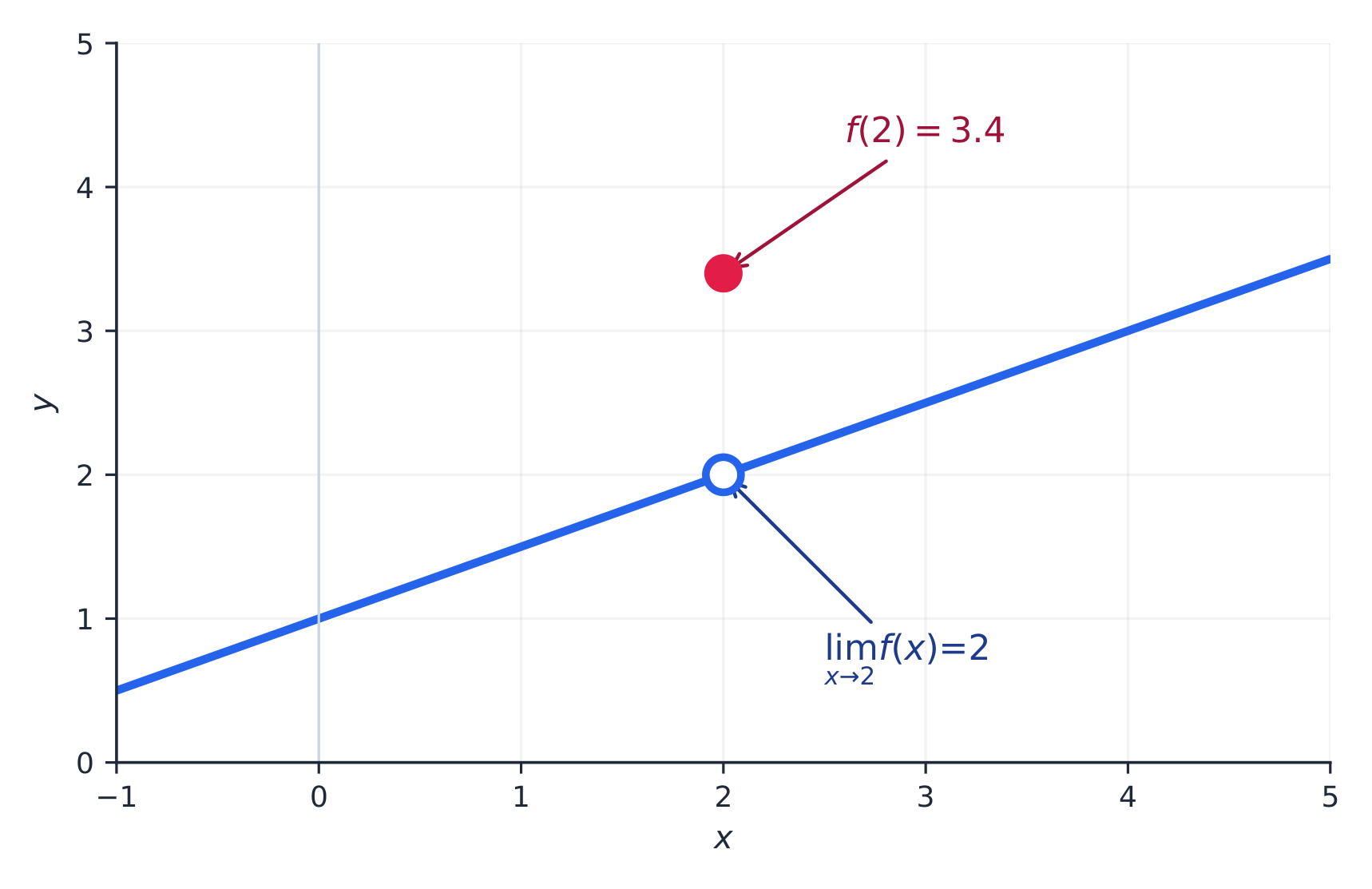
- 関数は $x=1$ で 穴(ホール) を持っていますが、明らかに $2$ を目指しています。そのターゲットとなる値が 極限 です。
Watch where the curve heads
y = ax² + bx + c
Drag the coefficients and pick an input $c$ in your mind — the limit is the height the curve approaches near $c$, not the point itself.
記法で書き下す:極限記号
- $\displaystyle\lim_{x \to c} f(x) = L$ と書き、"$f$ の $x$ の極限は、$x$ が 接近する $c$ として $L$ である"と読む。
- $c$ は私たちが creep して接近する入力であり、$L$ は関数が向かう出力である。
- 重要なのは、$x \to c$ が "$c$ に近づく" という意味であり、決して "$c$ と等しい" ではないことだ。点自体を避ける。
- 私たちの例では:$\displaystyle\lim_{x \to 1}\dfrac{x^2-1}{x-1} = 2$、$f(1)$ が存在しないにもかかわらず。
The notation $\lim_{x \to c} f(x) = L$ means that as $x$...
難易度 1/5 · 100 コイン + 今日初回完了時に小ボーナス付与
$x \to c$ means $x$ approaches $c$ without touching it, and $f(x)$ heads toward $L$.
Evaluate $\displaystyle\lim_{x \to 3}\dfrac{x^2-9}{x-3}$.
難易度 2/5 · 140 コイン + 今日初回完了時に小ボーナス付与
Factor: $\frac{(x-3)(x+3)}{x-3}=x+3$ for $x\neq3$, which heads to $3+3=6$.
左側と右側からの接近
- $c$ には2つの方向からアプローチでき、それぞれに独自の 片側極限 があります。
- 下方から($x$ が $c$ よりわずかに小さい場合):左側の極限、$\displaystyle\lim_{x \to c^-} f(x)$。
- 上方から($x$ が $c$ よりわずかに大きい場合):右側の極限、$\displaystyle\lim_{x \to c^+} f(x)$。
- 小さな$-$と$+$の印は$c$の上に配置され、進行方向を示している。
Which expression is the right-hand limit of $f$ at $c$?
難易度 1/5 · 100 コイン + 今日初回完了時に小ボーナス付与
The $+$ superscript on $c$ means $x$ approaches from above — the right-hand side.
両側極限が存在するためには、両側の値が一致している必要がある
- 両側極限 $\displaystyle\lim_{x \to c} f(x)$ が存在するのは、片側極限がどちらも存在し、かつ等しい場合のみに限る。
-
$$\lim_{x \to c^-} f(x) = \lim_{x \to c^+} f(x) = L \iff \lim_{x \to c} f(x) = L$$
- 左側が一つの値に近づくのに、右側が別の値に近づく場合は、両側極限は存在しない(DNE)。
A two-sided limit at $c$ exists only when the left-hand and right-hand limits are both present and ____.
難易度 1/5 · 100 コイン + 今日初回完了時に小ボーナス付与
The two one-sided limits must agree on a single value $L$.
Select all situations in which $\lim_{x\to c} f(x)$ does not exist.
難易度 2/5 · 140 コイン + 今日初回完了時に小ボーナス付与
A limit fails when the sides disagree, the value is unbounded, or it oscillates. A mismatch with $f(c)$ alone does not kill the limit — it only breaks continuity.
極限とは到達点ではなく、旅そのものである。$\lim_{x \to c} f(x)$ は $f(c)$ が定義されていない場合でも存在し得、点が曲線上にない場合に限り $f(c)$ と異なることもある。$\lim_{x\to c} f(x)=f(c)$ が常に成り立つと仮定してはいけない — それは特殊なケース(連続性)であり、一般則ではない。
If $f(c)$ is undefined, then $\lim_{x \to c} f(x)$ cannot exist.
難易度 1/5 · 100 コイン + 今日初回完了時に小ボーナス付与
The limit is about the approach, not the point. $\lim_{x\to 1}\frac{x^2-1}{x-1}=2$ even though $f(1)$ is undefined.
区間関数において、$\displaystyle\lim_{x\to 2^-} f(x) = 3$ と $\displaystyle\lim_{x\to 2^+} f(x) = 5$ 。
- 左側は $3$ に近づく;右側は $5$ に近づく。
- 両者は一致しないため、$\displaystyle\lim_{x \to 2} f(x)$ は存在しない — グラフは $x=2$ でジャンプしている。
- $x=2$ にどのような値(もしあれば)をプロットしても、この事実は変わらない。
$\displaystyle\lim_{x\to c} f(x)=L$ は $f(x)$ が $L$ に近づくとき、$x$ が $c$ に両側から近づくことを示していますが、$c$ を決して触れることはありません。両側の極限が存在するのは、左極限と右極限がどちらも存在し、かつ等しい場合に限ります。極限は関数が向かう先を示しており、それが $f(c)$ と一致するとは限りません。