| English | 意味 |
|---|---|
| iron core/ˈaɪən kɔː/ | 鉄芯 |
| right-hand grip rule/raɪt hænd ɡrɪp ruːl/ | 右手ねじ則 |
| bar magnet/bɑː ˈmæɡnɪt/ | 棒状磁石 |
| solenoid/ˈsəʊlənɔɪd/ | ソレノイド |
A magnet with an off switch
- A scrapyard crane picks up a tonne of steel, swings it across the yard, and drops it by flicking a switch.
- No permanent magnet can do that. What the crane carries is a coil of wire around an iron core, and its magnetism exists only while the current flows.
- Every field in this lesson comes from a current, which means every one of them can be switched, reversed or made stronger at will.
- This lesson is the field patterns that currents produce, and the forces between two currents.
The field around a straight wire
- The field forms concentric circles around the wire, in the plane perpendicular to it.
- Their spacing widens with distance, because the field weakens as you move away.
- The direction comes from the right-hand grip rule 右手定则: grip the wire with your right hand, thumb along the current, and your fingers curl the way the field points.
- For a current into the page, that gives a clockwise field.
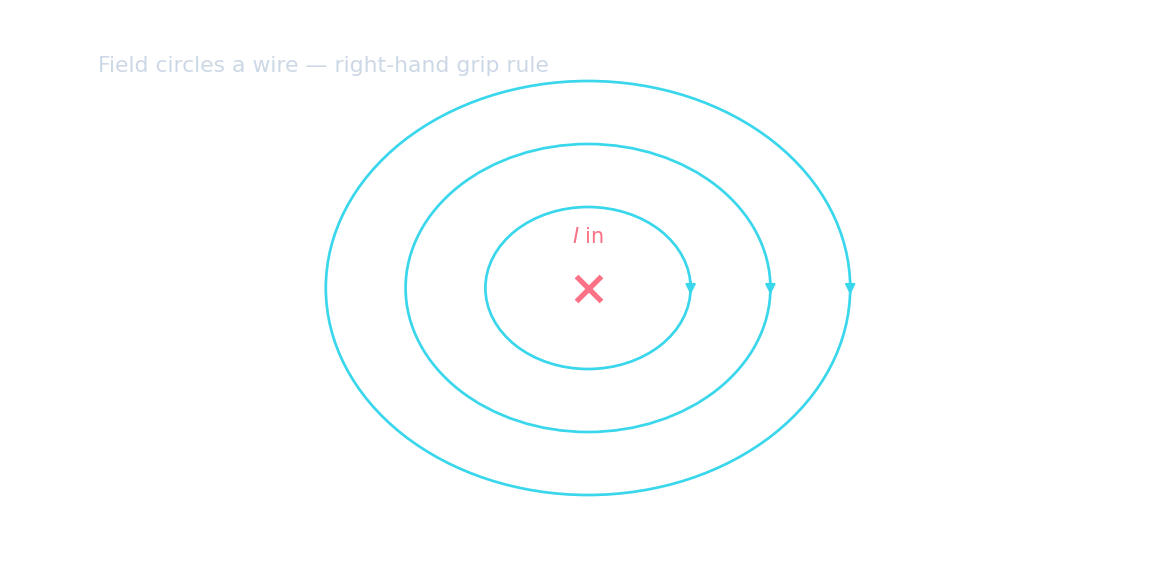
Circles, widening, each with an arrow
電流の磁界の法則の実験室
導線の周囲にある円形の磁界と電流の向きを結びつける。
長い直線導線の周囲の磁界は:
難易度 1/5 · 100 コイン + 今日初回完了時に小ボーナス付与
同心円状であり、向きは右手ねじの法則で与えられる。
右手ねじの法則は、電流を流す導線の周囲の磁界の向きを与える。
難易度 1/5 · 100 コイン + 今日初回完了時に小ボーナス付与
親指を電流の向きに合わせると、曲げた指が円形の磁界の向きを示す。
The flat circular coil
- Bend the wire into a loop and the circular fields around each side reinforce through the centre.
- So the field at the centre is at right angles to the plane of the coil, and strongest there.
- Seen from one face the coil behaves as a north pole, since the field leaves it there; from the other face, a south pole. A single loop is already a small bar magnet 条形磁铁.
平面コイルの中心における磁界の向きは何か?
難易度 1/5 · 100 コイン + 今日初回完了時に小ボーナス付与
両側の円形磁界が中心部で補完し合い、コイルは小さな棒磁石として振る舞い、一方の面から北極、他方から南極となる。
The solenoid
- A solenoid 螺线管 is many such loops in a row. Their fields add along the axis, so inside the field is nearly uniform and parallel to the axis, exactly like a stretched bar magnet.
- Outside it spreads out and falls off fast, and the ends behave as N and S poles.
- Three things strengthen it: more turns per unit length, a larger current, and an iron core 铁芯.

Uniform down the axis, and poles at the ends
長いソレノイド内部の磁界はほぼ____である。
難易度 1/5 · 100 コイン + 今日初回完了時に小ボーナス付与
引き伸ばした棒磁石のようであり、内部の磁界は均一で軸に平行である。
鉄芯を入れるとソレノイドの磁界が大幅に増大する。
難易度 1/5 · 100 コイン + 今日初回完了時に小ボーナス付与
鉄の原子レベルの磁石が整列して磁界に加算され、電磁石やトランスに利用される。
ソレノイド内部の磁界を増加させる変化はどれか。すべて選びよ。
難易度 2/5 · 140 コイン + 今日初回完了時に小ボーナス付与
単位長さあたりの巻き数、電流、および強磁性芯である。導線が太くなっても抵抗は下がるが、同一電流であれば磁界自体は変わらない。
Worked example: why the core helps
- Explain why inserting an iron core greatly increases the magnetic field of a solenoid.
- The core is a ferrous material, so the solenoid's field magnetises it: its atomic magnets line up with the field.
- The magnetised core then produces its own magnetic field, which adds to the field of the current.
- The two together are far stronger than the current's field alone. Both steps, magnetised and adds its own field, are needed for the marks. "It concentrates the field lines" is not the marked answer.
鉄芯がソレノイドの磁界を強化する理由の説明を正しい順序で並べ替えよ。
難易度 3/5 · 200 コイン + 今日初回完了時に小ボーナス付与
得点には「磁化」および「自身の磁界を加える」の両方の中間ステップが必要である。「磁界を集中させる」という表現は採点対象外である。
Two parallel currents
- Each wire sits in the field of the other, so each experiences a motor-effect force $F = BIL$.
- Apply the left-hand rule to each wire in turn, using the field the other one makes. The result is symmetric, as Newton's third law requires.
- Currents in the same direction attract. Currents in opposite directions repel.
- This force is the basis of the historical definition of the ampere.
電流が同じ向きを流す二つの平行導線:
難易度 1/5 · 100 コイン + 今日初回完了時に小ボーナス付与
同じ向きの電流は互いに引き寄せ、逆向きの電流は反発する。これがアンペアの定義の根拠である。
各タスクに対応する法則を結びつけよ。
難易度 2/5 · 140 コイン + 今日初回完了時に小ボーナス付与
平行導線の問題では両方が必要である。右の手で片方の導線が生じる磁界を求め、左の手で他方に作用する力を求める。
Worked example: predicting the direction
- Two long parallel wires carry currents in the same direction. Show that they attract.
- Use the right-hand grip rule on the left wire: in the region of the right wire, its field points into the page, say.
- Now use the left-hand rule on the right wire: field into the page, current up the page, so the force on it is towards the left wire.
- Repeat for the other wire and the force is towards the first. They attract. Note that like currents attract, which is the opposite of what like charges do.
Marks that slip away
- Right hand for the field a current makes; left hand for the force on a current in a field. Both appear in a parallel-wires question and they are not interchangeable.
- The field around a wire is circles, not lines along the wire, and their spacing widens.
- The iron core is magnetised and adds its own field. Say both parts.
- Currents in the same direction attract, unlike charges of the same sign.
You've got it
- a straight wire's field is concentric circles with widening spacing, direction from the right-hand grip rule
- a flat coil gives a field at right angles through its centre and acts as a small bar magnet; a solenoid is nearly uniform inside and has poles at its ends
- more turns per unit length, a larger current and an iron core all strengthen a solenoid, the core because it is magnetised and adds its own field
- parallel currents attract when in the same direction and repel when opposite, found by using the right-hand rule for the field and the left-hand rule for the force