| English | 意味 |
|---|---|
| simple harmonic motion/ˈsɪmpl hɑːˈmɒnɪk ˈməʊʃn/ | 単調振動 |
| displacement/dɪˈspleɪsmənt/ | 変位 |
| equilibrium/ˌiːkwɪˈlɪbrɪəm/ | 平衡 |
| amplitude/ˈæmplɪtjuːd/ | 振幅 |
| period/ˈpɪərɪəd/ | 周期 |
| frequency/ˈfriːkwənsi/ | 周波数 |
| angular frequency/ˈæŋɡjʊlə ˈfriːkwənsi/ | 角周波数 |
The lamp that taught the world to keep time
- In 1583 a student in Pisa cathedral, bored during a sermon, timed a swinging lamp against his own pulse. Whether the lamp swung wide or narrow, each swing took the same time.
- That is not obvious and it is not true of most motions. It is true whenever the restoring force grows in proportion to how far the thing has been displaced, and that one condition defines the whole topic.
- Galileo's observation became the pendulum clock, and every clock for the next 300 years.
- This lesson is simple harmonic motion 简谐运动: its defining equation, the words that describe it, and how to read $\omega$ off a graph.
The definition
- A body moves with simple harmonic motion when its acceleration is proportional to its displacement 位移 from a fixed point, and always directed towards that point.
- Both halves are needed for both marks. "Proportional to displacement" alone describes a force pushing it further away just as well.
- In symbols, with the minus sign carrying "towards the equilibrium position":

Displaced right, accelerating left; displaced left, accelerating right
簡易調和運動において、加速度は次のように表される:
難易度 1/5 · 100 コイン + 今日初回完了時に小ボーナス付与
これはまさに $a = -\omega^{2}x$ です — 変位が大きいほど引き戻す力が大きく、常に中央 toward 向かいます。
単振動の完全な定義には、どの文が必要ですか?すべて選択してください。
難易度 2/5 · 140 コイン + 今日初回完了時に小ボーナス付与
これらの2つの文が定義であり、両方のポイントを含みます。一定周期はそれらの帰結であり、速度が一定であることは明らかにありません。
The vocabulary
- Displacement $x$: distance from the equilibrium 平衡 position, with a direction. Amplitude 振幅 $x_0$: the maximum displacement.
- Period 周期 $T$: the time for one complete oscillation. Frequency 频率 $f = 1/T$: oscillations per second, in hertz.
- Angular frequency 角频率 $\omega$: connects the two, $\omega = \dfrac{2\pi}{T} = 2\pi f$. Given any one of $\omega$, $f$ and $T$ you can find the others, and most questions start by doing exactly that.
振り子(ペンドラム)を揺らす
揺らし始め、その後開始角度を変えてみてください — 1回分のEndTime(周期)は変わりません(これが良い時計になる理由です)。次に紐を長くするか、月へ移動すれば、周期が変化することを見ます。
ある振動の周期が $2.0\ \text{s}$ です。その角周波数 $\omega$ はいくつですか?
難易度 2/5 · 140 コイン + 今日初回完了時に小ボーナス付与
$\omega = \dfrac{2\pi}{T} = \dfrac{2\pi}{2.0} = \pi \approx 3.14\ \dfrac{\text{rad}}{\text{s}}$.
Displacement with time
- Starting from the equilibrium position at $t = 0$: $x = x_0 \sin(\omega t)$. Starting from an extreme: $x = x_0 \cos(\omega t)$.
- Which you use depends only on where the motion starts. Read the question's opening condition before choosing.
- The graph is a sine curve of amplitude $x_0$ and period $T$, and the motion repeats exactly.

One period, one full cycle, and then the same again
Speed anywhere in the motion
- The speed at displacement $x$, without needing the time:
- At the centre, $x = 0$, this gives the maximum speed $v_{\text{max}} = \omega x_0$. At the extremes, $x = \pm x_0$, it gives zero.
- That is the pattern to hold on to: fastest in the middle, momentarily at rest at each end, and the acceleration is the other way round, zero in the middle and greatest at the ends.
単振動において、速度が最大となるのは ____ 位置です。
難易度 1/5 · 100 コイン + 今日初回完了時に小ボーナス付与
中央では全エネルギーが運動エネルギーなので、速度は最大です($v = \omega x_0$)。
運動の極限($x = \pm x_0$)では、速度はゼロです。
難易度 1/5 · 100 コイン + 今日初回完了時に小ボーナス付与
振動子は両端で一瞬静止してから反転します — 速度ゼロ、加速度最大。
振幅が $0.10\ \text{m}$ で、$\omega = 10\ \dfrac{\text{rad}}{\text{s}}$ の振動子がある。最大速度はいくらか?
難易度 2/5 · 140 コイン + 今日初回完了時に小ボーナス付与
最大速度 $= \omega x_0 = 10 \times 0.10 = 1.0\ \dfrac{\text{m}}{\text{s}}$。
各物理量を、振動中のどこで最大になるかと対応させください。
難易度 2/5 · 140 コイン + 今日初回完了時に小ボーナス付与
速度と加速度は異なる位置でピークを迎え、同時に最大になることはありません。
Worked example: from period to maximum speed
- A mass oscillates with a period of $2.0\ \text{s}$ and an amplitude of $0.10\ \text{m}$. Find its maximum speed and its maximum acceleration.
- First $\omega$: $\omega = \dfrac{2\pi}{T} = \dfrac{2\pi}{2.0} = 3.14\ \text{rad/s}$. Almost every SHM question begins here.
- Maximum speed, at the centre: $v_{\text{max}} = \omega x_0 = 3.14 \times 0.10 = 0.31\ \text{m/s}$.
- Maximum acceleration, at the extremes: $a_{\text{max}} = \omega^2 x_0 = 3.14^2 \times 0.10 = 0.99\ \text{m/s}^2$.
- Note where each maximum occurs. A question asking "at what displacement" wants the centre for speed and the extremes for acceleration.
周期 2.0 s、振幅 0.10 m の振動があります。最大速度はいくつ m/s ですか?
難易度 2/5 · 140 コイン + 今日初回完了時に小ボーナス付与
omega = 2 pi / T = 3.14 rad/s であり、v_max = omega x0 = 0.31 m/s で、これは中心で発生します。最大加速度は両端で、omega squared times x0 = 0.99 m/s^2 です。
Reading the acceleration-displacement graph
- Because $a = -\omega^2 x$, a graph of acceleration against displacement is a straight line through the origin with a negative gradient.
- The gradient is $-\omega^2$, so $\omega = \sqrt{|\text{gradient}|}$ and then $T = 2\pi/\omega$.
- This is the standard way an exam gives you $\omega$ without stating it. A straight line through the origin with negative gradient is also the standard way of asking you to show that a motion is simple harmonic.
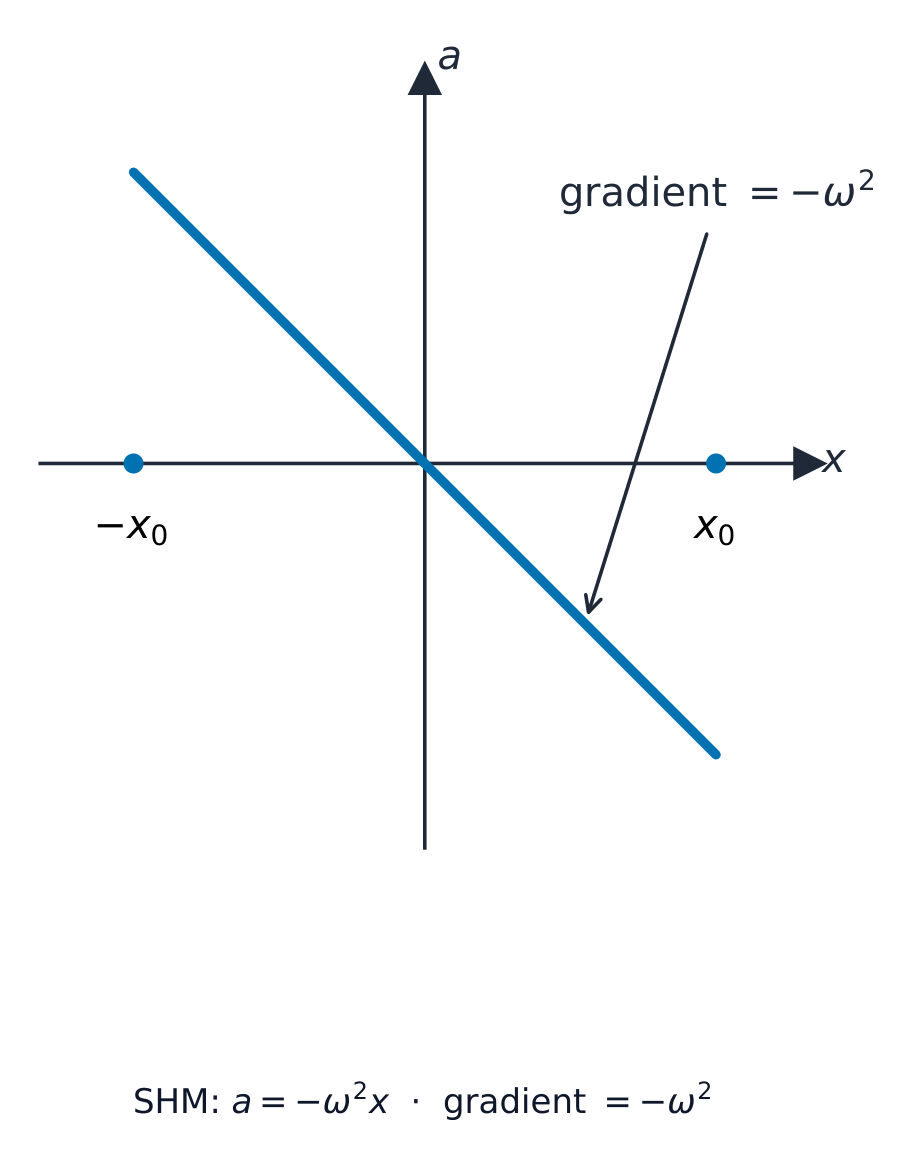
Straight, through the origin, negative: all three matter
SHMの加速度-変位グラフにおいて、傾き(勾配)は次のどれ等于しますか?
難易度 1/5 · 100 コイン + 今日初回完了時に小ボーナス付与
$a = -\omega^{2}x$ は傾き $-\omega^{2}$ の直線なので、$\omega = \sqrt{|\text{gradient}|}$ 。
Worked example: is it simple harmonic?
- Measurements of a trolley's acceleration at various displacements give a straight line through the origin with gradient $-25\ \text{/s}^2$. Show that the motion is simple harmonic and find the period.
- The graph is a straight line, so $a \propto x$; it passes through the origin, so there is no constant term; and its gradient is negative, so the acceleration is directed towards the equilibrium position. Those three facts are the definition, so the motion is simple harmonic.
- The gradient is $-\omega^2 = -25$, so $\omega = 5.0\ \text{rad/s}$ and $T = \dfrac{2\pi}{5.0} = 1.3\ \text{s}$.
ある振動子の加速度-変位グラフは原点を通る直線であり、勾配は秒あたり²で -25 である。周期はいくつ秒か?
難易度 2/5 · 140 コイン + 今日初回完了時に小ボーナス付与
傾きは minus omega squared なので、omega = 5.0 rad/s であり、T = 2 pi / 5.0 = 1.3 s です。直線であり、原点を通り、負であることも、運動が単振動であることを示す証明です。
Marks that slip away
- The definition needs both halves: proportional to displacement and directed towards a fixed point. The minus sign is what carries the second.
- $\omega$ is in rad s$^{-1}$, not hertz. Convert with $\omega = 2\pi f$ before substituting.
- Speed is greatest at the centre; acceleration is greatest at the extremes. They are never both maximum at once.
- Choose sine or cosine from where the motion starts, not by habit.
You've got it
- SHM: acceleration proportional to displacement and directed towards a fixed point, so $a = -\omega^2 x$
- $\omega = \dfrac{2\pi}{T} = 2\pi f$, and almost every question starts by finding $\omega$
- $x = x_0\sin\omega t$ from the centre or $x_0\cos\omega t$ from an extreme; $v = \pm\omega\sqrt{x_0^2 - x^2}$, so $v_{\text{max}} = \omega x_0$ at the centre and $a_{\text{max}} = \omega^2 x_0$ at the ends
- an acceleration-displacement graph that is straight, through the origin and negative proves SHM, and its gradient is $-\omega^2$