| English | 意味 |
|---|---|
| radians/ˈreɪdɪənz/ | ラジアン |
| arc length/ɑːk leŋθ/ | 弧長 |
| angular speed/ˈæŋɡjʊlə spiːd/ | 角速度 |
| period/ˈpɪərɪəd/ | 周期 |
| frequency/ˈfriːkwənsi/ | 周波数 |
| tangential/tænˈdʒenʃl/ | 接線方向 |
| linear speed/ˈlɪnɪə spiːd/ | 線速度 |
The merry-go-round
- Two horses on a merry-go-round both go round once together.
- Yet the outer horse clearly moves faster than the inner one.
- The link between "going round" and "speed" is what we set up here.
Angles in radians 弧度
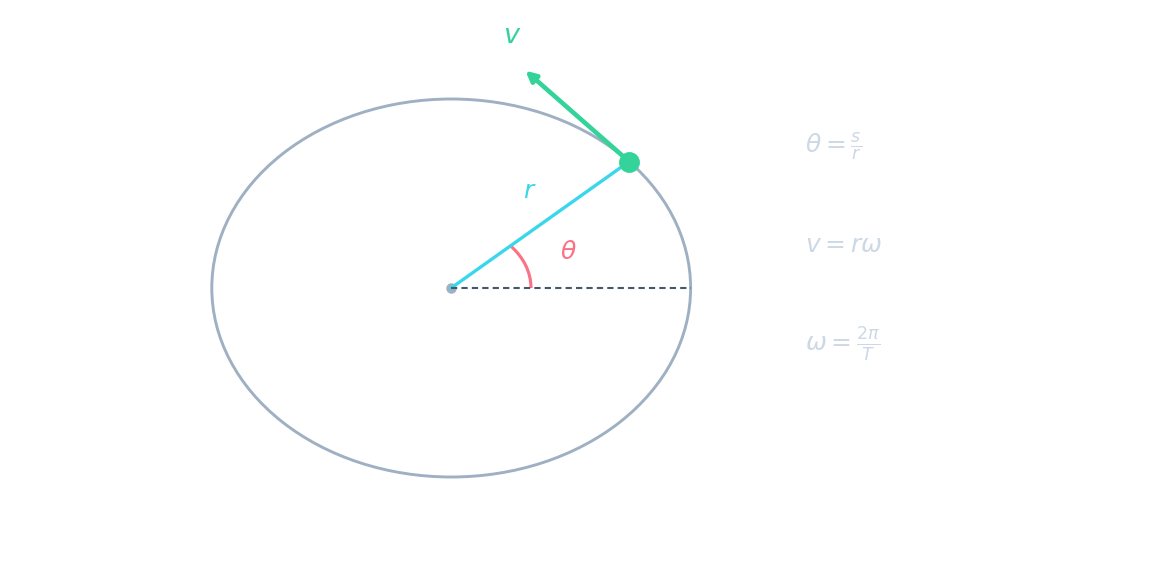
- A radian is the angle whose arc length 弧长 equals the radius: $\theta = \dfrac{s}{r}$.
- A full circle is $2\pi\ \text{rad}$. (Set your calculator to radians for this topic.)

A Ferris wheel: each car moves in a circle at a steady angular speed 角速度
角速度
s = rθ
角速度は時間あたりの角度を表し、弧長 s = rθ である。
1ラジアンとは、弧長が以下のものに等しい角度のことである:
難易度 1/5 · 100 コイン + 今日初回完了時に小ボーナス付与
$\theta = \dfrac{s}{r}$ なので、弧 $s$ が半径 $r$ に等しいとき、角度はちょうど1ラジアンとなる。
完全な円には何ラジアンあるか?
難易度 2/5 · 140 コイン + 今日初回完了時に小ボーナス付与
完全な円の弧長は $s = 2\pi r$ なので、$\theta = \dfrac{2\pi r}{r} = 2\pi \approx 6.28\ \text{rad}$ となる。
各用語を、試験官が採点基準として示す定義と結びつけなさい。
難易度 2/5 · 140 コイン + 今日初回完了時に小ボーナス付与
ラジアンを180/π度として定義したり、θ = s/rの式を用いたりすることは不正解とする。弧長が半径と等しいことが正解である。
Angular speed
- Angular speed $\omega$ is how fast the angle changes: $\omega = \dfrac{\theta}{t}$.
- Unit: $\dfrac{\text{rad}}{\text{s}}$.

One radian is the angle whose arc length equals the radius
Period 周期 and frequency 频率
- One turn takes the period $T$, so $\omega = \dfrac{2\pi}{T} = 2\pi f$.
- $f = \dfrac{1}{T}$ is the number of turns per second (Hz).

As the radius turns through the angle the object moves an arc at speed v
物体は$2.0\ \text{s}$ごとに一周する。角速度はいくつか?
難易度 2/5 · 140 コイン + 今日初回完了時に小ボーナス付与
$\omega = \dfrac{2\pi}{T} = \dfrac{2\pi}{2.0} = \pi \approx 3.14\ \dfrac{\text{rad}}{\text{s}}$.
角速度は $2\pi$ を ____ で割った値に等しい。
難易度 1/5 · 100 コイン + 今日初回完了時に小ボーナス付与
$\omega = \dfrac{2\pi}{T}$ — 一周($2\pi$)を1周にかかる時間で割った値。
Linear and angular speed
- The actual (tangential 切向) speed is $v = r\omega$.
- Same $\omega$, bigger $r$ → bigger $v$ — which is why the outer horse is faster.
半径$0.50\ \text{m}$の点で、角速度$\omega = 4.0\ \dfrac{\text{rad}}{\text{s}}$で回転している。この点の線速度はいくつか?
難易度 2/5 · 140 コイン + 今日初回完了時に小ボーナス付与
$v = r\omega = 0.50 \times 4.0 = 2.0\ \dfrac{\text{m}}{\text{s}}$.
メリーゴーラウンドにおいて、中心から遠い馬ほど線速度は大きい。
難易度 1/5 · 100 コイン + 今日初回完了時に小ボーナス付与
同じ角速度 $\omega$ だが $v = r\omega$ が大きいので、半径が大きいほど線速度も大きくなる。
車輪は4.0秒に一度回転する。その角速度はrad/sでいくつになるか?
難易度 2/5 · 140 コイン + 今日初回完了時に小ボーナス付与
omega = 2 pi / T = 1.57 rad/s。この単元のすべての公式はラジアンを前提としているため、電卓を度数モードに設定したままでは v = r omega も誤った結果となる。
Describing uniform circular motion
- The exam asks for it "in terms of velocity and acceleration". Say all three things:
- the speed is constant, but the velocity is not — it is along the tangent and its direction changes continuously;
- the acceleration has constant magnitude and is always directed towards the centre, perpendicular to the velocity.
均一円運動をする物体について、正しい記述をすべて選びよ。
難易度 2/5 · 140 コイン + 今日初回完了時に小ボーナス付与
速さは一定だが方向は continuously に変化するため加速度が存在し、その大きさは一定で常に中心に向いている。
均一円運動において、何が一定か?すべて選びよ。
難易度 2/5 · 140 コイン + 今日初回完了時に小ボーナス付与
速度は方向が continuously に変化するため、まさにそれゆえに加速度が存在する。力は仕事を行わないため、運動エネルギーは決して変化しない。
Worked example: standing still, moving fast
Cambridge is at latitude $52.2^\circ$ on an Earth of radius $6.37 \times 10^{6}\ \text{m}$ that turns once a day. Find the radius of the circle Cambridge moves round, its speed, and the resultant force on a $60\ \text{kg}$ student needed for this motion.
- Radius of the circle: the city circles the Earth's axis, not its centre, so $r = R\cos 52.2^\circ = 6.37 \times 10^{6} \times 0.613 = 3.90 \times 10^{6}\ \text{m}$.
- Angular speed: $\omega = \dfrac{2\pi}{T} = \dfrac{2\pi}{86\,400} = 7.27 \times 10^{-5}\ \dfrac{\text{rad}}{\text{s}}$.
- Speed: $v = r\omega = 3.90 \times 10^{6} \times 7.27 \times 10^{-5} = 284\ \dfrac{\text{m}}{\text{s}}$.
- Resultant force: $F = mr\omega^{2} = 60 \times 3.90 \times 10^{6} \times (7.27 \times 10^{-5})^{2} = 1.2\ \text{N}$, towards the axis.
- Check: a tiny force compared with the student's $590\ \text{N}$ weight — which is why we do not notice the spin, even though we are moving faster than a jet aircraft.
$\omega$ must be in radians per second. Revolutions per minute become $\dfrac{\text{rpm} \times 2\pi}{60}$; a full turn is $2\pi$ in every formula here, never $360$. $r$ in $v = r\omega$ is in metres. And the period is the time for one complete revolution, not for a half-turn or a swing.
ドリルビットは分あたり$3000$回転で回っている。その角速度はrad/sでいくつになるか?
難易度 2/5 · 140 コイン + 今日初回完了時に小ボーナス付与
$3000$ rpm は $50$ /s に相当します。各回転は $2\pi$ rad なので、$\omega = 50 \times 2\pi = 314\ \dfrac{\text{rad}}{\text{s}}$ となります。
Numbers to get a feel for
- A CD at $500$ revolutions per minute: $\omega = \dfrac{500 \times 2\pi}{60} = 52\ \dfrac{\text{rad}}{\text{s}}$.
- A car wheel of radius $0.30\ \text{m}$ at $20\ \dfrac{\text{m}}{\text{s}}$: $\omega = \dfrac{v}{r} = 67\ \dfrac{\text{rad}}{\text{s}}$, about $11$ turns a second.
- The Earth: one turn in $86\,400\ \text{s}$, so $\omega = 7.3 \times 10^{-5}\ \dfrac{\text{rad}}{\text{s}}$ — slow in angle, fast at the rim.
You've got it
- a radian: $\theta = \dfrac{s}{r}$; a full circle is $2\pi\ \text{rad}$
- angular speed $\omega = \dfrac{\theta}{t} = \dfrac{2\pi}{T} = 2\pi f$ (rad/s — convert rpm)
- linear speed 线速度 $v = r\omega$ (bigger radius → faster); uniform circular motion: constant speed, changing velocity, acceleration towards the centre