| English | 意味 |
|---|---|
| radiation/ˌreɪdɪˈeɪʃn/ | 放射線 |
| positron/ˈpɒzɪtrɒn/ | 陽電子 |
| photon/ˈfəʊtɒn/ | 光子 |
| penetration/ˌpenɪˈtreɪʃn/ | 透過性 |
| ionising/ˈaɪənaɪzɪŋ/ | 電離作用 |
| deflected/dɪˈflektɪd/ | 曲がり |
| antiparticles/ˌæntɪˈpɑːtɪklz/ | 反粒子 |
| neutrinos/njuːˈtriːnəʊz/ | 中微子 |
Three kinds of radiation 辐射
- An unstable nucleus settles down by throwing out radiation.
- There are three kinds — alpha, beta and gamma — and they behave very differently.
- Telling them apart is the heart of this topic.
What each one is
- α: a helium nucleus ($^{4}_{2}\alpha$), charge $+2e$, mass $\approx 4\ \text{u}$.
- β: a fast electron ($\beta^{-}$) or positron 正电子 ($\beta^{+}$), charge $\mp e$, tiny mass.
- γ: a high-energy photon 光子, no charge, no mass.
放射性崩壊
A = A₀·bᵗ
活動 減衰 は指数関数的です — 基底 b を 1 より下に設定してください。
α粒子とは:
難易度 1/5 · 100 コイン + 今日初回完了時に小ボーナス付与
α粒子は $^{4}_{2}\alpha$ — 電荷が $+2e$ のヘリウム-4原子核である。
Penetration 穿透 and ionising 电离
- α: stopped by paper; strongly ionising.
- β: stopped by a few mm of aluminium.
- γ: only reduced by thick lead; weakly ionising.
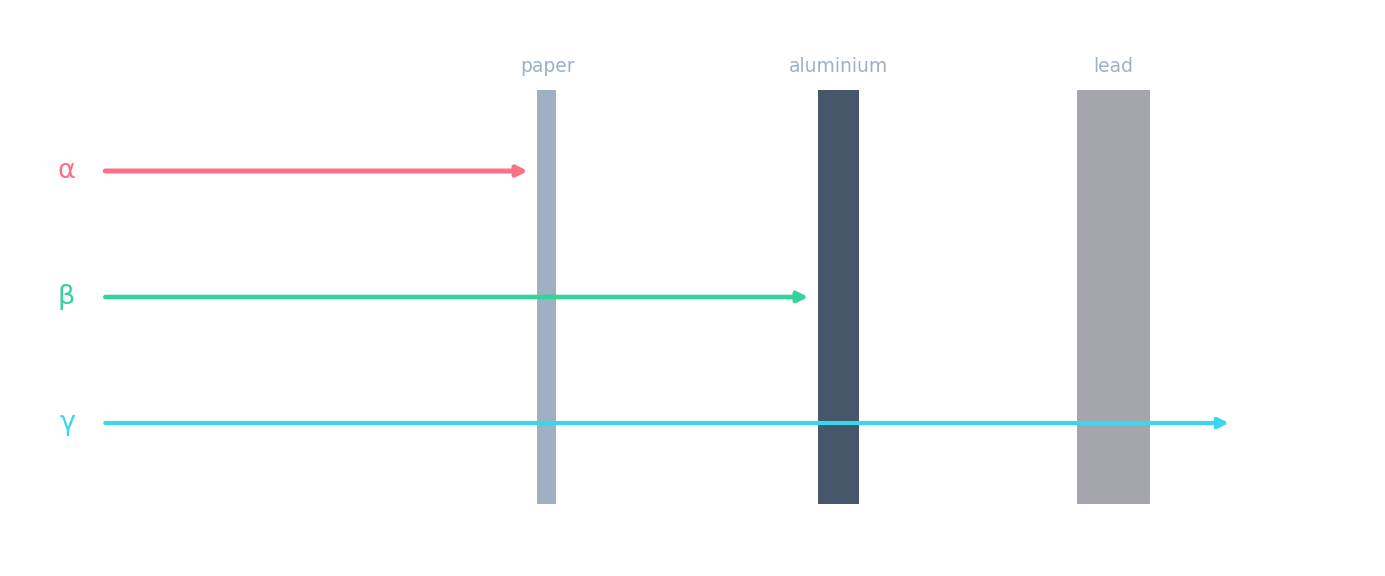
各放射線に対応して、それを遮断する物質を結ぶ。
難易度 2/5 · 140 コイン + 今日初回完了時に小ボーナス付与
貫通力は α < β < γ;イオン化能力はその逆(αが最も強い)。
3種類の中で、α放射線が最も強いイオン化能力を持つ。
難易度 1/5 · 100 コイン + 今日初回完了時に小ボーナス付与
はい — αは最も強いイオン化能力(つまり最も低い貫通力)を持ち、γは最も弱いイオン化能力(つまり最も高い貫通力)を持つ。
In an electric field
- The field pushes charges: α is deflected 偏转 towards the negative plate, β$^{-}$ the opposite way, γ not at all.
- The force is $F = Eq$, so the α feels twice the force of a β — but its mass is thousands of times larger, so it curves far less.
- Same rule for any two charged particles in the same field: compare the forces by charge, the accelerations by $\dfrac{q}{m}$.
α粒子、β⁻粒子、γ線が同一の均一な電気場内で横並びに入射した。正しい記述はどれか?
難易度 1/5 · 100 コイン + 今日初回完了時に小ボーナス付与
異なる電荷は逆向きに力を受ける。β⁻は質量比に対する電荷量が遥かに大きいため、遥かに大きな加速度を得る;電荷を持たないγには力が働かない。
Antiparticles 反粒子 and neutrinos 中微子
- Every particle has an antiparticle — same mass, opposite charge (the positron is the electron's).
- β-decay always emits a (anti)neutrino too: nearly massless, no charge, very hard to detect.
ポジトロンは電子の ____ である。
難易度 1/5 · 100 コイン + 今日初回完了時に小ボーナス付与
反粒子は同じ質量だが反対の電荷を持つ — ポジトロンは電子の $+e$ で、電子の $-e$ に相当する。
Why β is continuous
- α-decay shares energy between two particles → the α has one fixed energy (discrete).
- β-decay shares energy between three (with the neutrino) → β energies range from zero up to a maximum (continuous).
β粒子は連続したエネルギー分布で放出される。これはエネルギーが以下の粒子間で共有されるためである:
難易度 1/5 · 100 コイン + 今日初回完了時に小ボーナス付与
3つの粒子で共有するため、β粒子は最大値までの任意のエネルギーを取りうる。α崩壊では2つの粒子間で共有されるため、α粒子のエネルギーは固定される。
Decay equations
- α: $^{A}_{Z}\text{X} \to {}^{A-4}_{Z-2}\text{Y} + {}^{4}_{2}\alpha$.
- β$^{-}$: $^{A}_{Z}\text{X} \to {}^{A}_{Z+1}\text{Y} + {}^{0}_{-1}\beta + \bar{\nu}_{e}$ (a neutron becomes a proton).
- β$^{+}$: $^{A}_{Z}\text{X} \to {}^{A}_{Z-1}\text{Y} + {}^{0}_{+1}\beta + \nu_{e}$ (a proton becomes a neutron).
α崩壊において、核子数 $A$ はどれだけ減少するか?
難易度 2/5 · 140 コイン + 今日初回完了時に小ボーナス付与
α粒子は4核子(陽子2+中性子2)を運ぶため、$A$ は4減少し($Z$ は2減少する)。
β$^{-}$ 崩壊において、陽子数 $Z$ は:
難易度 1/5 · 100 コイン + 今日初回完了時に小ボーナス付与
中性子が陽子に変換されるため、$Z$ は1増加し、$A$ はそのままとなる。
Worked example: nitrogen-12 and a field
Nitrogen-12, $^{12}_{7}\text{N}$, decays by emitting a positron. The emitted positron and an α-particle then pass through the same uniform electric field.
- Equation: $^{12}_{7}\text{N} \to {}^{12}_{6}\text{C} + {}^{0}_{+1}\beta + \nu_{e}$. Check: $12 = 12 + 0$ and $7 = 6 + 1$.
- Charge on the positron: $+e$ — the electron's antiparticle.
- Forces in the field: $F = Eq$, so $\dfrac{F_{\alpha}}{F_{\beta}} = \dfrac{2e}{e} = 2$.
- Accelerations: $a = \dfrac{Eq}{m}$, so $\dfrac{a_{\alpha}}{a_{\beta}} = \dfrac{2e / 4\,\text{u}}{e / (\text{u}/1840)} \approx \dfrac{1}{3700}$ — the positron accelerates thousands of times more.
- Check: twice the force but four thousand times the mass: the α barely bends. Both are pushed the same way, because both are positive.
原子核X(電荷$+2e$、質量$4\ \text{u}$)と原子核Y(電荷$+e$、質量$3\ \text{u}$)が同一の均一な電気場内にある。Xの加速度 : Yの加速度 の比は何らか?
難易度 2/5 · 140 コイン + 今日初回完了時に小ボーナス付与
$a = \dfrac{Eq}{m}$ なので、比は $\dfrac{2/4}{1/3} = \dfrac{0.5}{0.333} = 1.5$ となる。力の比だけでは $2$ になるが、質量の影響で変わる。
A β$^{-}$ particle comes from the nucleus — a neutron turns into a proton — not from the orbiting electrons. A γ-ray changes neither $A$ nor $Z$; it only carries away energy. And the reason β energies are continuous is the (anti)neutrino sharing the energy — that is the exam's favourite "explain" question in this topic.
You've got it
- α = He nucleus, $+2e$, $4\ \text{u}$ (paper-stopped, strong ioniser); β = electron/positron (Al-stopped); γ = photon (lead)
- in a field: force $\propto q$, acceleration $\propto \dfrac{q}{m}$; α and β$^{-}$ bend opposite ways, γ does not bend
- β-decay emits a (anti)neutrino, which is why its energy spectrum is continuous; α: $A{-}4, Z{-}2$; β$^{-}$: $Z{+}1$; β$^{+}$: $Z{-}1$