| English | 意味 |
|---|---|
| Kirchhoff's laws/ˈkɜːkhɒfs lɔːz/ | キルヒホッフの法則 |
| junctions/ˈdʒʌŋkʃnz/ | 節点 |
| conservation of charge/ˌkɒnsəˈveɪʃn ɒv tʃɑːdʒ/ | 電荷保存の法則 |
| conservation of energy/ˌkɒnsəˈveɪʃn ɒv ˈenədʒi/ | エネルギー保存の法則 |
| series/ˈsɪəriːz/ | 直列 |
| parallel/ˈpærəlel/ | 並列 |
Two rules for any circuit
- A tangle of wires can look impossible to solve.
- But just two rules — Kirchhoff's laws 基尔霍夫定律 — crack any of them.
- Each is really a conservation law in disguise.
First law: junctions 节点
- At any junction, current in = current out.
- It comes from conservation of charge 电荷守恒 — charge cannot pile up at a point.
直列・並列回路
直列と並列のスイッチを切り替え、電球を追加します。直列では電圧を共有し、一处の断線ですべて消滅しますが、並列ではそれぞれが全電圧を受け取り、一处の断線はその分岐のみを失います。
$5.0\ \text{A}$ が分岐点に流入し、2つの枝に分かれる。片方が $2.0\ \text{A}$ を運ぶとき、もう片方は何を運ぶか?
難易度 2/5 · 140 コイン + 今日初回完了時に小ボーナス付与
流入電流=流出電流:$5.0 = 2.0 + I$ なので、$I = 3.0\ \text{A}$ 。
Second law: loops
- Around any closed loop, total e.m.f. = total p.d. across the components.
- It comes from conservation of energy 能量守恒 — each coulomb gives back what it gained.
- Go round the loop in one direction: an e.m.f. counts positive if you pass through the source from $-$ to $+$; a p.d. $IR$ counts positive if you go with the current.
各キルヒホッフの法則と、その背後にある保存則を対応させよ。
難易度 2/5 · 140 コイン + 今日初回完了時に小ボーナス付与
分岐点に電荷は蓄積できない;ループ内を回る電荷が源から得たエネルギーは、素子に与えたエネルギーと等しい。
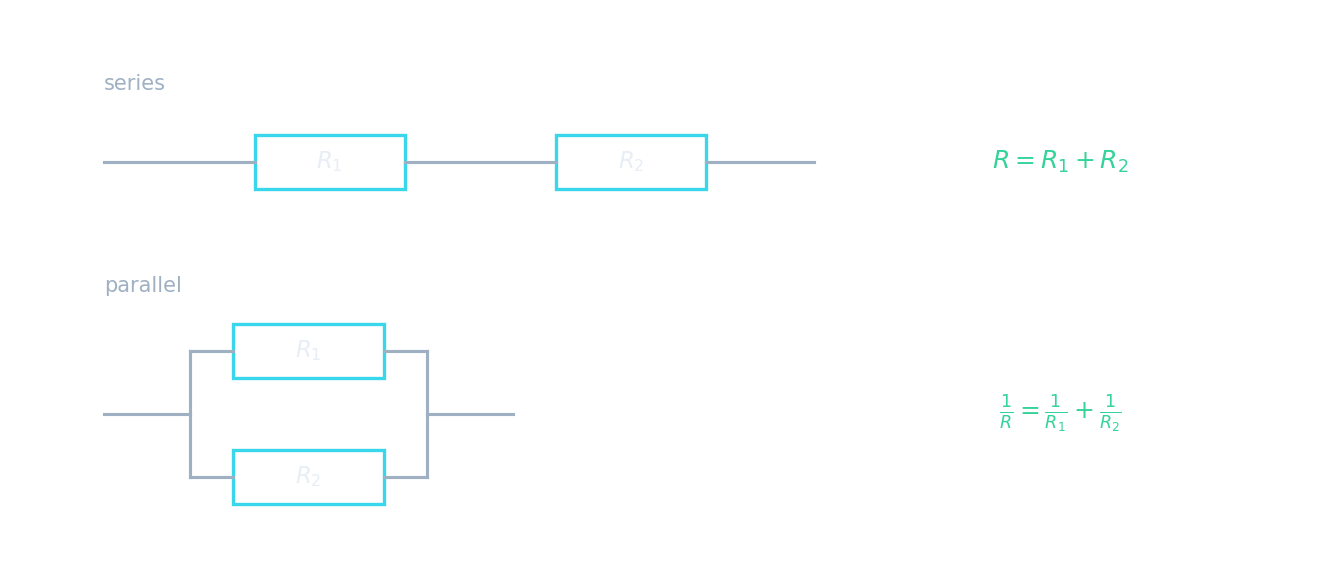
Resistors in series 串联
- Same current through each; the p.d.s add.
- $R_{\text{series}} = R_1 + R_2 + \ldots$ — always larger than each one.

Two resistors in series and their single equivalent resistor
$3.0\ \Omega$ と $6.0\ \Omega$ の抵抗器が直列に接続されています。合成抵抗はいくつですか?
難易度 2/5 · 140 コイン + 今日初回完了時に小ボーナス付与
$R = R_1 + R_2 = 3.0 + 6.0 = 9.0\ \Omega$.
Resistors in parallel 并联
- Same p.d. across each; the currents add.
- $\dfrac{1}{R_{\text{parallel}}} = \dfrac{1}{R_1} + \dfrac{1}{R_2} + \ldots$ — always smaller than the smallest one.

Two resistors in parallel and their single equivalent resistor
$3.0\ \Omega$ と $6.0\ \Omega$ の抵抗器が並列接続されている。合成抵抗はいくらか?
難易度 2/5 · 140 コイン + 今日初回完了時に小ボーナス付与
$\dfrac{1}{R} = \dfrac{1}{3.0} + \dfrac{1}{6.0} = \dfrac{1}{2.0}$ なので、$R = 2.0\ \Omega$ — どちらよりも小さい。
並列結合の合成抵抗は、常に其中的に最も小さい抵抗器よりも小さい。
難易度 1/5 · 100 コイン + 今日初回完了時に小ボーナス付与
はい — 並列パスを追加することで、電流にもう一つの経路を与え、全体の抵抗を下げる。
Worked example: a cell with a parallel pair
A cell of e.m.f. $6.0\ \text{V}$ and internal resistance $1.0\ \Omega$ is connected to a $4.0\ \Omega$ and a $6.0\ \Omega$ resistor in parallel. Find the current in the cell, the terminal p.d., and the current in each resistor.
- Parallel pair: $\dfrac{1}{R} = \dfrac{1}{4.0} + \dfrac{1}{6.0} = \dfrac{5}{12}$, so $R = 2.4\ \Omega$.
- Whole circuit: $R_{\text{total}} = 2.4 + 1.0 = 3.4\ \Omega$, so $I = \dfrac{6.0}{3.4} = 1.8\ \text{A}$ (second law: $\varepsilon = I(R + r)$).
- Terminal p.d.: $V = 6.0 - 1.8 \times 1.0 = 4.2\ \text{V}$ — the p.d. across both resistors.
- Branch currents: $\dfrac{4.2}{4.0} = 1.1\ \text{A}$ and $\dfrac{4.2}{6.0} = 0.70\ \text{A}$.
- Check (first law): $1.1 + 0.70 = 1.8\ \text{A}$, the current in the cell. The smaller resistor takes the larger share.
起電力 $12\ \text{V}$、内部抵抗 $2.0\ \Omega$ の電池が、2つの $8.0\ \Omega$ 抵抗器に並列接続されています。端子電圧(V)はいくつですか?
難易度 2/5 · 140 コイン + 今日初回完了時に小ボーナス付与
2つの等しい $8.0\ \Omega$ 抵抗器を並列にすると $4.0\ \Omega$ になります。$I = \dfrac{12}{4.0 + 2.0} = 2.0\ \text{A}$ なので、$V = 12 - 2.0 \times 2.0 = 8.0\ \text{V}$ です。
Explaining a change with the laws
- A thermistor in parallel with a resistor R, across a real cell. Temperature rises — why does the current in R fall?
- Chain it: thermistor resistance ↓ → total circuit resistance ↓ → current in the cell ↑ → lost volts $Ir$ ↑ → terminal p.d. ↓ → current in R $= \dfrac{V}{R}$ ↓.
- Every arrow is a mark. The current in the cell goes up while the current in R goes down — both at once.
熱敏抵抗器が、実在する電池の両端にある抵抗器 R と並列接続されており、温度が上昇しました。推論の順序を正しく並べ替えてください。
難易度 3/5 · 200 コイン + 今日初回完了時に小ボーナス付与
抵抗が少なくなる → 電池電流が増える → ロストボルツが増える → 端子電圧が減る → R の電流が減る。なお、電池の電流は増加しているが、R の電流は減少している点に注意。
Solving a circuit
- Label every current with a direction.
- Apply the junction rule and the loop rule, plus $V = IR$, then solve together.
2つの等しい抵抗器 $R$ を並列接続した場合、合成抵抗は:
難易度 1/5 · 100 コイン + 今日初回完了時に小ボーナス付与
$\dfrac{1}{R_{\text{tot}}} = \dfrac{1}{R} + \dfrac{1}{R} = \dfrac{2}{R}$ 、したがって $R_{\text{tot}} = \tfrac{1}{2}R$ 。
The parallel formula gives $\dfrac{1}{R}$ — invert at the end, or you will quote $0.42\ \Omega$ for a $2.4\ \Omega$ pair. Two equal resistors in parallel give exactly half. Adding any resistor in parallel always lowers the total. And all branches in parallel have the same p.d., so you never add p.d.s across parallel branches.
並列接続された素子には、常に同じ ____ がかけられています。
難易度 1/5 · 100 コイン + 今日初回完了時に小ボーナス付与
並列枝は同じ2つの接合部を共有するため、各素子の端子電圧は同一であり、異なるのは電流です。
You've got it
- first law (junctions): current in = current out — conservation of charge
- second law (loops): total e.m.f. = total p.d. — conservation of energy; $\varepsilon = I(R + r)$
- series: $R = R_1 + R_2$; parallel: $\dfrac{1}{R} = \dfrac{1}{R_1} + \dfrac{1}{R_2}$ (then invert); a change anywhere alters the cell current and the terminal p.d.