| English | 意味 |
|---|---|
| superposition/ˌsuːpəpəˈzɪʃn/ | 重畳 |
| constructive/kənˈstrʌktɪv/ | 建設的 |
| destructive/dɪˈstrʌktɪv/ | 相殺的 |
| in phase/ɪn feɪz/ | 同位相 |
| stationary wave/ˈsteɪʃənəri weɪv/ | 定在波 |
| node/nəʊd/ | 節点 |
| antinode/ˌæntɪˈnəʊd/ | 腹点 |
| progressive wave/prəˈɡresɪv weɪv/ | 進行波 |
音によるノイズキャンセリング
- ノイズキャンセリングヘッドホンは、周囲のノイズを打ち消すような波を再生する。
- 2つの波は加算されたり、互いに打ち消したりする。
- この波の重ね合わせの原理こそが、このトピック全体の核心である。
重畳の原理
- 波が重なった地点における変位は、個別の変位の和となる。
- その後、波は変化することなく继续进行する。
Stationary waves
y = y₁ + y₂
Two waves superpose: where they reinforce you get antinodes, where they cancel, nodes.
When two waves overlap at a point, the resultant displacement is:
難易度 1/5 · 100 コイン + 今日初回完了時に小ボーナス付与
That is the principle of superposition — displacements add (as vectors) at each point.
Match each term to the definition the examiner marks.
難易度 2/5 · 140 コイン + 今日初回完了時に小ボーナス付与
Displacements add. Amplitudes and intensities do not, which is why two equal waves can give zero at one point and four times the intensity at another.
建設的干渉と破壊的干渉
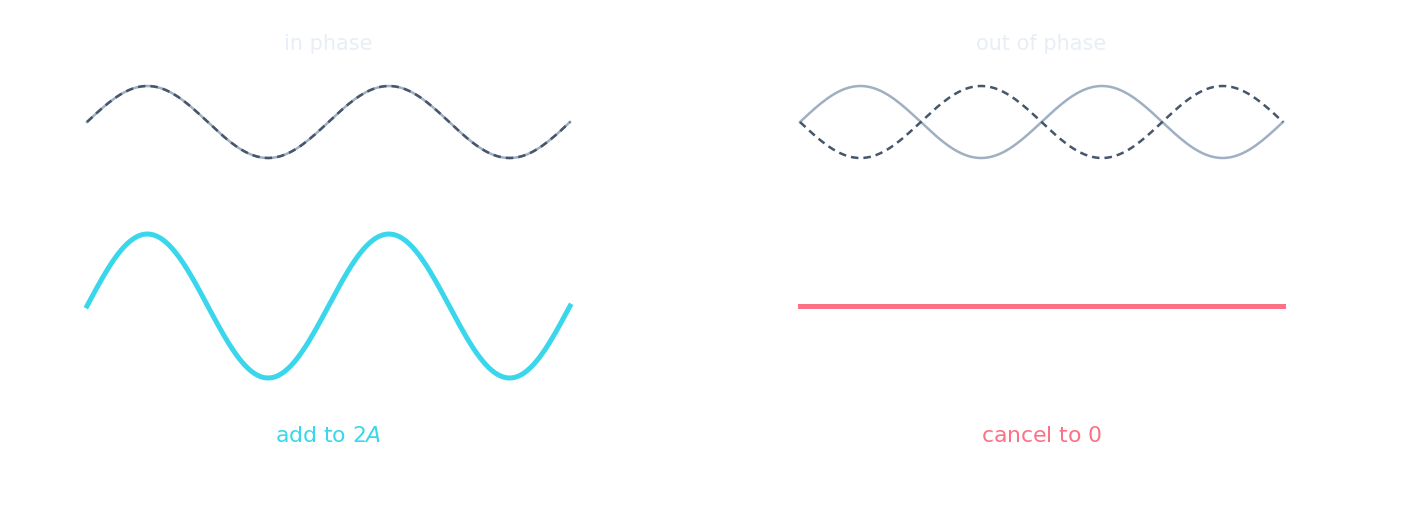
- 同位相(山と山が重なる)→ 振幅が加算 → 建設的干渉。
- 逆位相(山と谷が重なる)→ 振幅が打ち消し合う → 破壊的干渉。
- $I \propto A^{2}$ であるため、同位相の2つの同じ波は、1つの波の強度の4倍となる。

位相の揃って到達した2つの波は加算され、振幅が倍になる(建設的干渉)
Standing waves & harmonics
A string fixed at both ends only resonates at its harmonics. Drag n to see the nodes, antinodes and how the wavelength changes.
Match what happens when the two waves meet.
難易度 2/5 · 140 コイン + 今日初回完了時に小ボーナス付与
In phase → a bigger wave; exactly out of phase → they cancel.
Two equal waves meeting in phase give four times the intensity of one wave alone.
難易度 1/5 · 100 コイン + 今日初回完了時に小ボーナス付与
The amplitude doubles to $2A$, and $I \propto A^{2}$, so $I \propto (2A)^{2} = 4A^{2}$.
定常波
- 2つの同一の波が逆向きに進んで重なり合うことで定常波が形成される。
- 波が自身に反射して戻ってくる際に起こる——弦や空気柱内など。
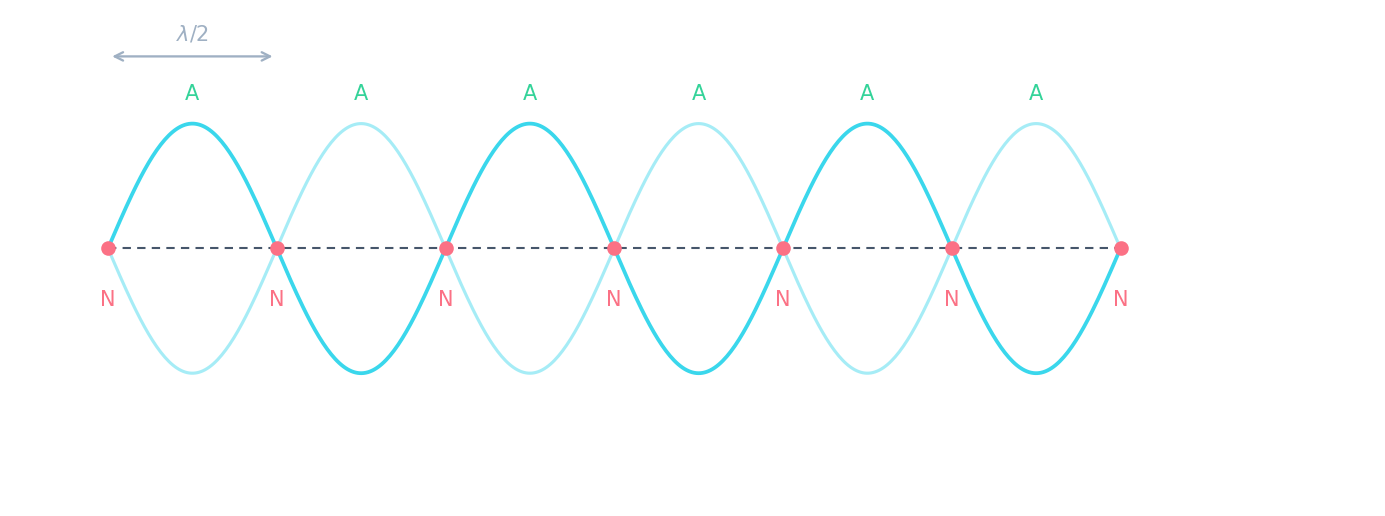
節と反転節
- 節は絶対に動かない(波が常に打ち消し合うため)、反転節は最大の振幅を持つ。
- 隣り合う節の間隔は $\dfrac{\lambda}{2}$ 、節と次の反転節の間隔は $\dfrac{\lambda}{4}$ である。

完全に逆位相で到達した2つの波がゼロに干渉する(破壊的干渉)
A point on a stationary wave that is always at zero displacement is called a ____.
難易度 1/5 · 100 コイン + 今日初回完了時に小ボーナス付与
At a node the two waves always cancel. Halfway between nodes is an antinode (biggest swing).
Neighbouring nodes on a stationary wave are $0.30\ \text{m}$ apart. What is the wavelength?
難易度 2/5 · 140 コイン + 今日初回完了時に小ボーナス付与
Neighbouring nodes are $\dfrac{\lambda}{2}$ apart, so $\lambda = 2 \times 0.30 = 0.60\ \text{m}$.
What is needed to form a stationary wave? Select all that apply.
難易度 2/5 · 140 コイン + 今日初回完了時に小ボーナス付与
Equal amplitudes give the cleanest nodes, but the marked requirements are same frequency, same speed, opposite directions.
定常波と進行波
- 定常波はエネルギーを伝搬せず、そのパターンが固定されます。
- 進行波は移動しながらエネルギーを伴って伝搬します。
A stationary wave transfers energy along its length.
難易度 1/5 · 100 コイン + 今日初回完了時に小ボーナス付与
No — the pattern stays put and no energy travels along it. A progressive wave is the one that carries energy.
On a stationary wave, adjacent nodes are 0.30 m apart. What is the wavelength, in metres?
難易度 2/5 · 140 コイン + 今日初回完了時に小ボーナス付与
Adjacent nodes are HALF a wavelength apart, so the wavelength is 0.60 m. Taking the node spacing as a full wavelength halves every answer that follows.
Put the comparison of a stationary and a progressive wave in order, stationary first.
難易度 3/5 · 200 コイン + 今日初回完了時に小ボーナス付与
Those three contrasts are what a compare question is marked on, and the phase one is the one most often left out.
管と弦
- 閉端は節、開端は腹です。
- 閉管の基本音: $L = \dfrac{\lambda}{4}$。両端開放: $L = \dfrac{\lambda}{2}$。節間隔を測定 → $\lambda$、次に $v = f\lambda$ を求める。
In a pipe closed at one end, the fundamental fits a length of:
難易度 1/5 · 100 コイン + 今日初回完了時に小ボーナス付与
A node at the closed end and an antinode at the open end is a quarter of a wave, so $L = \dfrac{\lambda}{4}$.
見落としやすいポイント
- 重畳の原理は変位を加算するものであり、振幅や強度ではありません。結果として得られる強度は、合成振幅の二乗に比例します。
- 隣り合う節の間隔は波長半分であり、節から次の腹までの距離は四分の一です。
- 定常波は、同じ周波数と速さで逆向きに進行する2つの進行波によって生じます。全てを明記すること。
- 定常波では振幅が位置によって変化し、2つの節の間のすべての点は同位相です。進行波では振幅はどこでも同じで、位相は一定の割合で変化します。
- 節とは、常に変位がゼロの点であり、一時的に波形が平坦になる点ではありません。
理解できましたか
- 重畳: 重なった変位は加算(建設的干渉)または打ち消し合い( destructive 的干渉)する。
- 定常波には固定された節と腹があり、それらは $\dfrac{\lambda}{2}$ だけ離れています。
- 進行波とは異なり、エネルギーをほとんど伝搬しません。