| English | 意味 |
|---|---|
| electromagnetic waves/ɪˌlektrəʊməɡˈnetɪk weɪvz/ | 電磁波 |
| spectrum/ˈspektrəm/ | スペクトル |
| vacuum/ˈvækjuːm/ | 真空 |
| microwave/ˈmaɪkrəʊweɪv/ | マイクロ波 |
| infrared/ˌɪnfrəˈred/ | 赤外線 |
| ultraviolet/ˌʊltrəˈvaɪəlɪt/ | 紫外線 |
| gamma/ˈɡæmə/ | ガンマ線 |
すべて同じファミリー
- ラジオ、火の熱、日焼け、病院のX線検査——これらはすべて電磁波である。
- 異なるのは波長のみ(したがって周波数)。
- 1つのファミリー、1つのスペクトル。
共通点
- 全ての電磁波は横波である。
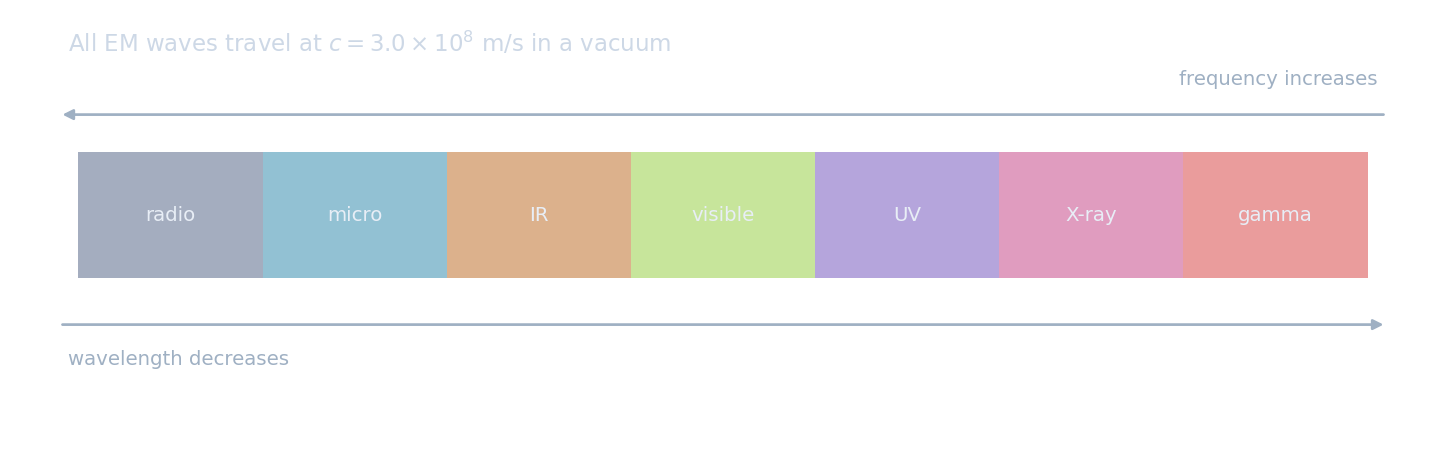
- 真空中では全て同じ速さ $c = 3.00 \times 10^{8}\ \dfrac{\text{m}}{\text{s}}$ で伝搬する。
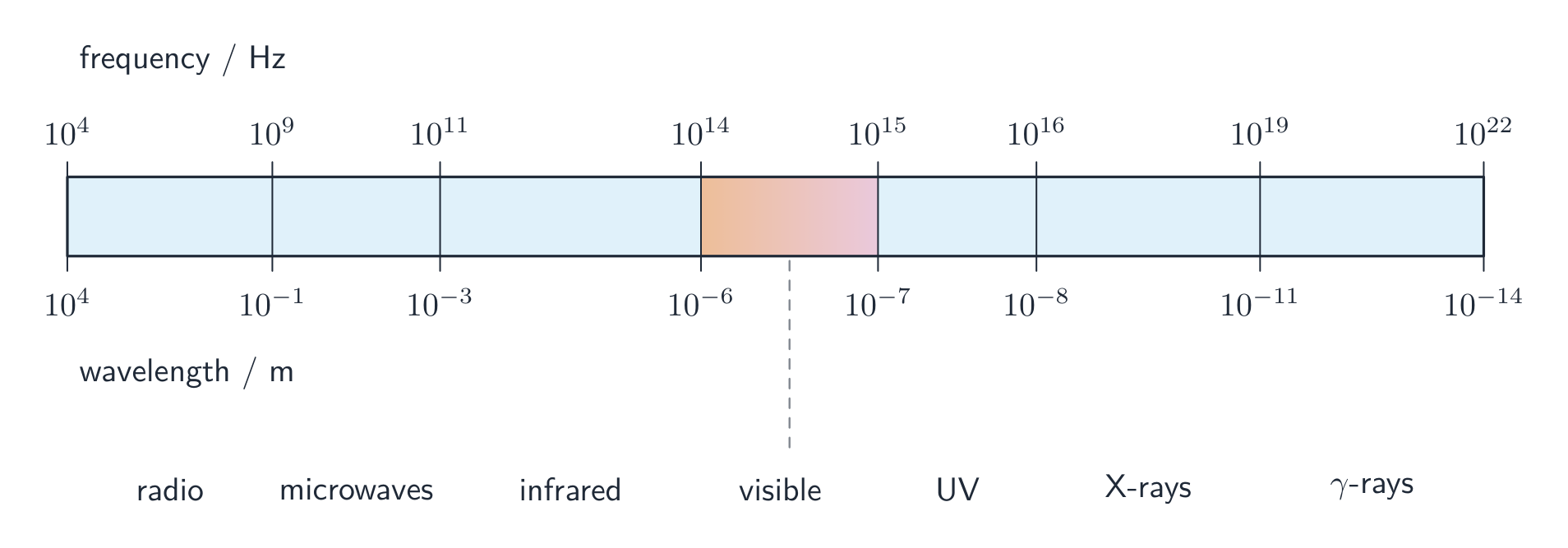
電磁波スペクトル
Slide across the spectrum
Radio waves, visible light and gamma rays are all the same wave — only the wavelength changes, and with it the frequency, photon energy and everyday use.
All electromagnetic waves are transverse.
難易度 1/5 · 100 コイン + 今日初回完了時に小ボーナス付与
Yes — every EM wave is transverse, and all travel at $c$ in a vacuum.
In a vacuum, which EM wave travels the fastest?
難易度 1/5 · 100 コイン + 今日初回完了時に小ボーナス付与
In a vacuum every EM wave travels at $c = 3.0 \times 10^{8}\ \dfrac{\text{m}}{\text{s}}$.
What do all electromagnetic waves share? Select all that apply.
難易度 2/5 · 140 コイン + 今日初回完了時に小ボーナス付与
Needing no medium is exactly what lets sunlight cross space. Being transverse is what makes every one of them polarisable, unlike sound.
スペクトルの順序
- 長い波長から短い波長へ:ラジオ・マイクロ波・赤外線・可視光・紫外線・X線・ガンマ線。
- 波長が短くなると、周波数は増大する。
Put these in order of increasing frequency (lowest first).
難易度 3/5 · 200 コイン + 今日初回完了時に小ボーナス付与
Frequency rises as wavelength falls: radio (longest) → microwave → visible → X-ray (much shorter).
Put the electromagnetic spectrum in order of increasing wavelength.
難易度 3/5 · 200 コイン + 今日初回完了時に小ボーナス付与
Increasing wavelength is decreasing frequency and decreasing photon energy, so the same list read backwards answers all three questions.
波長と関係式
- 桁のオーダーを暗記する:ラジオ $> 10^{-1}\ \text{m}$;マイクロ波 $10^{-1}$ から $10^{-3}\ \text{m}$;赤外線 $10^{-3}$ から $7 \times 10^{-7}\ \text{m}$;可視光 $400$–$700\ \text{nm}$;紫外線 $4 \times 10^{-7}$ から $10^{-8}\ \text{m}$;X線 $10^{-8}$ から $10^{-13}\ \text{m}$;ガンマ線 および $10^{-10}\ \text{m}$ より小さい。
- 可視光は狭い帯域 $400$–$700\ \text{nm}$ —— 短い端が紫、長い端が赤。
- $\lambda$ と $f$ を $c = f\lambda$ を使って切り替える。
Visible light has wavelengths of roughly:
難易度 1/5 · 100 コイン + 今日初回完了時に小ボーナス付与
About $400\ \text{nm}$ (violet) to $700\ \text{nm}$ (red) — a tiny slice of the whole spectrum.
A radio wave has wavelength $3.0\ \text{m}$. What is its frequency, in MHz? (Use $c = 3.0 \times 10^{8}\ \dfrac{\text{m}}{\text{s}}$.)
難易度 2/5 · 140 コイン + 今日初回完了時に小ボーナス付与
$f = \dfrac{c}{\lambda} = \dfrac{3.0 \times 10^{8}}{3.0} = 1.0 \times 10^{8}\ \text{Hz} = 100\ \text{MHz}$.
領域の名付け
- 試験問題では波長または周波数が与えられ、どの領域かを問われる。必要に応じて波長に変換し、梯子在配置せよ。
- $400\ \text{nm}$ の直下は紫外線、$700\ \text{nm}$ の直上は赤外線。
- X線とガンマ線は波長が重なる——発生源によって区別される(X線は電子、ガンマ線は原子核)。したがって重なり部分ではどちらの名前も正解になり得る。
An electromagnetic wave has a wavelength of 500 nm. What is its frequency, in units of 1e14 Hz?
難易度 2/5 · 140 コイン + 今日初回完了時に小ボーナス付与
f = c/lambda = 3.00e8/5.00e-7 = 6.0e14 Hz, in the green of the visible band. Convert nm to m before dividing.
計算例:どの領域か、そして周期は?
(a) レーザーは波長 $8.1 \times 10^{-8}\ \text{m}$ の波を放射する。(b) サテライト通信は $12\ \text{GHz}$ を使用する。それぞれの領域を名付け、サテライト波の周期をピコ秒単位で見つけよ。
- (a) $8.1 \times 10^{-8}\ \text{m} = 81\ \text{nm}$ は $400\ \text{nm}$ より小さく $10^{-8}\ \text{m}$ より大きいので:紫外線。周波数は $f = \dfrac{c}{\lambda} = \dfrac{3.00 \times 10^{8}}{8.1 \times 10^{-8}} = 3.7 \times 10^{15}\ \text{Hz}$。
- (b) $\lambda = \dfrac{c}{f} = \dfrac{3.00 \times 10^{8}}{12 \times 10^{9}} = 0.025\ \text{m}$ :数センチメートルなのでマイクロ波。
- 周期: $T = \dfrac{1}{f} = \dfrac{1}{12 \times 10^{9}} = 8.3 \times 10^{-11}\ \text{s} = 83\ \text{ps}$ 。
- 確認: $1\ \text{ps} = 10^{-12}\ \text{s}$ なので、$10^{-12}$ で割って変換する——答えが $0.083\ \text{ps}$ ならば接頭辞の適用ミスである。
An electromagnetic wave has a wavelength of $5.0 \times 10^{-9}\ \text{m}$. Which region of the spectrum is it in?
難易度 1/5 · 100 コイン + 今日初回完了時に小ボーナス付与
$5.0 \times 10^{-9}\ \text{m} = 5\ \text{nm}$ — shorter than $10^{-8}\ \text{m}$ (the bottom of the ultraviolet range), so X-rays.
Microwaves in a satellite link have a frequency of $12\ \text{GHz}$. What is their period, in ps?
難易度 2/5 · 140 コイン + 今日初回完了時に小ボーナス付与
$T = \dfrac{1}{f} = \dfrac{1}{12 \times 10^{9}} = 8.3 \times 10^{-11}\ \text{s}$, and $1\ \text{ps} = 10^{-12}\ \text{s}$, so $T = 83\ \text{ps}$.
$c = 3.00 \times 10^{8}\ \dfrac{\text{m}}{\text{s}}$ は真空中での速さ(空気中ではほぼ同じ)。ガラスや水中では波は遅くなり波長は短くなるが、周波数は変わらない——周波数は波源によって固定される。また、スペクトルの周波数順は波長順の逆である。
When light passes from air into glass, its speed and wavelength both decrease but its ____ does not change.
難易度 1/5 · 100 コイン + 今日初回完了時に小ボーナス付与
Frequency is set by the source. Since $v = f\lambda$, a smaller $v$ with the same $f$ means a smaller $\lambda$.
用途で識別する
- ラジオ: 放送。マイクロ波: 携帯電話、卫星通信、オーブン。赤外線: リモコン、熱成像、暖房。
- 可視光: 視覚、ファイバー光学信号。紫外線: フォスフォレスcence、殺菌、日焼け。
- X線: 医療画像。ガンマ線: 機器の殺菌、がん治療。
理解できましたか
- 全ての電磁波は横波であり、真空中で $c = 3.0 \times 10^{8}\ \dfrac{\text{m}}{\text{s}}$ で伝搬する
- 波長順:ラジオ → マイクロ波 → 赤外線 → 可視光 → 紫外線 → X線 → ガンマ線(周波数は逆)
- 可視光は $400$–$700\ \text{nm}$;$c = f\lambda$ と $T = \dfrac{1}{f}$ を用いて領域を名付ける