| English | 意味 |
|---|---|
| transverse/trænsˈvɜːs/ | 横波 |
| longitudinal/ˌlɒŋɡɪˈtjuːdɪnl/ | 縦波 |
| perpendicular/ˌpɜːpənˈdɪkjʊlə/ | 垂直 |
| electromagnetic waves/ɪˌlektrəʊməɡˈnetɪk weɪvz/ | 電磁波 |
| compressions/kəmˈpreʃnz/ | 圧縮部 |
| rarefactions/ˌreərɪˈfækʃnz/ | 希薄部 |
| energy transfer/ˈenədʒi ˈtrænsfɜː/ | エネルギー伝達 |
| propagation/ˌprɒpəˈɡeɪʃn/ | 伝播 |
Two ways to make a wave
- Shake a rope up and down — the wiggle runs along it.
- Push and pull a slinky end-on — a squash runs along it instead.
- Both carry energy, but the particles move in different directions.
Transverse 横波 waves
- The particles vibrate perpendicular 垂直 to the direction the energy travels.
- Examples: a wave on a rope, all electromagnetic waves 电磁波, ripples on water.
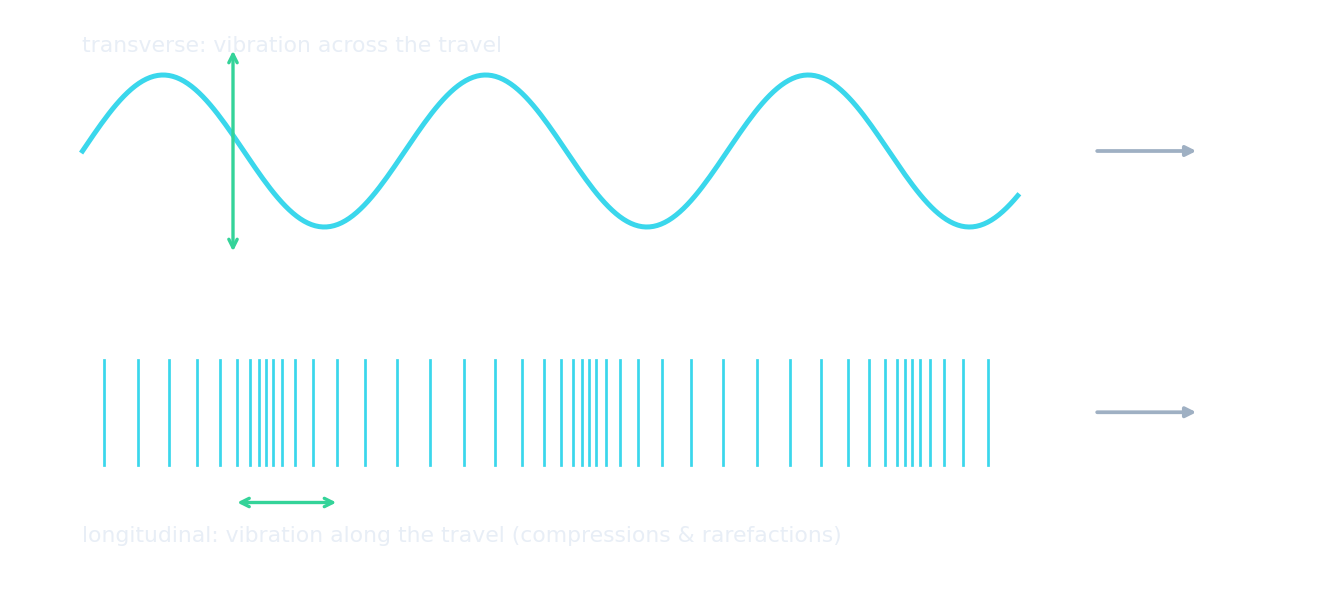

Transverse wave on a rope
横波
y = a sin(bx + c)
波の振幅と波長を変えよ。
横波において、粒子はどのように振動するか:
難易度 1/5 · 100 コイン + 今日初回完了時に小ボーナス付与
横波=エネルギー伝播に対して直角な振動(ロープ波、光、水の波紋)。
Longitudinal 纵波 waves
- The particles vibrate parallel to the direction of travel.
- Made of compressions 压缩 (squashed together) and rarefactions 稀疏 (spread out). Sound is longitudinal.

Longitudinal wave on a slinky spring
空気中を伝わる音は縦波である。
難易度 1/5 · 100 コイン + 今日初回完了時に小ボーナス付与
はい——空気粒子は進行方向に沿って往復振動し、圧縮部と希薄部を作る。
すべて横波である波を選択せよ。
難易度 2/5 · 140 コイン + 今日初回完了時に小ボーナス付与
光、水の波紋、ロープ波は横波である。音とスプリングの端押し波は縦波である。
縦波は圧縮部と____から成る。
難易度 1/5 · 100 コイン + 今日初回完了時に小ボーナス付与
圧縮部は粒子が集まる部分、希薄部は粒子が広がる部分である。
Say it the way the examiner wants
- The mark is for two directions in one sentence: the direction the particles vibrate, and the direction of energy transfer 能量传递 (the direction of propagation 传播).
- Transverse: "the vibrations are perpendicular to the direction of energy transfer."
- Longitudinal: "the vibrations are parallel to the direction of energy transfer."
- "The particles move up and down" scores nothing on its own — up and down relative to what?
各用語を、試験官が採点基準として示す定義と結びつけなさい。
難易度 2/5 · 140 コイン + 今日初回完了時に小ボーナス付与
これら全ては固定された語句に基づいて标记されている。「波の運動」ではなく「エネルギー伝播」が、2つの波型の定義に含まれる語句である。
Reading a longitudinal wave's graph
- The graph plots displacement along the direction of travel: positive means the particle has moved forward, negative means back.
- Two particles exactly one wavelength apart have the same displacement and move the same way.
- A compression sits where the particle behind has moved forward and the one ahead has moved back — the graph crosses zero going downwards.
- Which way is a particle moving now? Look at the graph just behind it (the side the wave comes from): that displacement is where it is heading.
ある縦波が右に進んでいる。その変位-距離グラフにおいて、粒子Pは左から右へ上昇する曲線の一部で変位0にある。今、Pはどの方向へ動いているか?
難易度 1/5 · 100 コイン + 今日初回完了時に小ボーナス付与
Pのすぐ後ろ(左側)を見ると、そこの変位は負であるため、Pは負の変位へ向かっており、後ろ向きに動いている。変位0にある粒子は決して静止しておらず、最も速い状態にある。
Two graphs
- Displacement–distance (a snapshot of the whole wave) → read the wavelength.
- Displacement–time (one point over time) → read the period.
- Both look like sine curves, for either type of wave.
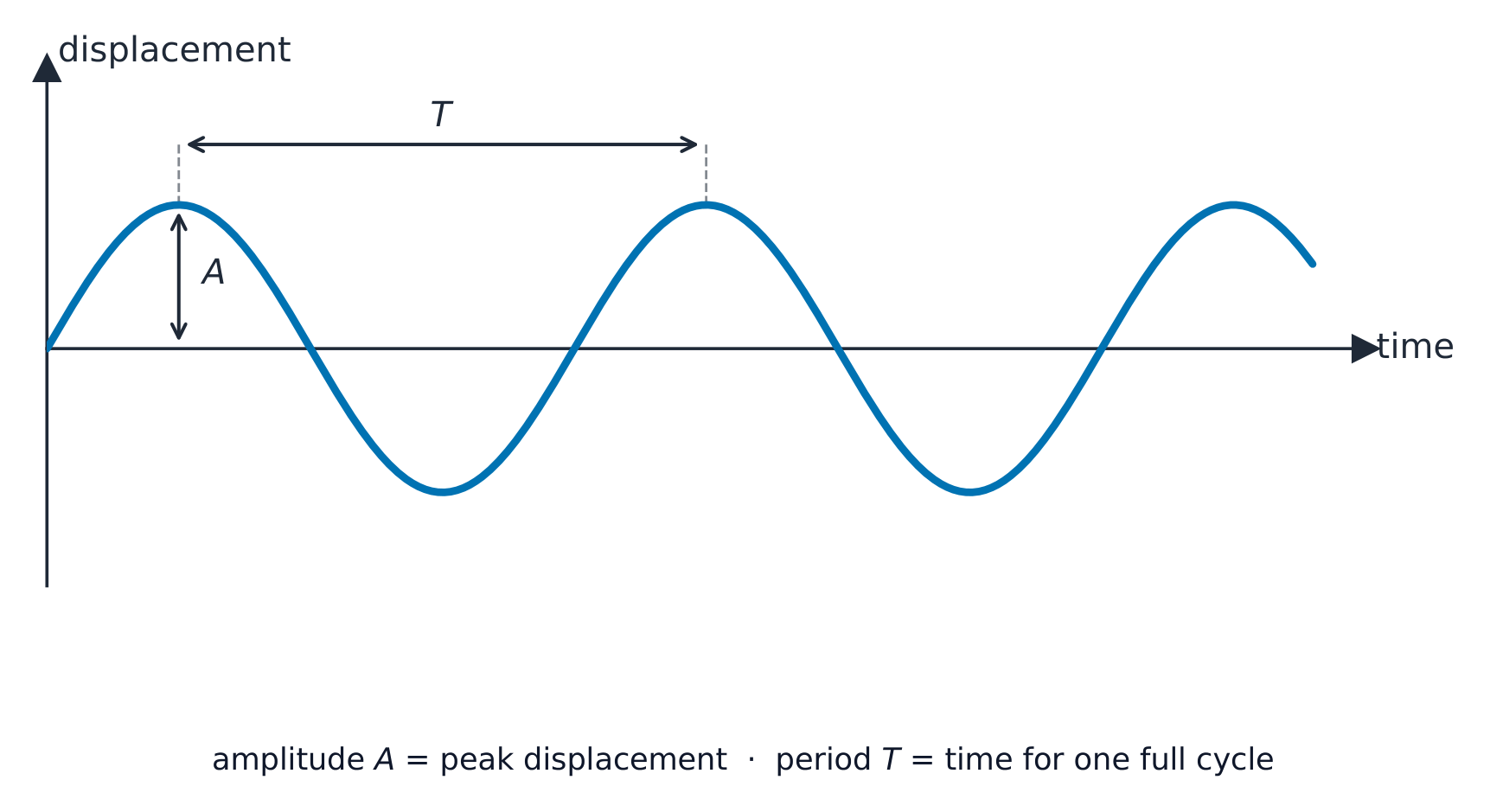
A displacement-time graph shows the wave's amplitude and period
各グラフと、そこから読み取れる情報を対応させよ。
難易度 2/5 · 140 コイン + 今日初回完了時に小ボーナス付与
距離に対するスナップショットから波長が読み取れ、時間をかけて一点を見つめると周期が読み取れる。
変位-距離グラフから読み取ることができるのはどれか?すべて選択せよ。
難易度 2/5 · 140 コイン + 今日初回完了時に小ボーナス付与
周期は変位-TIME(時間)グラフから得られる。時間グラフから波長を読み取ることは、この分野で最も一般的な誤りの一つである。
波の振幅が倍になりました。強度は何倍になりますか?
難易度 2/5 · 140 コイン + 今日初回完了時に小ボーナス付与
強度は振幅の二乗に比例するため、振幅を二倍にすると強度は四倍になる。また、強度とは進行方向に垂直な単位面積あたりの電力のことである。
Worked example: a sound wave on a graph
A displacement–distance graph of a sound wave (travelling to the right) shows particles X and Y $1.5$ wavelengths apart, separated by $0.24\ \text{m}$. The frequency is $2.0\ \text{kHz}$. Particle Z sits at zero displacement on a part of the graph that falls from left to right.
- Wavelength: $1.5\lambda = 0.24$, so $\lambda = 0.16\ \text{m}$.
- Speed: $v = f\lambda = 2000 \times 0.16 = 320\ \dfrac{\text{m}}{\text{s}}$.
- Z now: just behind Z (to its left) the displacement is positive, so Z is moving forward, in the direction of travel.
- Z a quarter of a period later: the whole pattern has moved on by $\dfrac{\lambda}{4}$, so Z takes the displacement that was $\dfrac{\lambda}{4}$ behind it — a crest, $+A$. Sketch the new graph as the old one shifted right by $\dfrac{\lambda}{4}$.
- Check: a particle at zero displacement is passing through its rest position, which is where it moves fastest — so it makes sense that it reaches maximum displacement a quarter period later.
変位-距離グラフにおいて、2波長ちょうど離れている2つの粒子は$0.68\ \text{m}$で隔てられている。この波の周波数が$1.0\ \text{kHz}$である。速さはいくらかm/sで表すか?
難易度 2/5 · 140 コイン + 今日初回完了時に小ボーナス付与
$2\lambda = 0.68$、つまり$\lambda = 0.34\ \text{m}$と$v = f\lambda = 1000 \times 0.34 = 340\ \dfrac{\text{m}}{\text{s}}$——空気中の音速である。
The displacement graph of a longitudinal wave looks exactly like a transverse wave, but the particles are not moving up and down. The vertical axis is displacement along the line of travel. Say "forward and back", and remember that the wave travels while the particles only oscillate about fixed positions.
You've got it
- transverse: vibration perpendicular to the energy transfer (rope, light, ripples)
- longitudinal: vibration parallel to the energy transfer — compressions & rarefactions (sound)
- on a longitudinal wave's graph, positive = forward; look just behind a particle to see where it is going
- displacement–distance shows $\lambda$; displacement–time shows $T$