| English | 意味 |
|---|---|
| Cartesian/kɑːˈtiːzɪən/ | デカルト |
| polar coordinates/ˈpəʊlə kəʊˈɔːdɪnəts/ | 極座標 |
| rotational symmetry/rəʊˈteɪʃənl ˈsɪmətri/ | 回転対称 |
| cardioid/ˈkɑːdɪəʊɪd/ | 心形線 |
| sector/ˈsektə/ | 扇形 |
The coordinate system that simplifies circles
- Describing a spiral or a circle in Cartesian 笛卡尔 coordinates requires messy equations. In polar coordinates 极坐标, a circle is just $r = \text{constant}$.
- Polar coordinates are natural for anything with rotational symmetry 旋转对称 — from planetary orbits to radar screens.
Polar coordinates
- Polar coordinates give a point by distance $r$ from the origin and angle $\theta$.
- Links to Cartesian:
Worked example. The point $(r, \theta) = (5, 60°)$ in Cartesian: $x = 5\cos 60° = 2.5$, $y = 5\sin 60° = 4.33$. So the point is $(2.5, 4.33)$.

Polar coordinates $(r,\theta)$ convert to Cartesian by $x=r\cos\theta$ and $y=r\sin\theta$

A spiral staircase: spirals are described naturally in polar coordinates (r, theta)
極座標
r = f(θ)
極形式では点は (r, θ) で表される。美しい曲線——ローゼン、カディオイド、螺旋——は r = f(θ) から生まれる。
極座標における x 座標は次で与えられる:
難易度 1/5 · 100 コイン + 今日初回完了時に小ボーナス付与
x = r cos θ および y = r sin θ。
(r, θ) = (5, 60°) を直交座標に変換せよ。x = r cos 60° は?
難易度 2/5 · 140 コイン + 今日初回完了時に小ボーナス付与
x = 5 cos 60° = 5 × 0.5 = 2.5。
直交座標上の点 (3, 4) について、r² = x² + y²。r² を求めよ。
難易度 2/5 · 140 コイン + 今日初回完了時に小ボーナス付与
r² = 3² + 4² = 9 + 16 = 25.
Polar curves
- Common polar curves:
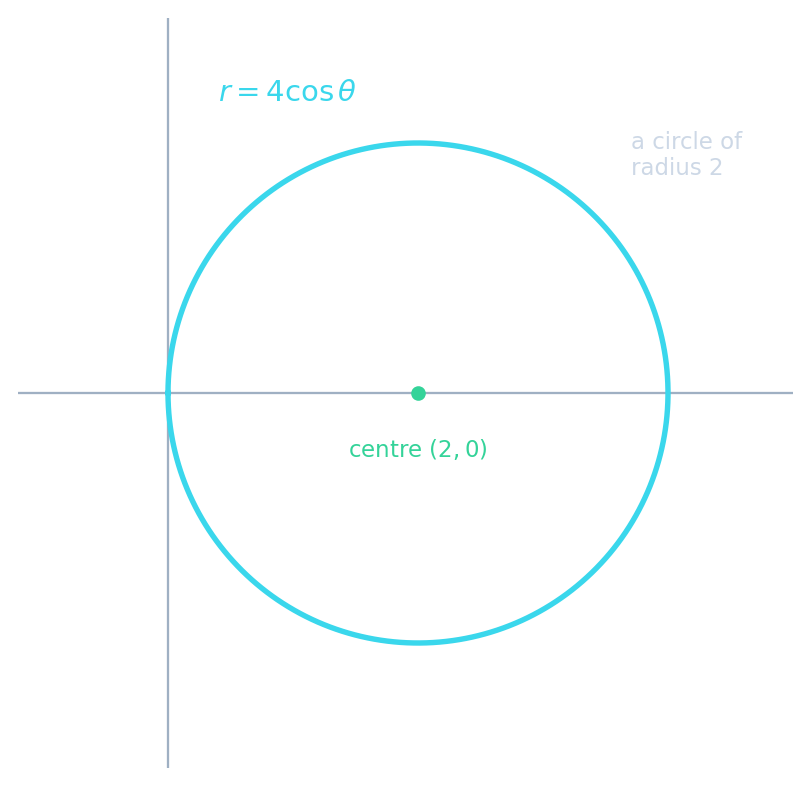
r = 4cos θ is a circle of radius 2 centred at (2, 0) — polar form makes it a one-line equation.
- $r = a$ — a circle of radius $a$ centred at the origin.
- $r = a\cos\theta$ — a circle of radius $\dfrac{a}{2}$ centred at $\left(\dfrac{a}{2}, 0\right)$.
- $r = a(1 + \cos\theta)$ — a cardioid 心脏线 (heart shape).
極曲線 r = 4cos θ は円である。その半径は?
難易度 2/5 · 140 コイン + 今日初回完了時に小ボーナス付与
r = 4cos θ は x² + y² = 4x すなわち (x−2)² + y² = 4 を与え、半径 2 の円である。
極曲線 r = a(1 + cos θ) は次と呼ばれます:
難易度 1/5 · 100 コイン + 今日初回完了時に小ボーナス付与
r = a(1 + cos θ) は心臓形をした曲線で、カディオイドと呼ばれる。
Polar area
- Sector 扇形 area: $\text{area} = \tfrac12\displaystyle\int_{\alpha}^{\beta} r^2\,d\theta$.
Don't forget the $\dfrac{1}{2}$. The polar area formula has a factor of $\dfrac{1}{2}$ that's easy to miss. It comes from the area of a thin triangular sector: $\dfrac{1}{2}r^2\,d\theta$.

A cardioid r = 1 + cos theta, a curve sketched directly in polar form
極扇形の面積は ½∫r² dθ である。
難易度 1/5 · 100 コイン + 今日初回完了時に小ボーナス付与
これは標準的な極面積の公式である。
Converting curves
- Example: $r = 4\cos\theta$ → multiply by $r$: $r^2 = 4r\cos\theta$ → $x^2 + y^2 = 4x$ → $(x-2)^2 + y^2 = 4$, a circle radius $2$.
You've got it
- $x = r\cos\theta$, $y = r\sin\theta$, $r^2 = x^2 + y^2$
- polar sector area $= \tfrac12\int r^2\,d\theta$
- $r = 4\cos\theta$ is a circle of radius 2 centred at $(2, 0)$