| English | 意味 |
|---|---|
| summation/sʌˈmeɪʃn/ | 和 |
| method of differences/ˈmeθəd ɒv ˈdɪfrənsɪz/ | 差分法 |
| telescope/ˈtelɪskəʊp/ | テレスコーピング |
| converge/kənˈvɜːdʒ/ | 収束する |
| sum to infinity/sʌm tʊ ɪnˈfɪnɪti/ | 無限級数の和 |
| partial fractions/ˈpɑːʃl ˈfrækʃnz/ | 部分分数 |
The sum that Gauss solved at age 10
- Young Gauss's teacher set the class the task of adding $1 + 2 + 3 + \cdots + 100$, expecting an hour's work. Gauss saw the pattern instantly: pair the first and last ($1 + 100 = 101$), the second and second-to-last ($2 + 99 = 101$), and so on — 50 pairs of 101 = 5050.
- Summation 求和 formulas turn long additions into simple algebra.
Standard summation results
Worked example. $\sum_{r=1}^{10} r^2 = \dfrac{10 \times 11 \times 21}{6} = \dfrac{2310}{6} = 385$.
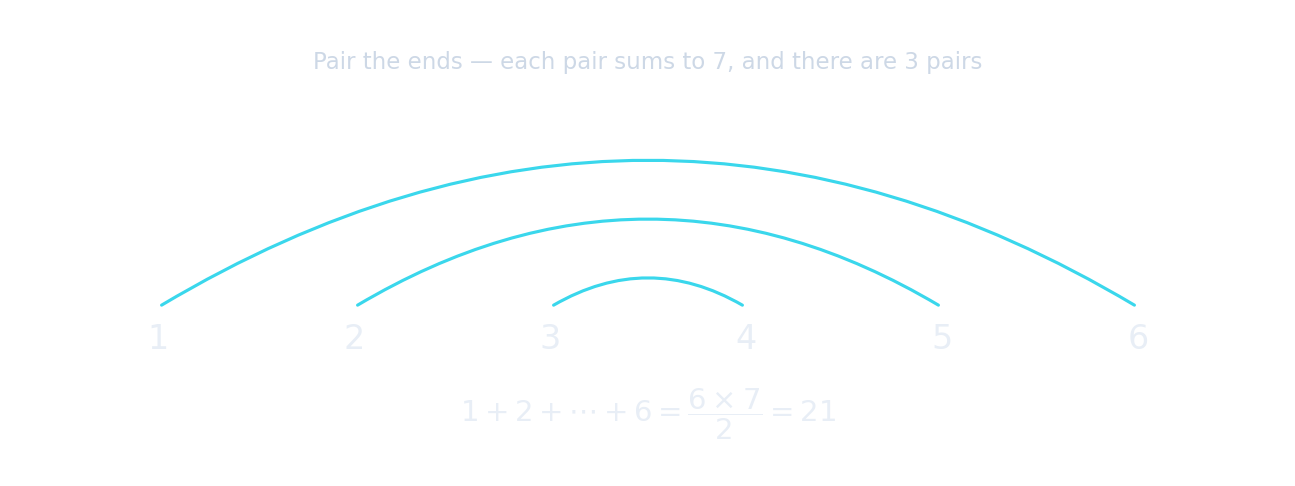
Summing 1 to n by pairing the ends: the total is n(n+1)/2
級数の和
Sₙ = Σ uₖ
項を一つずつ足していく——部分和が極限に向かって上昇する。
Σr = ½n(n+1) を用い、最初の5個の整数の和を求めよ。
難易度 2/5 · 140 コイン + 今日初回完了時に小ボーナス付与
½ × 5 × 6 = 15 (= 1+2+3+4+5).
Σr² = (1/6)n(n+1)(2n+1) を用い、最初の3個の平方数の和を求めよ。
難易度 2/5 · 140 コイン + 今日初回完了時に小ボーナス付与
(1/6)(3)(4)(7) = 84/6 = 14 (= 1+4+9).
Σr³ = ¼n²(n+1)² を用い、最初の3個の立方数の和を求めよ。
難易度 2/5 · 140 コイン + 今日初回完了時に小ボーナス付与
¼ × 9 × 16 = 36 (= 1+8+27)。補足:36 = 6² = (1+2+3)²。
標準結果を完成させよ:Σr (from 1 to n) = ______ n(n+1)。
難易度 1/5 · 100 コイン + 今日初回完了時に小ボーナス付与
初めから n までの整数の和は ½n(n+1) である。
Splitting sums
- Split a sum into standard pieces:
- $\sum_{r=1}^{n}(2r+1) = 2\sum r + \sum 1 = 2 \times \dfrac{n(n+1)}{2} + n = n(n+1) + n = n(n+2)$.
$\sum r^3 = (\sum r)^2$. This beautiful identity means the sum of cubes equals the square of the sum of the first $n$ integers. It's easy to verify: $\sum_{r=1}^{3} r^3 = 1 + 8 + 27 = 36 = 6^2 = (1+2+3)^2$.
Σ(2r+1) (r=1からnまで)= n(n+2)。n=4のとき、和を求める。
難易度 2/5 · 140 コイン + 今日初回完了時に小ボーナス付与
4 × 6 = 24。確認:3+5+7+9 = 24。
The method of differences 差分法
- If each term is $f(r) - f(r+1)$, almost everything cancels (telescopes 裂项相消).
- From the sum to $n$ terms you can see if a series converges 收敛 and find its sum to infinity 无穷和.
差分法において、各項が f(r) − f(r+1) で表される場合、多くの項が相殺(テレスコープ)する。
難易度 1/5 · 100 コイン + 今日初回完了時に小ボーナス付与
連続する項が相殺され、最初の項と最後の項だけが残る。
r=1 から ∞ までの Σ 1/(r(r+1)) は telescoping により 1 − 1/(n+1) に収束する。n→∞ のとき、無限和は?
難易度 2/5 · 140 コイン + 今日初回完了時に小ボーナス付与
n→∞ のとき 1/(n+1)→0 なので、和は 1 に近づく。
Worked example — method of differences
- Find $\sum_{r=1}^{n} \dfrac{1}{r(r+1)}$.
- Partial fractions 部分分式: $\dfrac{1}{r(r+1)} = \dfrac{1}{r} - \dfrac{1}{r+1}$.
- Sum telescopes: $\left(\dfrac{1}{1} - \dfrac{1}{2}\right) + \left(\dfrac{1}{2} - \dfrac{1}{3}\right) + \cdots = 1 - \dfrac{1}{n+1} = \dfrac{n}{n+1}$.
- As $n \to \infty$: sum to infinity $= 1$.
- A series is convergent when its sum to $n$ terms approaches a limit.
You've got it
- $\sum r = \tfrac12 n(n+1)$, $\sum r^2 = \tfrac16 n(n+1)(2n+1)$, $\sum r^3 = \tfrac14 n^2(n+1)^2$
- split sums into standard pieces
- method of differences telescopes $f(r) - f(r+1)$