| English | 意味 |
|---|---|
| machine learning/məˈʃiːn ˈlɜːnɪŋ/ | 機械学習 |
| backpropagation/ˌbækprəpəˈɡeɪʃn/ | 逆伝播 |
| supervised learning/ˈsuːpəvaɪzd ˈlɜːnɪŋ/ | 教師あり学習 |
| classification/ˌklæsɪfɪˈkeɪʃn/ | 分類 |
| unsupervised learning/ʌnˈsuːpəvaɪzd ˈlɜːnɪŋ/ | 教師なし学習 |
| clusters/ˈklʌstəz/ | クラスター |
| reinforcement learning/ˌriːɪnˈfɔːsmənt ˈlɜːnɪŋ/ | 強化学習 |
| agent/ˈeɪdʒənt/ | エージェント |
| reward/rɪˈwɔːd/ | 報酬 |
| policy/ˈpɒlɪsi/ | ポリシー |
| gradient descent/ˈɡreɪdɪənt dɪˈsent/ | 勾配降下法 |
| loss function/lɒs ˈfʌŋkʃn/ | 損失関数 |
| epoch/ˈiːpɒk/ | エポック |
The program that taught itself an opening no human had played
- AlphaGo Zero was given the rules of Go and nothing else. No human games, no opening book, no advice. It played against itself, starting from random moves.
- In three days it surpassed the version that had beaten the world champion. Along the way it rediscovered centuries of human opening theory, and then discarded parts of it as inferior.
- It learned from a single number after each game: won or lost. That is a completely different kind of learning from being shown a million labelled photographs.
- This lesson is the three paradigms of machine learning, what data each needs, and how a network's weights are actually changed by backpropagation 反向传播.
Supervised learning
- Supervised learning 监督学习 trains on data that carries labels: photographs tagged "cat" or "dog", emails marked spam or not, houses with their sale prices.
- The model learns the mapping from input to label, and is then given inputs it has never seen and asked to produce the label.
- It splits into classification 分类, where the output is a category, and regression, where the output is a number.
- Its cost is the labels: someone must produce them, which for a million images is a great deal of human work.

Labelled examples in, a model out, then unlabelled inputs
教師付き学習では、以下を使用します:
難易度 1/5 · 100 コイン + 今日初回完了時に小ボーナス付与
教師付き学習はラベル付きサンプル(例:猫/犬タグ付き画像)を用いて訓練する。
Unsupervised learning
- Unsupervised learning 无监督学习 is given data with no labels and asked to find structure in it.
- The commonest use is clustering: grouping into clusters 聚类 of similar items, such as customers who buy similar things, without anyone deciding in advance what the groups should be.
- That is its strength and its weakness: it can discover a grouping nobody suspected, and it cannot tell you what the grouping means.
教師なし学習は、以下のために使用されます:
難易度 1/5 · 100 コイン + 今日初回完了時に小ボーナス付与
ラベルがない場合、教師なし学習はデータ内のパターンやクラスタを発見する。
Reinforcement learning
- Reinforcement learning 强化学习 has an agent 智能体 acting in an environment. Each action changes the state and returns a reward 奖励, which may be zero for a long time.
- The agent learns a policy 策略, a strategy for choosing actions, that maximises its total reward over time. It learns by trial and error, with no labelled examples at all.
- It suits problems that are a sequence of decisions where the right move is only revealed by the eventual outcome: games, robot control, self-driving cars. That is exactly the AlphaGo Zero case.
強化学習において、エージェントは以下によって学習する:
難易度 1/5 · 100 コイン + 今日初回完了時に小ボーナス付与
エージェントは行動を試みて報酬を受け取り、長期的な報酬を最大化するポリシーを学習する。
強化学習において、エージェントは時間を通じて総報酬を最大化する____を学習する。
難易度 1/5 · 100 コイン + 今日初回完了時に小ボーナス付与
報酬による試行錯誤で学習するため、ラベル付きサンプルが一切不要であり、これが意思決定の連続に適している理由である。
Worked example: choose the paradigm
- Ten thousand medical scans, each labelled by a doctor as showing a tumour or not, are used to train a system to flag new scans. Supervised: the data has labels and the task is to learn input to label, specifically a classification.
- A shop wants to know whether its customers fall into natural groups, without deciding the groups in advance. Unsupervised: no labels exist, and the task is to find structure, specifically clustering.
- A robot arm must learn to place components, judged only by whether each attempt succeeded. Reinforcement: an agent, a sequence of actions, and a reward rather than a label.
- Name the paradigm, then justify from the data: labelled, unlabelled, or a reward signal.
AI学習タイプラボ
AIの例を、関連する学習の種類や関心事に基づいて分類してください。
各MLパラダイムとそのデータを対応させてください。
難易度 2/5 · 140 コイン + 今日初回完了時に小ボーナス付与
教師付き=ラベル;教師なし=ラベルなし;強化=報酬フィードバック。
各状況と、そこで必要な機械学習のパラダイムを対応させてください。
難易度 2/5 · 140 コイン + 今日初回完了時に小ボーナス付与
ラベル、ラベルなし、または報酬。パラダイムを決定するのはタスクの難易度ではなく、データである。
Training by backpropagation
- Training means adjusting the weights so the network's outputs match the targets. The method is backpropagation with gradient descent 梯度下降.
- Forward pass: feed an input through the network and get its output. Compute the error using a loss function 损失函数, which measures how far the output is from the target.
- Backward pass: propagate that error backwards through the layers to find each weight's gradient, that is, how much that weight contributed to the error.
- Update: change each weight by a small step against its gradient. The step size is the learning rate.
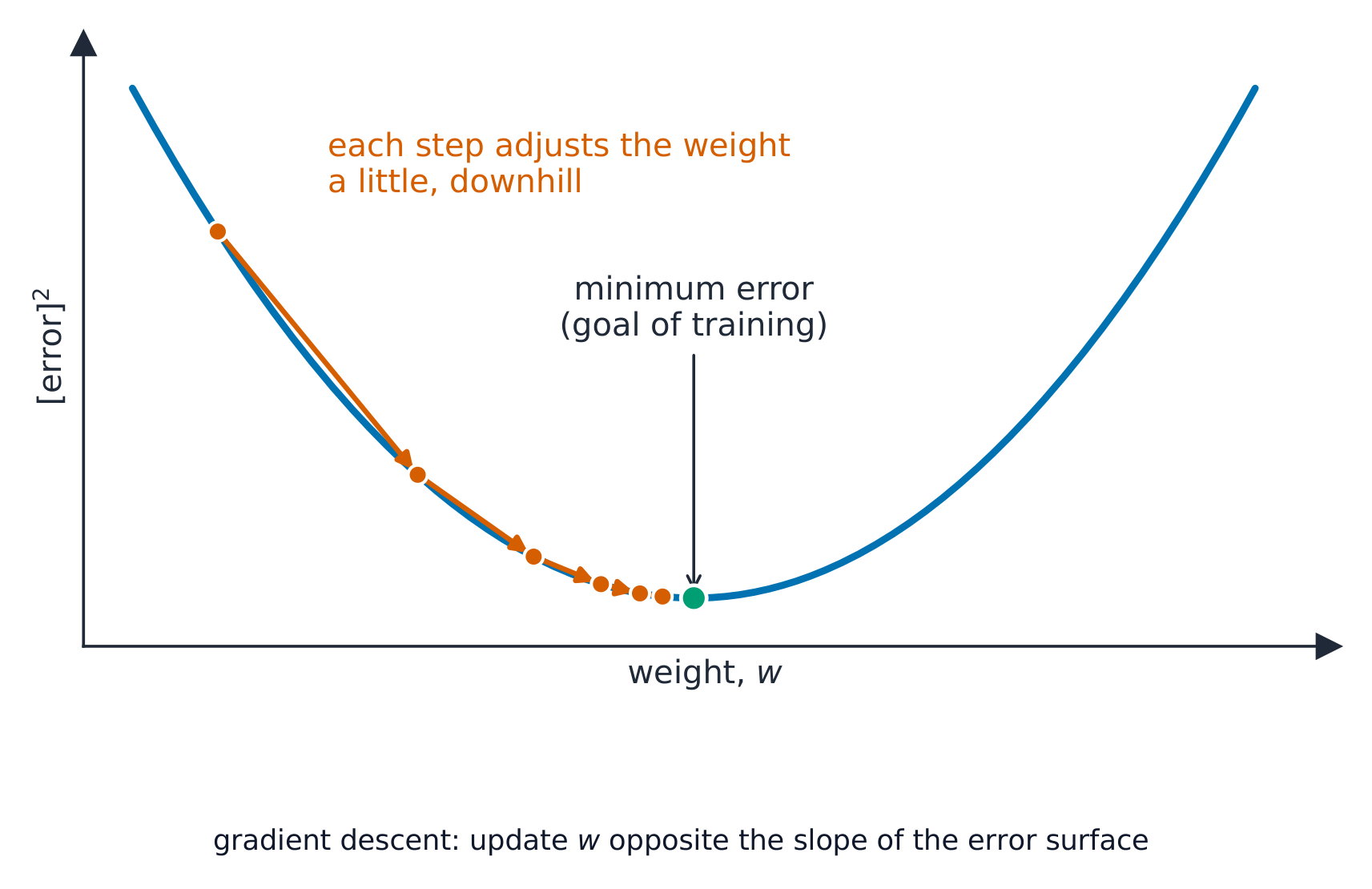
Downhill, one small step at a time
逆伝播法はネットワークを以下のように学習させる:
難易度 1/5 · 100 コイン + 今日初回完了時に小ボーナス付与
誤差が出力からネットワークを通じて逆伝播(連鎖律)され、すべての重みの勾配が見つかり、その後重みは下り坂へ移動する。
1エポック分の逆伝播学習を正しい順序で並べ替えよ。
難易度 3/5 · 200 コイン + 今日初回完了時に小ボーナス付与
順伝播、誤差計算、逆伝播、更新を多数のエポックにわたり繰り返す。誤差が減少しなくなるまで行う。
Epochs, and why the learning rate matters
- One pass through the whole training set is an epoch 训练轮次. Training repeats for many epochs until the error stops falling.
- Too large a learning rate overshoots the minimum and the error jumps about; too small and training takes far longer than it needs to.
- After training, using the model is only a forward pass, which is why a trained network answers instantly even though training took days.
勾配降下法において、学習率は各重みの更新におけるステップの大きさを設定する。大きすぎると最小値を超過し、小さすぎると学習が遅くなる。
難易度 1/5 · 100 コイン + 今日初回完了時に小ボーナス付与
逆伝播法は各重みの勾配を見つけます。学習率は、その勾配に沿って重みがどの程度下るかをスケールします。
学習に関する記述として正しいものはどれか。すべて選択せよ。
難易度 2/5 · 140 コイン + 今日初回完了時に小ボーナス付与
学習率は各重みの更新の大きさである。そのため、学習には数日かかるのに対し、予測はミリ秒で済む。
Marks that slip away
- Justify a paradigm from the data: labelled means supervised, unlabelled means unsupervised, a reward signal means reinforcement.
- Reinforcement learning has no labels. Calling its reward a label is the classic confusion.
- Backpropagation is forward, error, backward, update, repeated. Naming only "it adjusts the weights" is half an answer.
- The learning rate is the size of each step, not the speed of training or the number of epochs.
You've got it
- supervised learns input to label from labelled data, for classification or regression · unsupervised finds structure such as clusters in unlabelled data · reinforcement has an agent learning a policy from rewards by trial and error
- choose the paradigm from what the data provides, not from the task's difficulty
- backpropagation: a forward pass, an error from the loss function, a backward pass giving each weight's gradient, then an update of size set by the learning rate
- training repeats for many epochs; using the trained model is one forward pass