コンテンツへスキップ
英語文法 · B2

物語の時制

  • 1 物語の時制
    1.1

    Simple Past and Past Continuous

    English
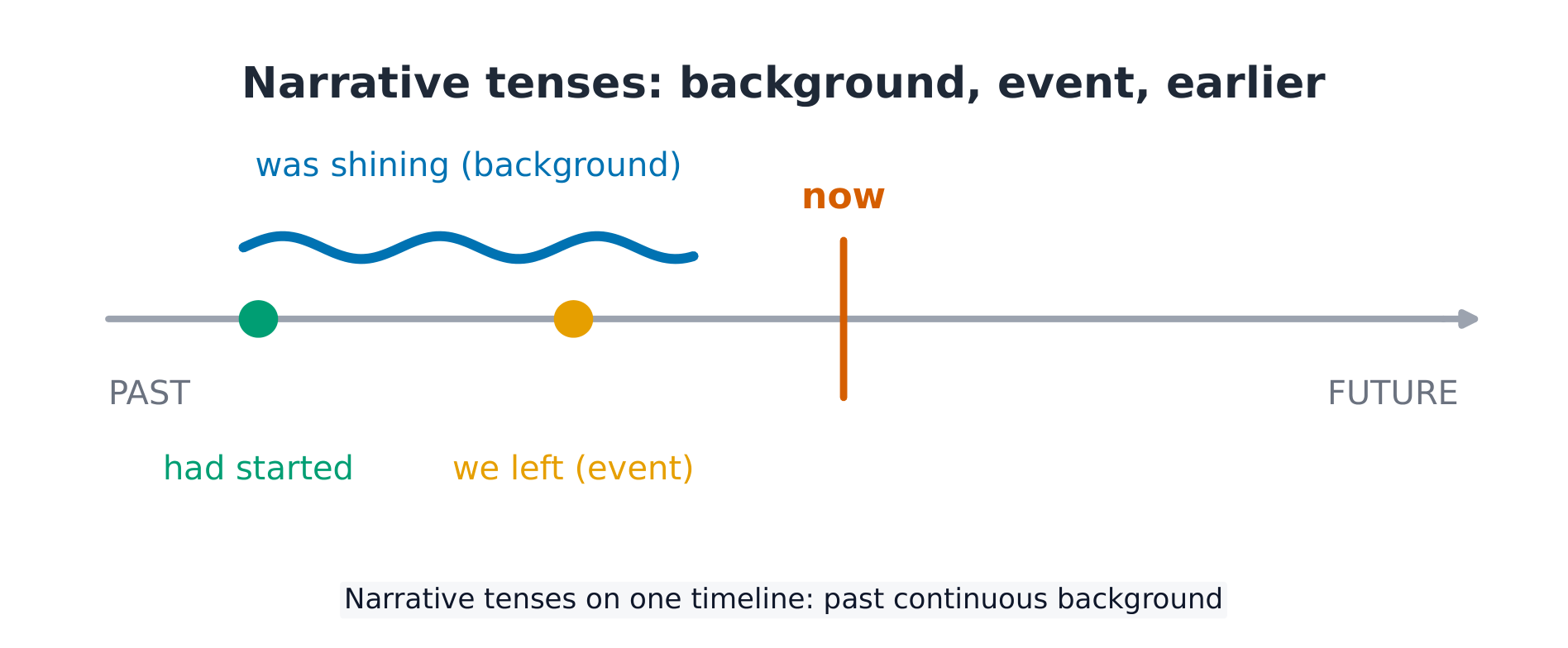
    Narrative tenses: background, event, earlier

    When telling stories, English uses a set of narrative tenses in combination. The most basic two are:

    • Simple Past: The main actions that advance the plot (one after another).
    • Past Continuous: Setting the background, describing what was happening at that time.

    (冠词)The 太阳sun (过去进行)was 照耀shining 当...时when 我们we 出发left.

    We set off while the sun was shining brightly. (Background + main action)

    她She (过去进行)was 做饭cooking 当...时when (冠词)the 电话phone 响了rang.

    Her phone rang while she was cooking.

    Note A long background action uses the past continuous (was cooking); a short action interrupting it uses the simple past (rang).

    1.2

    Past Perfect for the Earlier Past

    English

    To indicate an action that occurred before another past action, use the past perfect (had + past participle).

    当...时When 我们we 到达arrived (冠词), the 电影film (过去完成)had 已经already 开始started.

    By the time we arrived, the film had already started. (Started first, arrived later)

    Combination in Narrative:

    • Earliest → Past Perfect (had started).
    • Later → Simple Past (arrived).
    • Background → Past Continuous (was raining).

    Note These three tenses combined clearly convey the timeline of a story.

    1.3

    Past Perfect Continuous

    English

    The past perfect continuous (had been + V-ing) emphasizes an action that continued up until a specific point in the past.

    她She (过去)was 累tired 因为because 她she (过去完成)had (进行)been 工作working 一整天all day.

    She was tired because she had been working all day.

    Difference from Past Perfect:

    • Past Perfect Continuous: Emphasizes the continuous process / duration (had been working — kept doing it).
    • Past Perfect: Emphasizes completion / result (had finished — got it done).

    Note Stative verbs (know, be) do not take the continuous form: use had known, not ~~had been knowing~~.

    Common Errors

    • ❌ ~~When the phone rang, she cooked dinner.~~ (Meaning: "was cooking") → ✓ …she was cooking dinner. — Using simple past implies she started cooking after the phone rang.
    • ❌ ~~While I walked home, I was meeting a friend.~~ → ✓ While I was walking home, I met a friend. — Long background actions use continuous tense; short actions use simple past. Do not reverse this.
    • ❌ ~~She had finished the report, then she had sent it.~~ → ✓ She finished the report, then sent it. — When narrating in chronological order, simple past is sufficient; past perfect is only used to look back at an earlier event.
    • ❌ ~~It was the first time I saw snow.~~ → ✓ It was the first time I had seen snow. — "First time" in past narration requires past perfect.

すべてのトピック · 英語文法 · B2

ログインまたはアカウント作成

IGCSE, A-Level & AP