Model zarah kinetik
Diperkenalkan| English | Makna |
|---|---|
| particles/ˈpɑːtɪklz/ | partikel |
| kinetic particle model/kɪˈnetɪk ˈpɑːtɪkl ˈmɒdl/ | model partikel kinetik |
| solid/ˈsɒlɪd/ | padat |
| liquid/ˈlɪkwɪd/ | cair |
| gas/ɡæs/ | gas |
| temperature/ˈtemprɪtʃə/ | suhu |
| absolute zero/ˈæbsəluːt ˈzɪərəʊ/ | nol mutlak |
| kelvin/ˈkelvɪn/ | kelvin |
| Brownian motion/ˈbraʊnɪən ˈməʊʃn/ | gerak brown |
Everything is made of particles 粒子
- Look closely enough and all matter is tiny particles that never stop moving.
- This one idea — the kinetic particle model 分子动理论 — explains solids 固体, liquids 液体, gases 气体, heat and pressure.
- Let's see what the particles are doing.
The three states of matter
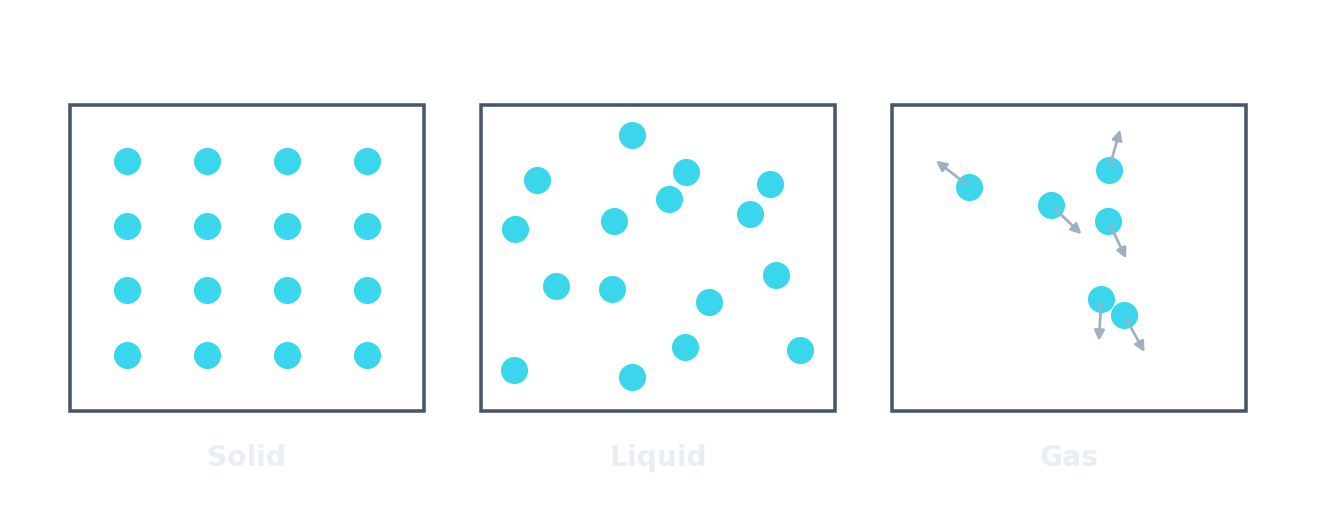
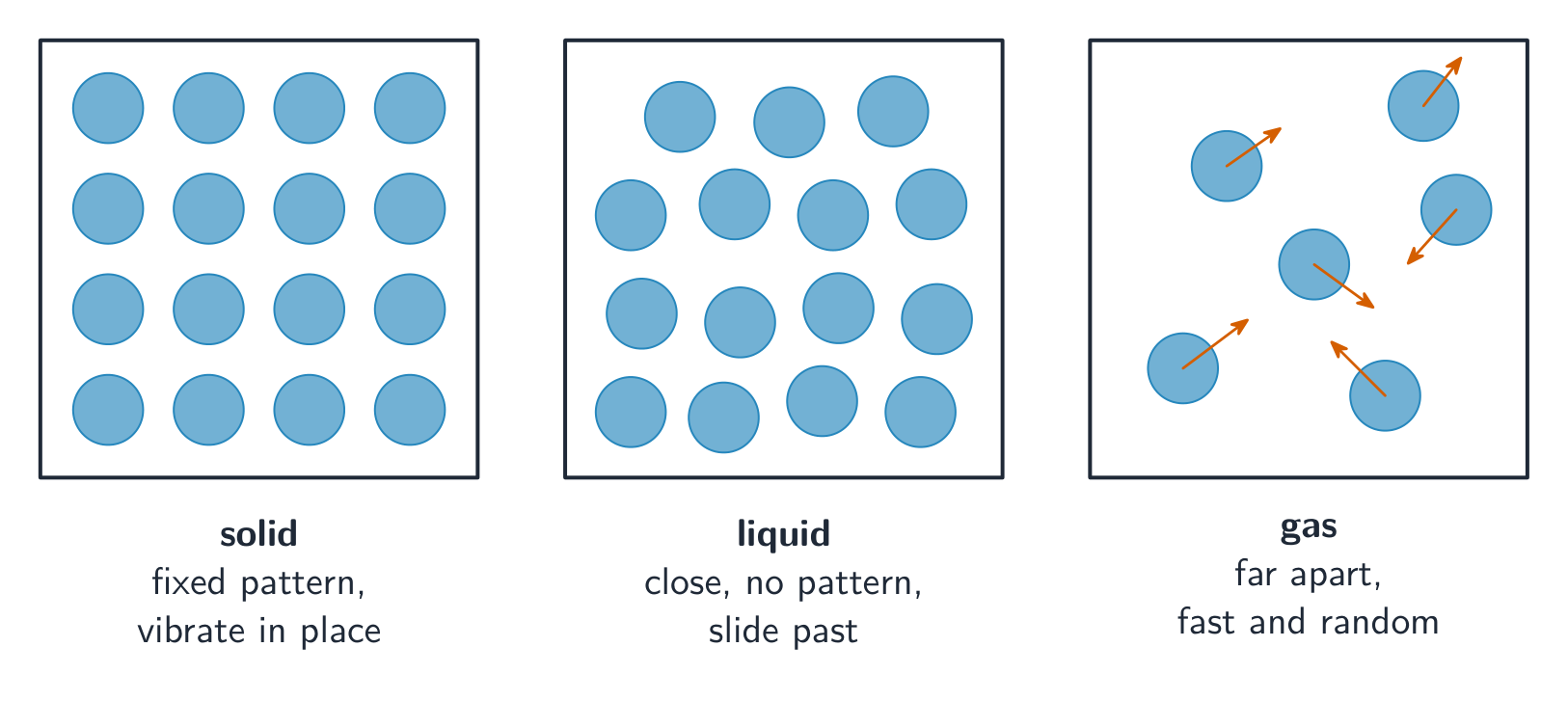
- Solid — particles packed in a regular pattern, only vibrating. Fixed shape and volume.
- Liquid — particles still close but jumbled; they slide past each other. Fixed volume, takes the container's shape.
- Gas — particles far apart, fast and random. Fills the whole container.
Memampatkan gas (Hukum Boyle)
Geserkan piston masuk untuk mengecilkan isipadu. Zarah yang sama dipadatkan ke ruang yang lebih kecil, jadi mereka menampar dinding lebih kerap dan tekanan meningkat — manakala tekanan × isipadu kekal tetap.
Dalam keadaan manakah zarah-zarah itu berjauh, bergerak pantas, dan bergerak secara rawak?
Kesulitan 1/5 · 100 koin + bonus kecil pada penyelesaian pertama hari ini
Zarah gas berada jauh dan bergerak pantas secara rawak, mengisi bekas. Padat hanya bergetar; cecair meluncur melalui satu sama lain.
Temperature 温度 and particle energy
- Heat a substance and its particles move faster — they gain kinetic energy.
- Temperature is a measure of the average kinetic energy of the particles.
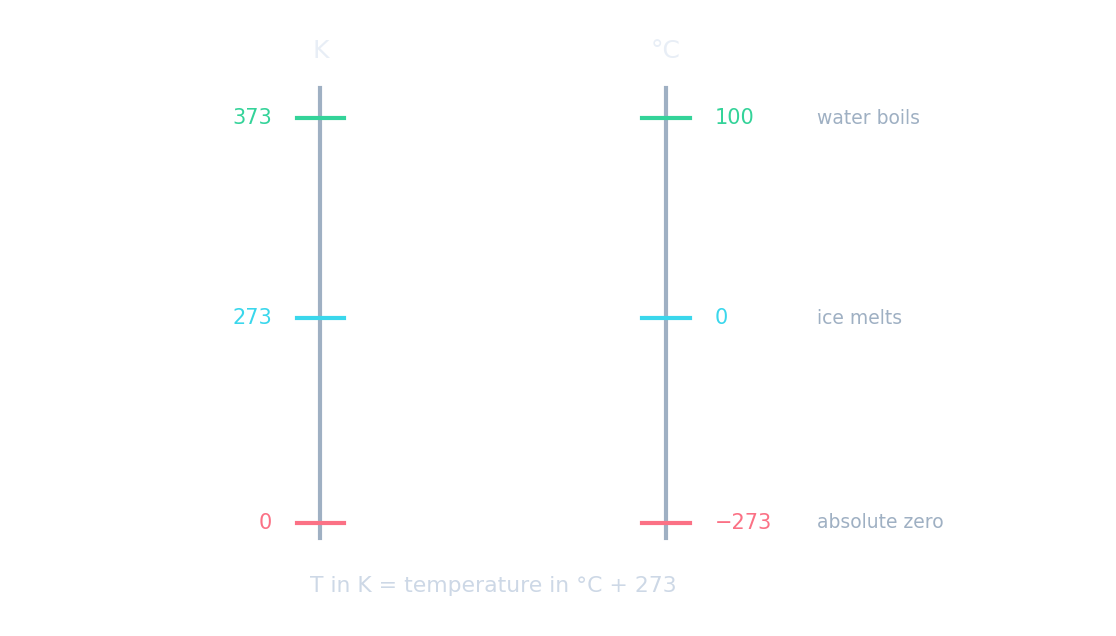
- The lowest possible temperature is absolute zero 绝对零度, $-273\ {}^{\circ}\text{C}$ — particles have the least energy.
The particle model of solids, liquids and gases
Suhu adalah ukuran:
Kesulitan 1/5 · 100 koin + bonus kecil pada penyelesaian pertama hari ini
Lebih panas bermaksud zarah bergerak lebih pantas, jadi suhu mengukur tenaga kinetik purata mereka.
The kelvin 开尔文 scale
- Scientists often measure temperature in kelvin (K), starting from absolute zero.
- To convert:
- So $0\ {}^{\circ}\text{C} = 273\ \text{K}$ and $27\ {}^{\circ}\text{C} = 300\ \text{K}$.
Ubah $27\ {}^{\circ}\text{C}$ ke kelvin.
Kesulitan 2/5 · 140 koin + bonus kecil pada penyelesaian pertama hari ini
$T = \theta + 273 = 27 + 273 = 300\ \text{K}$.
Gas pressure
- Gas particles constantly hit the walls of their container. Each hit is a tiny push.
- The pressure is the total force of these hits on each unit of area.
- Heat the gas (fixed volume) → faster, harder, more frequent hits → higher pressure.
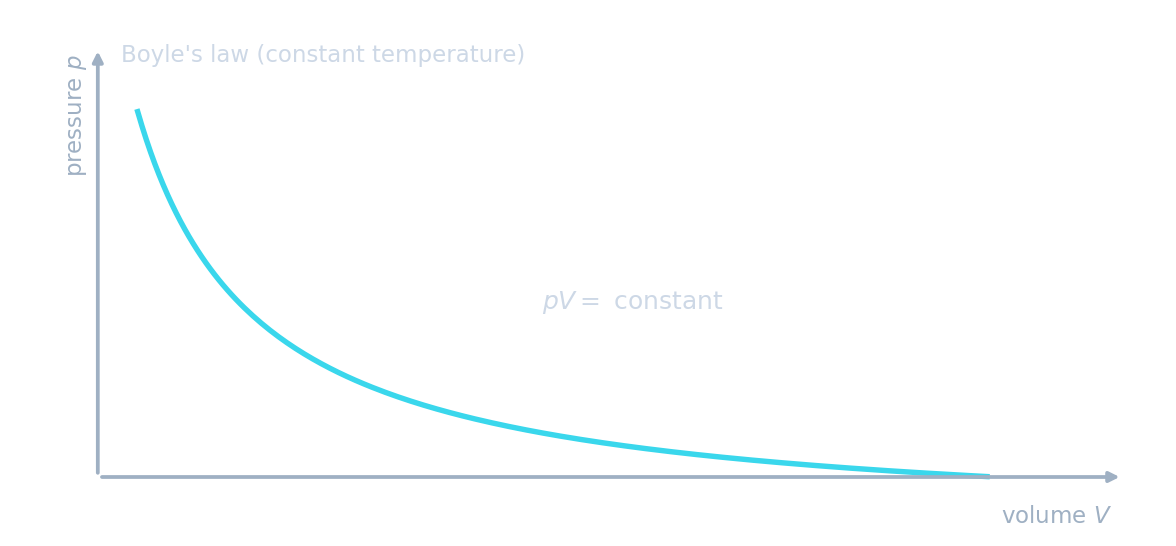
- Squeeze it smaller (fixed temperature) → more hits per second on each area → higher pressure.
- For a fixed mass of gas at constant temperature, $pV = \text{constant}$ (halve the volume → double the pressure).
Gas mempunyai isipadu $200\ \text{cm}^3$ pada $100\ \text{kPa}$. Ia dimampatkan kepada $100\ \text{cm}^3$ pada suhu tetap. Berapakah tekanan baharu, dalam kPa?
Kesulitan 2/5 · 140 koin + bonus kecil pada penyelesaian pertama hari ini
$pV$ kekal: $100 \times 200 = p \times 100$, jadi $p = 200\ \text{kPa}$. Menggandakan isipadu mengalikan dua tekanan.
Memanaskan gas dalam tin kedap berisipadu tetap akan meningkatkan tekanannya.
Kesulitan 1/5 · 100 koin + bonus kecil pada penyelesaian pertama hari ini
Zarah yang lebih panas bergerak lebih pantas dan menampar dinding lebih kuat dan lebih kerap, jadi tekanan meningkat.
Brownian motion 布朗运动
- Under a microscope, smoke specks in air jiggle along jerky, random paths.
- This is Brownian motion: the big specks are knocked about by fast, invisible air particles.
- It is strong evidence that matter really is made of moving particles.
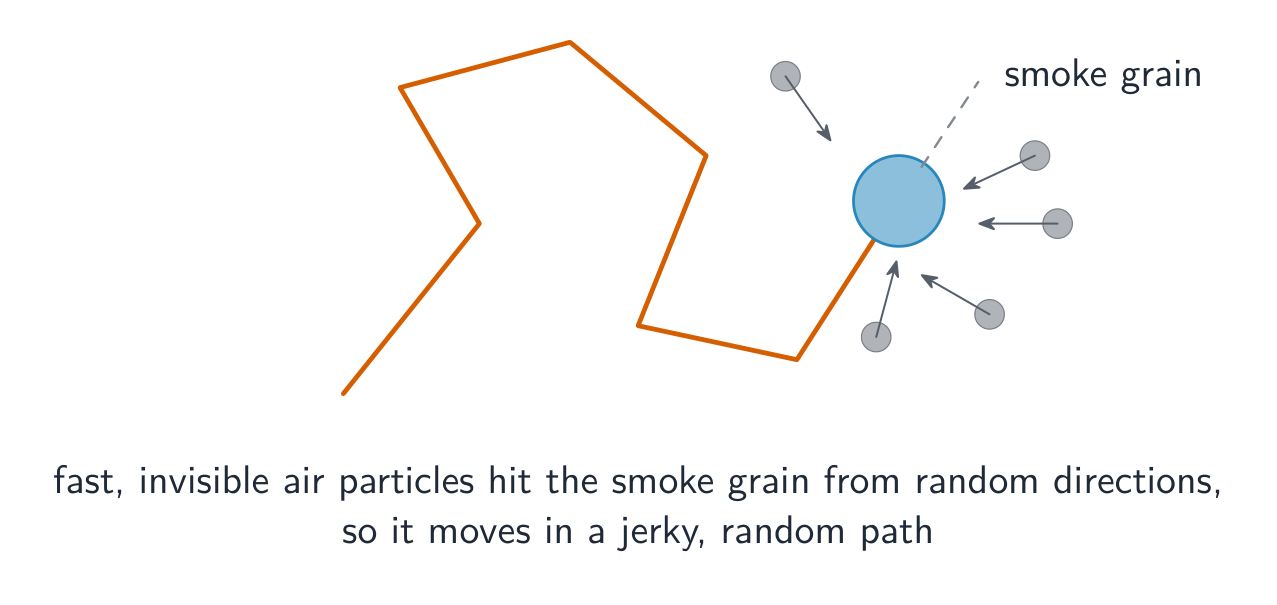
Random hits from fast, invisible air particles push a smoke grain along a jerky, random path
Zarah asap dilihat di bawah mikroskop bergoncang secara rawak. Ini kerana:
Kesulitan 1/5 · 100 koin + bonus kecil pada penyelesaian pertama hari ini
Gerakan Brown: zarah udara kecil yang pantas mengetuk zarah asap yang lebih besar, bukti bagi zarah yang bergerak.
Worked examples
1. A gas at $100\ \text{kPa}$ fills $2.0\ \text{m}^3$. It is squeezed to $0.50\ \text{m}^3$ at constant temperature. $pV$ stays constant: $100 \times 2.0 = p \times 0.50$, so $p = 400\ \text{kPa}$. A quarter of the volume gives four times the pressure.
2. Convert $27\ {}^{\circ}\text{C}$ and $-73\ {}^{\circ}\text{C}$ to kelvin: add 273, giving $300\ \text{K}$ and $200\ \text{K}$.
Change to kelvin only when the formula needs it. A temperature change is the same in °C and K, but $0\ {}^{\circ}\text{C}$ is not zero energy: absolute zero is $-273\ {}^{\circ}\text{C}$. In $pV = \text{constant}$, keep the units of $p$ and $V$ the same on both sides.
Konversi 15 derajat Celcius ke kelvin. Gas pada 80 kPa menempati 60 sentimeter kubik dan ditekan hingga 40 sentimeter kubik pada suhu konstan. Berapa tekanan barunya?
15 ditambah 273 adalah 288. 80 dikali 60 dibagi dengan 40 adalah 120 kilopascal.
Berapa tekanan baru?
Kesulitan 1/5 · 100 koin + bonus kecil pada penyelesaian pertama hari ini
80 kali 1.5 adalah 120 kilopascal.
You've got it
- solid (fixed, vibrating) · liquid (close, sliding) · gas (far apart, fast)
- temperature = average kinetic energy of particles; absolute zero $= -273\ {}^{\circ}\text{C}$
- $T\,(\text{K}) = \theta\,({}^{\circ}\text{C}) + 273$
- gas pressure = particle hits per unit area; at constant temperature $pV = \text{constant}$
Write from the data: find the pressure
- 15 degrees Celsius is converted to kelvin. A gas at 80 kPa occupies 60 cubic centimetres and is squeezed to 40 cubic centimetres at the same temperature.
- Find the kelvin temperature and the new pressure.