Price elasticity of demand (PED)
Diperkenalkan 21:51
Alokasi Sumber Daya
Tidak ada seorang pun di dunia yang bertanggung jawab memutuskan berapa banyak biji kopi yang harus ditanam. Tidak ada komite yang bertemu. Tidak ada rencana yang tertulis. Dan bagaimanapun, sebagian besar pagi hari, ada kopi.…
Narasi bahasa Inggris · takarir bahasa Inggris dan 中文 yang dapat dipilih
In this lesson
| English | Makna |
|---|---|
| price elasticity of demand/praɪs ɪlæˈstɪsɪti ɒv dɪˈmænd/ | elastisitas harga permintaan |
| elastic/ɪˈlæstɪk/ | elastis |
| inelastic/ɪnɪˈlæstɪk/ | tidak elastis |
| substitutes/ˈsʌbstɪtjuːts/ | substitusi |
| necessities/nəˈsesɪtiz/ | kebutuhan pokok |
| luxuries/ˈlʌkʃəriz/ | barang mewah |
| revenue/ˈrevənjuː/ | pendapatan |
A peso on every litre, Mexico 2014
- In January 2014 Mexico added a tax of one peso per litre to sugary drinks, which raised their price by about 10%. In the first year, purchases of taxed drinks fell by about 6% on average, and by more in poorer households. People kept buying most of their usual drinks, but fewer of them.
- Economists measure this response with the price elasticity of demand 需求价格弹性 (PED).
Mexico's tax raised drink prices by 10% and purchases fell by 6%. What is the PED?
Kesulitan 2/5 · 140 koin + bonus kecil pada penyelesaian pertama hari ini
−6 ÷ 10.
Calculating PED
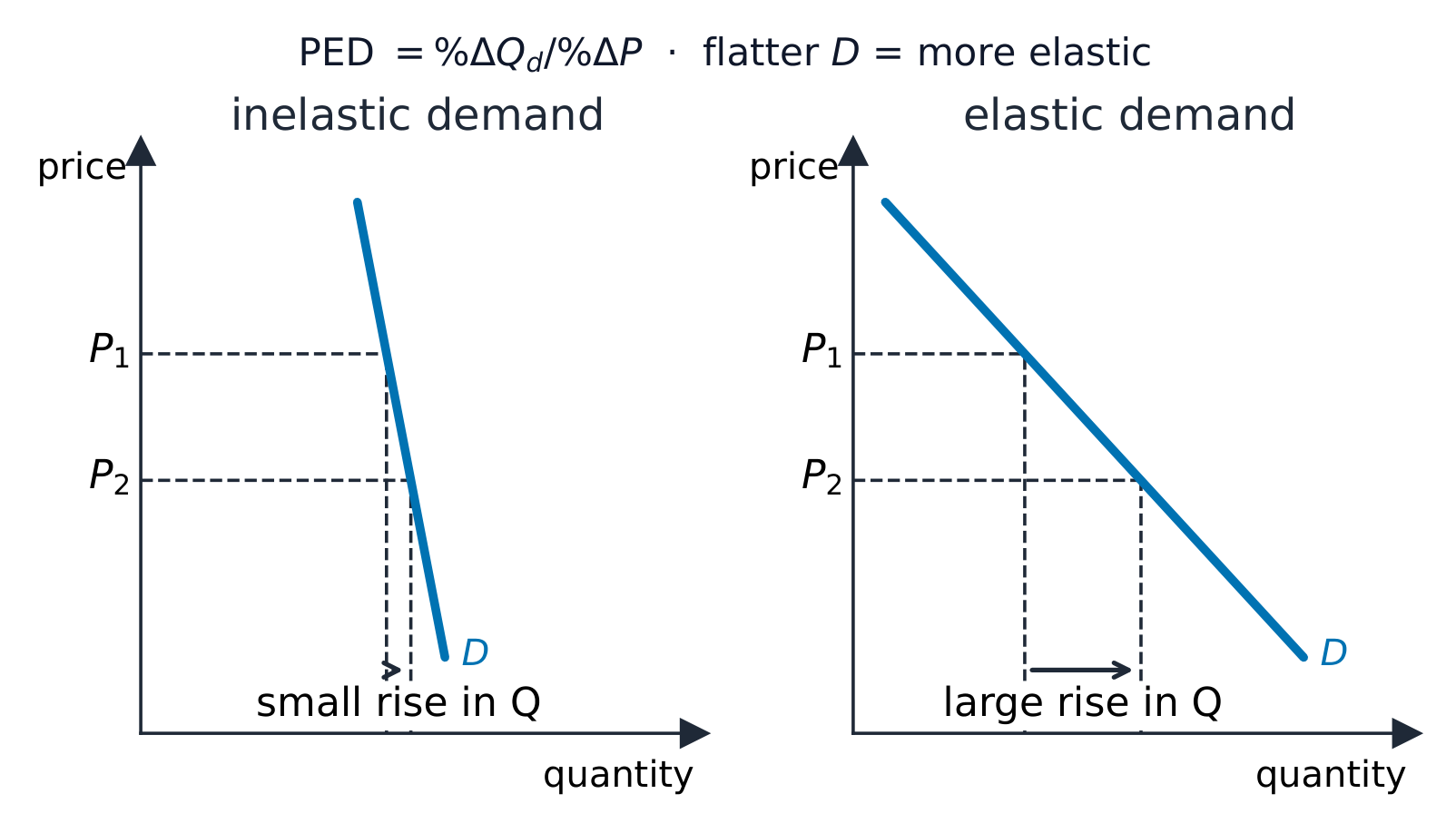
- $\text{PED} = \dfrac{\%\ \text{change in quantity demanded}}{\%\ \text{change in price}}$.
- Mexico: $-6\% \div 10\% = -0.6$. The minus sign shows that quantity falls when price rises.
Percentage responsiveness and revenue
Initial-value percentages compare a price rise with a quantity fall. The lesson’s percentage-only example sets both starting indices to 100; reference examples use their stated prices and quantities.
Price rises by 5% and quantity demanded falls by 15%. What is PED?
Kesulitan 2/5 · 140 koin + bonus kecil pada penyelesaian pertama hari ini
−15 ÷ 5.
Elastic and inelastic
- Elastic 富有弹性 demand: PED above 1 (ignoring the sign) — quantity changes by a bigger percentage than price.
- Inelastic 缺乏弹性 demand: PED below 1 — quantity changes by a smaller percentage. Mexico's sugary drinks were inelastic.

Match each PED to its type.
Kesulitan 2/5 · 140 koin + bonus kecil pada penyelesaian pertama hari ini
Compare with 1.
What decides PED?
- Close substitutes 替代品 make demand elastic (one brand of crisps); few substitutes make it inelastic. Necessities 必需品 are inelastic; luxuries 奢侈品 are more elastic.
- A large share of income, and more time to find alternatives, make demand more elastic.
Which product probably has the most elastic demand?
Kesulitan 1/5 · 100 koin + bonus kecil pada penyelesaian pertama hari ini
Many close substitutes.
Worked example: what happens to revenue?
A café sells 400 cakes a week at $2. It raises the price to$2.50 and sells 360.
- % change in price: $\dfrac{0.50}{2} \times 100 = 25\%$. % change in quantity: $\dfrac{-40}{400} \times 100 = -10\%$.
- PED: $-10 \div 25 = -0.4$ → inelastic.
- Revenue 收益: before $2 \times 400 = \$800$; after $2.50 \times 360 = \$900$. With inelastic demand, the price rise increased revenue.
A shop sells 200 pens at $1. It raises the price to$1.20 and sells 190. What is the new revenue in dollars?
Kesulitan 2/5 · 140 koin + bonus kecil pada penyelesaian pertama hari ini
1.20 × 190; up from 200.
Who uses PED?
- Firms: raise prices for inelastic products; cut prices for elastic ones to win more customers and revenue.
- Governments: taxes on goods with inelastic demand raise a lot of money, but they reduce consumption only a little — as Mexico found.
Taxing a good with inelastic demand raises a lot of tax revenue.
Kesulitan 1/5 · 100 koin + bonus kecil pada penyelesaian pertama hari ini
Quantity falls only a little.
A fall in quantity does not mean demand is elastic. Compare the percentages: Mexico's purchases fell, but by less than the price rose, so demand was inelastic.
If quantity falls after a price rise, demand must be elastic.
Kesulitan 1/5 · 100 koin + bonus kecil pada penyelesaian pertama hari ini
Compare the percentages.
PED = % change in quantity demanded ÷ % change in price. Above 1 is elastic, below 1 inelastic. Substitutes, luxuries, share of income and time make demand more elastic. For inelastic goods, a price rise increases revenue.
A cinema is the only one in a small town. Explain whether it should raise its ticket prices to increase revenue.
Applying PED.