The development life cycle and design tools
Diperkenalkan 9:16
Siklus Hidup Pengembangan Program
Setiap aplikasi di telepon Anda ditulis oleh seseorang seperti ini. Namun mereka tidak mulai dengan mengetik kode. Sebelum baris pertama, masalah dipelajari, solusinya dirumuskan…
Narasi bahasa Inggris · takarir bahasa Inggris dan 中文 yang dapat dipilih
In this lesson
| English | Makna |
|---|---|
| program development life cycle/ˈprəʊɡræm dɪˈveləpmənt laɪf ˈsaɪkl/ | siklus hidup pengembangan program |
| design/dɪˈzaɪn/ | desain |
| analysis/əˈnæləsɪs/ | analisis |
| coding/ˈkəʊdɪŋ/ | pengkodean |
| testing/ˈtestɪŋ/ | pengujian |
| abstraction/əbˈstrækʃn/ | abstraksi |
| decomposition/ˌdiːkɒmpəˈzɪʃn/ | dekomposisi |
| flowchart/ˈfləʊtʃɑːt/ | diagram alir |
| pseudocode/ˈsuːdəʊkəʊd/ | pseudokode |
Building a program
- A program is built in stages — the program development life cycle 程序开发生命周期.
- We plan it with design 设计 tools, then write the algorithm.
- Every algorithm breaks into input → processing → output.
The four stages
- Analysis 分析 — study the problem and work out what's needed.
- Design — plan how the program will work.
- Coding 编码 — write the code, testing 测试 small parts as you go (iterative testing).
- Testing — run the finished program with test data to find errors.
- Two analysis skills: abstraction 抽象 (keep only the important details) and decomposition 分解 (break a big problem into smaller parts).
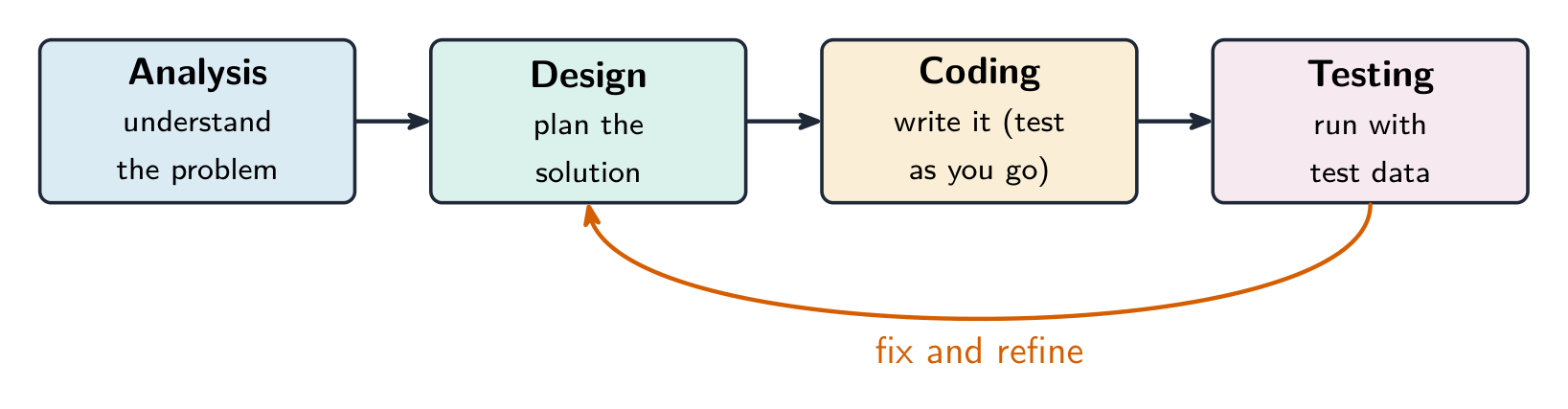
Siklus hidup pengembangan perangkat lunak
Step through the stages every project follows — work out what's needed, plan it, build it, then check it. Getting analysis right first saves a lot of rework later.
Put the development life cycle stages in order.
Kesulitan 3/5 · 200 koin + bonus kecil pada penyelesaian pertama hari ini
Analysis (what is needed) → design (plan) → coding (write) → testing (check).
Abstraction means:
Kesulitan 1/5 · 100 koin + bonus kecil pada penyelesaian pertama hari ini
Abstraction simplifies; decomposition breaks a problem into parts.
Match each design concept to what it means.
Kesulitan 2/5 · 140 koin + bonus kecil pada penyelesaian pertama hari ini
Abstraction simplifies, decomposition splits up, pseudocode plans the steps, and IPO is the overall flow.
Design tools
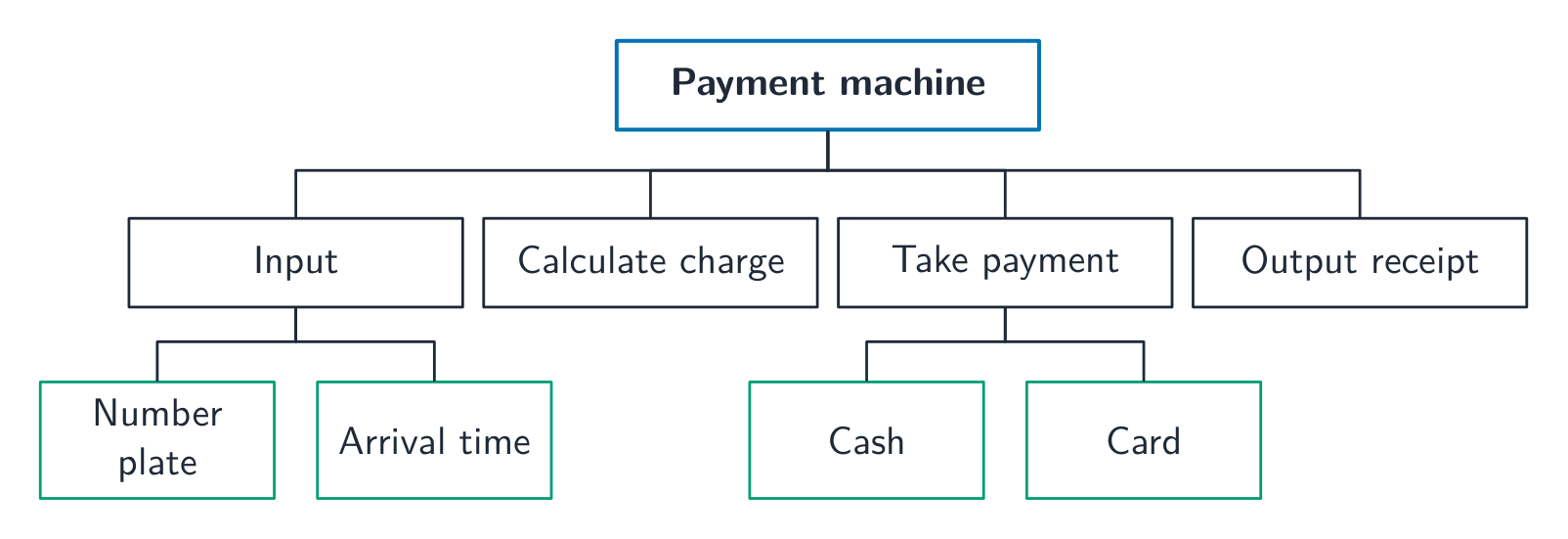
- A structure diagram — shows the parts of a system and how they fit together.
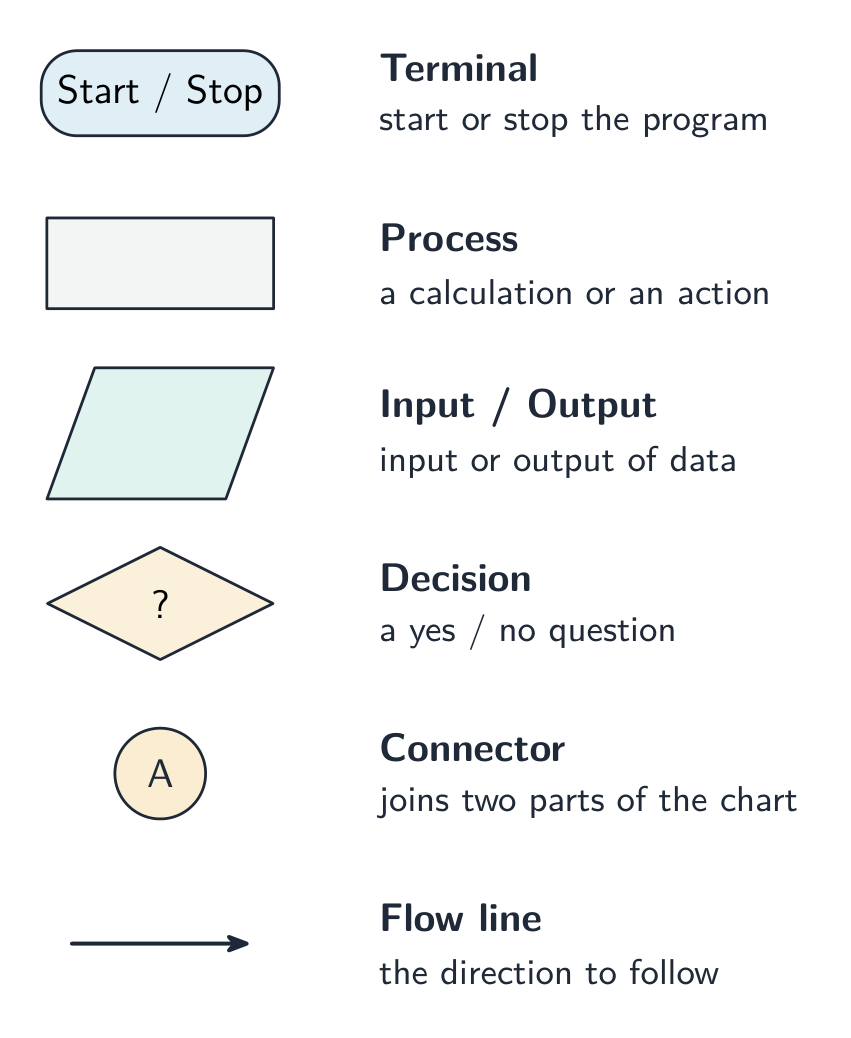
- A flowchart 流程图 — boxes and arrows showing the steps in order.
- Pseudocode 伪代码 — steps in simple, code-like English (not a real language).
Pseudocode is:
Kesulitan 1/5 · 100 koin + bonus kecil pada penyelesaian pertama hari ini
Pseudocode describes an algorithm in readable, code-like English without being a real language.
Input, processing, output
- Every algorithm decomposes into input (the data in), processing (the work done), and output (the result).
- e.g. "average of three marks": input the 3 marks → add them and divide by 3 → output the average.

Every algorithm can be decomposed into:
Kesulitan 1/5 · 100 koin + bonus kecil pada penyelesaian pertama hari ini
Input (data in) → processing (the work) → output (the result).
Worked example: a car-park payment machine
A car park needs a payment machine. Use decomposition and IPO to plan it.
- Decomposition splits the problem into sub-tasks: read the number plate, calculate the charge, take payment, print a receipt. Abstraction keeps only what matters: arrival time and plate matter, the car's colour does not.
- For the "calculate charge" part: input the arrival and leaving times; process: hours = leaving − arrival, charge = hours × rate; output the charge on the screen.
Removing details that are not needed to solve a problem is called:
Kesulitan 1/5 · 100 koin + bonus kecil pada penyelesaian pertama hari ini
Decomposition breaks a problem into parts; abstraction removes unneeded detail.
In a flowchart, a decision is drawn as a diamond with a yes and a no exit.
Kesulitan 1/5 · 100 koin + bonus kecil pada penyelesaian pertama hari ini
Processes are rectangles, input and output are parallelograms, and decisions are diamonds.
You've got it
- life cycle: analysis → design → coding → testing
- abstraction = keep what matters; decomposition = break into parts
- design tools: structure diagram, flowchart, pseudocode
- every algorithm = input → processing → output