Rencana belajar Anda · Lanjut · Tinjau →
非(要) … 不可 (benar-benar harus / bersikeras)
DiperkenalkanPosisi tersimpan Anda tetap berada di browser ini. Melanjutkan tidak menyelesaikan pelajaran atau menjawab pertanyaannya.
 6:57
HSK 6 Tata Bahasa 7: Pola Lanjutan
岂不是. Mina sudah percaya bahwa desain baru malam ini adalah ide buruk. Dengan 岂不是, ia mengubah keyakinan itu menjadi pertanyaan dan mendorong kelompok untuk setuju. Ia tidak…
Penjelasan bahasa Inggris + contoh Mandarin · caption mengikuti teks yang diucapkan
In this lesson
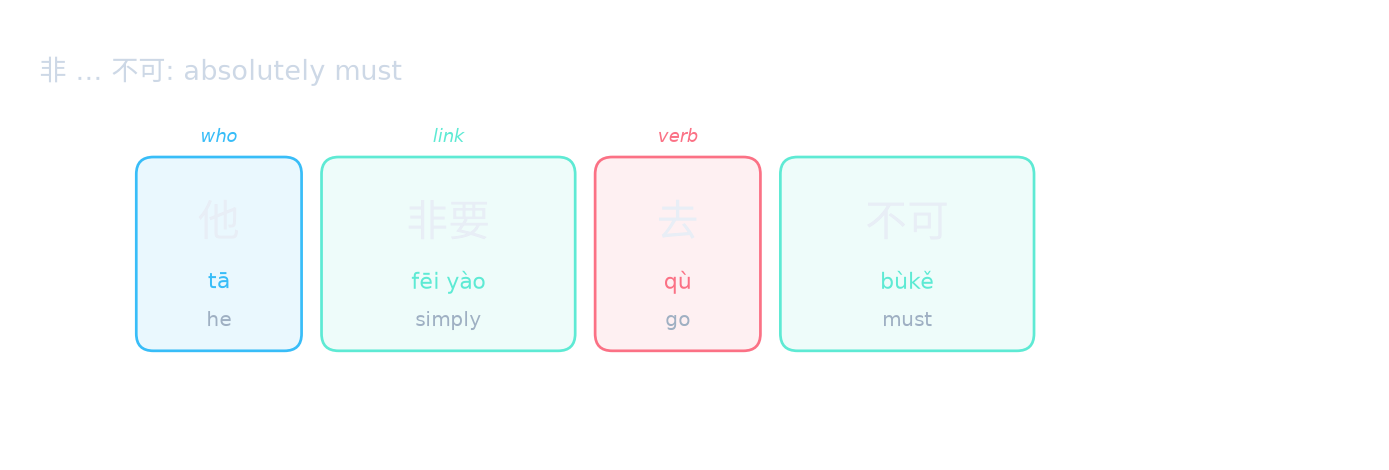
He simply must go
- Your little brother wants to go to the amusement park in the rain and won't take no for an answer.
- down / next; to fall (rain), get off下so much这么big大(modifier / structural particle)的rain雨,he他to want absolutely非要go去(must)不可。 — "It's pouring, and he simply insists on going."
- Goal: say someone insists on something with (must)非 (want / will / need要) + verb + (must)不可.
(must)非 (want / will / need要) + verb + (must)不可 = must, insist on
- (must)非…(must)不可 is a double negative: "not doing it is not allowed" → must, absolutely have to.
- With want / will / need要, it often shows insistence: he他to want absolutely非要go去(must)不可 — "He insists on going."
this matter这件事(must)非he他go去(must)不可。
Complete: “This problem absolutely must be solved.” 这个问题非解决____。
Kesulitan 1/5 · 100 koin + bonus kecil pada penyelesaian pertama hari ini
非…不可.
Necessity and stubbornness
- Necessity: this这个problem问题(must)非be solved解决(must)不可。 — "This problem absolutely must be solved."
- Stubbornness: I / me我to speak说need not不用,she / her她to want absolutely非要to treat (someone to a meal)请客(must)不可。 — "I said there was no need, but she insisted on paying."
this这个problem问题(must)非be solved解决(must)不可。
Build: “She insisted on paying.”
Kesulitan 3/5 · 200 koin + bonus kecil pada penyelesaian pertama hari ini
非要 + verb + 不可.
Keep both parts
- In careful style, keep (must)不可 (or won't do不行 / won't do / (…不成?) surely not不成) at the end: (must)非go去(must)不可. In speech (must)不可 is sometimes dropped: he他to want absolutely非要go去.
- (must)非 + verb, then (must)不可: not (must)非(must)不可go去.
- (must)非 + person + verb + (must)不可 = only this person will do: 这件matter事(must)非he他go去(must)不可。 — "He's the one who has to go." he他(must)非go去(must)不可。 — "He simply must go."
Which order is correct?
Kesulitan 1/5 · 100 koin + bonus kecil pada penyelesaian pertama hari ini
The frame is 非 + (要) + verb + 不可, meaning “must, insist on”: 他非要去不可. 非 comes before the verb phrase and 不可 closes the sentence.
(must)非…(must)不可 versus must必须 and definitely / certain一定want / will / need要
- must必须 / definitely / certain一定want / will / need要 = must (plain).
- (must)非…(must)不可 is more emphatic, often with a sense of insistence or "no other way".
you你must必须on time按时finish完成。
非…不可 is more emphatic than 必须.
Kesulitan 1/5 · 100 koin + bonus kecil pada penyelesaian pertama hari ini
It stresses there is no other way.
Recap
- (must)非 (want / will / need要) + verb + (must)不可 = absolutely must / insist on (emphatic double negative).
- Plainer: must必须 / definitely / certain一定want / will / need要.
Read the full reference: HSK 6 grammar — Sentence patterns.
Your little brother wants to go to the amusement park in the rain and won't take no for an answer. Close the examples. Say a Mandarin response, then write it in Chinese. Explain briefly in English what the lesson’s pattern adds. Compare with the model, then change one detail and try again.
This is supported productive practice. Compare meaning and structure; your answer need not copy the model. A partner or teacher must hear the spoken response to comment on pronunciation.