Rencana belajar Anda · Lanjut · Tinjau →
Statement + 嘛 (hal yang jelas)
DiperkenalkanPosisi tersimpan Anda tetap berada di browser ini. Melanjutkan tidak menyelesaikan pelajaran atau menjawab pertanyaannya.
 3:24
HSK 6 Tata Bahasa 5: 是否, 与否, 之, 嘛, 呗
是否 diikuti kata kerja atau kata sifat. 是否 adalah pertanyaan ya-tidak formal: menyematkan "apakah". Tertulis dan formal: 请确认是否参加. Lihat lembar kerja untuk bentuk lengkap…
Penjelasan bahasa Inggris + contoh Mandarin · caption mengikuti teks yang diucapkan
In this lesson
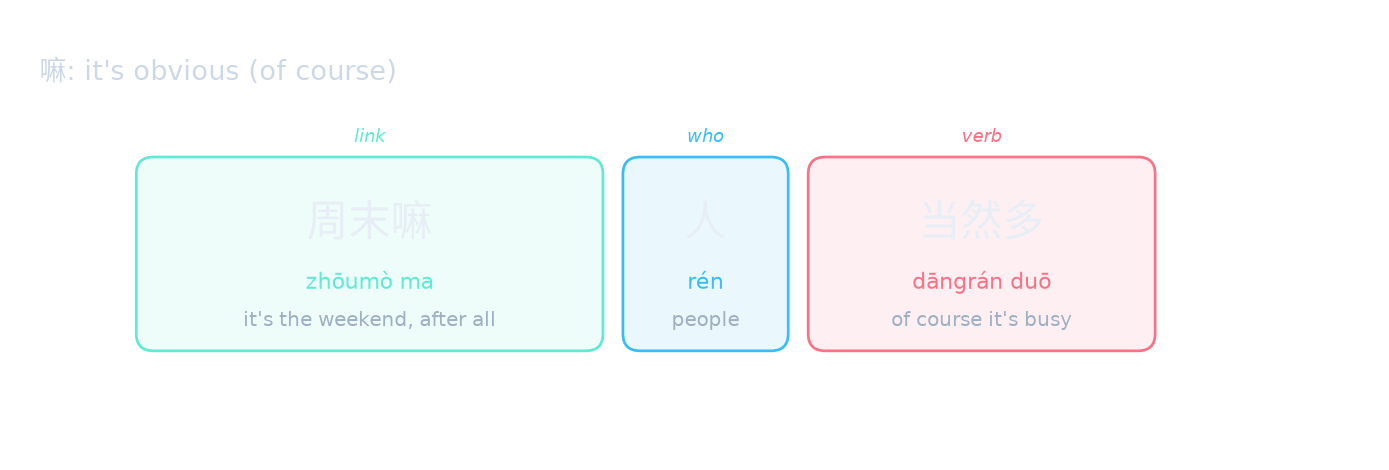
Of course it's crowded
- Your friend complains about the crowds at the shopping mall on a Saturday.
- weekend周末(after all)嘛,person人of course当然many; much多。 — "Well, it's the weekend — of course it's crowded."
- Goal: present something as obvious in speech with statement + (after all)嘛.
Statement + (after all)嘛 = it's obvious
- (after all)嘛 at the end of a statement presents it as obvious, a reason the listener should accept.
- It can also follow a topic before the comment: weekend周末(after all)嘛,….
he他is是new新arrived来的(after all)嘛,not不familiar熟悉very很normal正常。
Complete: “It's handmade, after all — of course it's pricey.” 手工做的____,贵一点儿很正常。
Kesulitan 1/5 · 100 koin + bonus kecil pada penyelesaian pertama hari ini
嘛 presents the reason as obvious.
Explaining and gentle urging
- Explaining: by hand手工made做(modifier / structural particle)的(after all)嘛,expensive贵a bit一点儿very很normal正常。 — "It's handmade, after all — of course it's a bit pricey."
- Urging: hurry up / a bit faster快点儿(after all)嘛! — "Come on, hurry up!" (softly insistent)
by hand手工made做的(after all)嘛,expensive贵a bit一点儿very很normal正常。
Build: “It's the weekend — of course it's crowded.”
Kesulitan 3/5 · 200 koin + bonus kecil pada penyelesaian pertama hari ini
Topic + 嘛, then the comment.
(after all)嘛 is not (yes/no ?)吗
- (yes/no ?)吗 asks a yes/no question; (after all)嘛 states something obvious. you你to know知道(yes/no ?)吗? asks; you你to know知道(after all)嘛 means "you know that, obviously".
- (after all)嘛 is casual; leave it out of formal writing.
- (after all)嘛 adds "you know, it's obvious": weather天气no good不好(after all)嘛,we / us我们another day改天to go去。 — "The weather's bad, after all — let's go another day."
Which is a yes/no question?
Kesulitan 1/5 · 100 koin + bonus kecil pada penyelesaian pertama hari ini
吗 asks; 嘛 states the obvious.
(after all)嘛 versus (suggestion)吧 and (simple)呗
- (suggestion)吧 suggests or guesses: to walk / to leave走(suggestion)吧 / he他is是teacher老师(suggestion)吧? — "He's a teacher, isn't he?"
- (simple)呗 shrugs: "that's all there is to it": won't / can't不会(就 + 学) then learn就学(simple)呗 — "If you don't know how, just learn."
don't不know how会then就learn学(simple)呗。
快点儿嘛! is a soft, insistent urging.
Kesulitan 1/5 · 100 koin + bonus kecil pada penyelesaian pertama hari ini
True. After a request, 嘛 makes it softer and slightly coaxing while still insistent: 快点儿嘛! “Come on, hurry up!”
Recap
- Statement + (after all)嘛 = it's obvious, after all; also gentle urging (hurry up / a bit faster快点儿(after all)嘛).
- Not a question ((yes/no ?)吗); casual only.
Read the full reference: HSK 6 grammar — Particles.
Your friend complains about the crowds at the shopping mall on a Saturday. Close the examples. Say a Mandarin response, then write it in Chinese. Explain briefly in English what the lesson’s pattern adds. Compare with the model, then change one detail and try again.
This is supported productive practice. Compare meaning and structure; your answer need not copy the model. A partner or teacher must hear the spoken response to comment on pronunciation.