Rencana belajar Anda · Lanjut · Tinjau →
Mengembangkan cerita dari empat gambar
DiperkenalkanPosisi tersimpan Anda tetap berada di browser ini. Melanjutkan tidak menyelesaikan pelajaran atau menjawab pertanyaannya.
 9:59
HSK 5 Tata Bahasa 20: Pola kalimat — tingkat lanjut
Bingkai ini membahas 把: paksa, anggap, dan kesalahpahaman. 把 mengambil objek, dan kata kerja menyatakan apa yang terjadi pada objek tersebut. Ini adalah penggunaan tingkat lanjut yang akan Anda temui sekali…
Penjelasan bahasa Inggris + contoh Mandarin · caption mengikuti teks yang diucapkan
Dalam pelajaran ini
Four pictures, one story
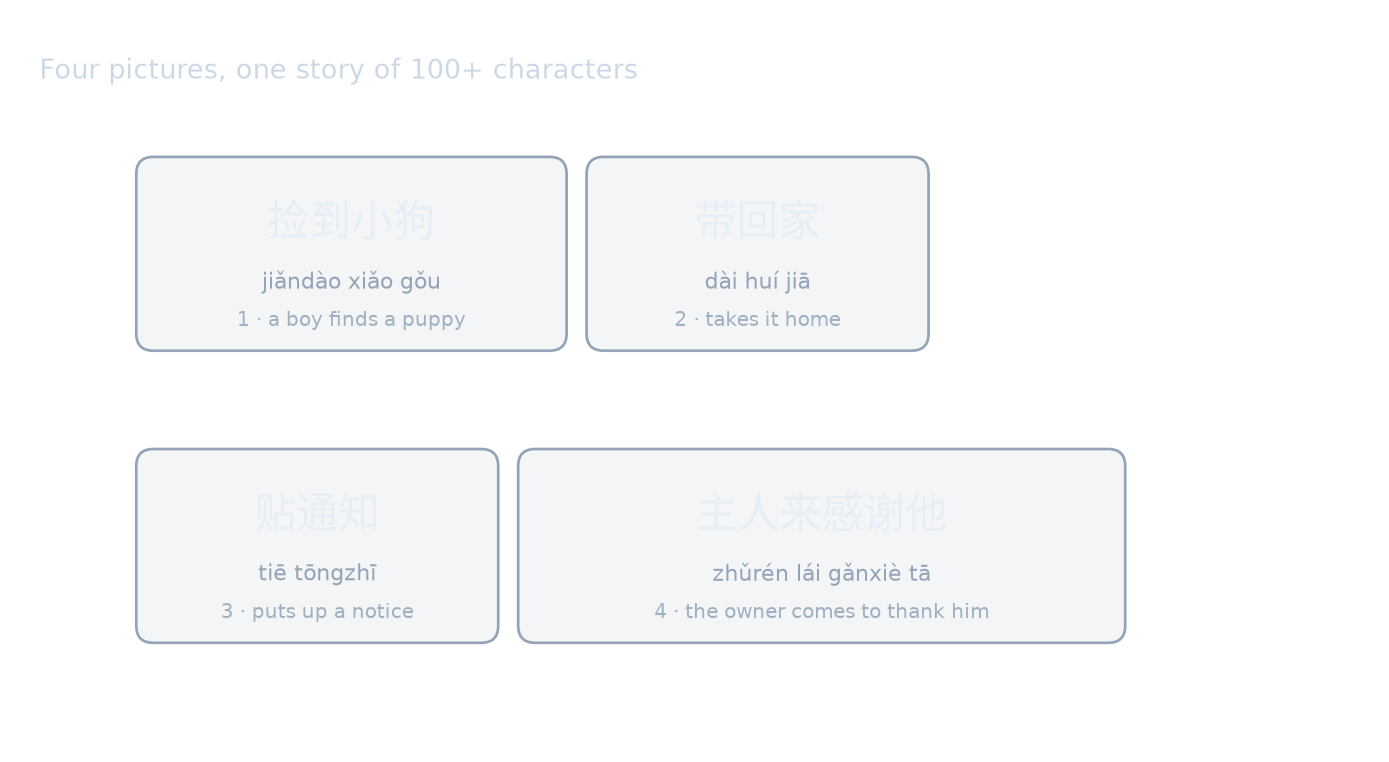
- Four pictures show: a boy finds a lost puppy, carries it home, puts up notices, and the owner comes to thank him.
- The task asks for a story of at least one hundred characters that connects the four pictures without inventing a different plot.
One or two sentences per picture
- Picture 1: 一天to finish school (for the day)放学(modifier / structural particle)的time; when时候,小明at / in在curb路边to notice发现(completed / change)了一只pup小狗。 ("One day after school, Xiaoming found a puppy by the road") Picture 2: he / him他to look at; to watch; to read看pup小狗degree / adjective linker很pitiful可怜,then / just就(把: marks the object)把it它to hold / hug抱to return / (times)回(completed / change)了home / family / (measure: shops)家。 — "He saw that the puppy was in a sorry state, so he picked it up and took it home."
- Picture 3: he / him他at / in在housing estate小区inside; in里to stick贴(completed / change)了一张to notify / notice通知,to speak说he / him他to pick up捡to / arrive / (result: get)到(completed / change)了一只pup小狗。 — "He put up a notice in the neighborhood saying he had found a puppy." Picture 4: next day第二天,pup小狗(modifier / structural particle)的host; owner主人to look for; to give change找to come来(completed / change)了,extremely grateful非常感谢he / him他。 — "The next day, the puppy's owner came looking for it and thanked him warmly."
Xiao Ming小明by在the road路边found发现了a一只puppy小狗。
Put the story in order.
Kesulitan 3/5 · 200 koin + bonus kecil pada penyelesaian pertama hari ini
Follow the order of the pictures.
Link and refer clearly
- Time and result words: 一天, then / after然后, and so于是, next day第二天, finally; last最后, result; as a result结果.
- Use pronouns once the noun is clear: pup小狗 → it它; 小明 → he / him他. Do not switch names or change who does what.
Weak: 小明to find找到dog狗。小明to return home回家。小明sticker贴纸。host; owner主人to come来(completed / change)了。 (no links, repetitive). Better: use and so于是, it它, next day第二天 and one feeling: 小明in one's heart / mind心里degree / adjective linker很happy; glad高兴.
Which word best links “he felt sorry for the puppy” to “he carried it home”? 他看小狗很可怜,___ 把它抱回了家。
Kesulitan 1/5 · 100 koin + bonus kecil pada penyelesaian pertama hari ini
于是 introduces the action that followed.
他把小狗抱回了家,给 ____ 喝了一些水。(it)
Kesulitan 1/5 · 100 koin + bonus kecil pada penyelesaian pertama hari ini
它 refers back to the puppy.
Stay with the pictures
- Add feelings and reasons that fit (he / him他degree / adjective linker很anxious担心pup小狗hungry饿(completed / change)了), but do not invent events not shown (no "the dog ran away again").
- Check length: four pictures × about 25–30 characters ≈ 100–120.
Sesuai dengan gambar atau ciptaan?
Bedakan elaborasi yang sesuai dengan plot yang diciptakan.
Adding an event that the pictures do not show makes the story stronger.
Kesulitan 1/5 · 100 koin + bonus kecil pada penyelesaian pertama hari ini
Stay with the pictures; add feelings and reasons, not new events.
About how many characters per picture reach the hundred-character minimum for four pictures?
Kesulitan 1/5 · 100 koin + bonus kecil pada penyelesaian pertama hari ini
Four pictures × 25–30 characters ≈ 100–120 characters, which reaches the minimum with a small margin. 10 per picture is too few; 60 or 100 would be far too long.
Common mistakes
- Describing each picture separately with no links.
- Adding plot twists the pictures don't show.
Recap
- One or two sentences per picture, linked by time and result words, with clear pronoun references.
- Add fitting feelings and reasons, not new events; reach at least one hundred characters.