Rencana belajar Anda · Lanjut · Tinjau →
难怪 (no wonder)
DiperkenalkanPosisi tersimpan Anda tetap berada di browser ini. Melanjutkan tidak menyelesaikan pelajaran atau menjawab pertanyaannya.
 2:31
HSK 5 Tata Bahasa 21: Pola kalimat majemuk
怪不得 atau 难怪. Pola dari lembaran catatan. Lihat lembaran catatan untuk bentuk lengkap dan batas penggunaannya. Lihat lembaran catatan untuk bentuk lengkap, makna, dan batas penggunaannya.
Penjelasan bahasa Inggris + contoh Mandarin · caption mengikuti teks yang diucapkan
In this lesson
So that's why!
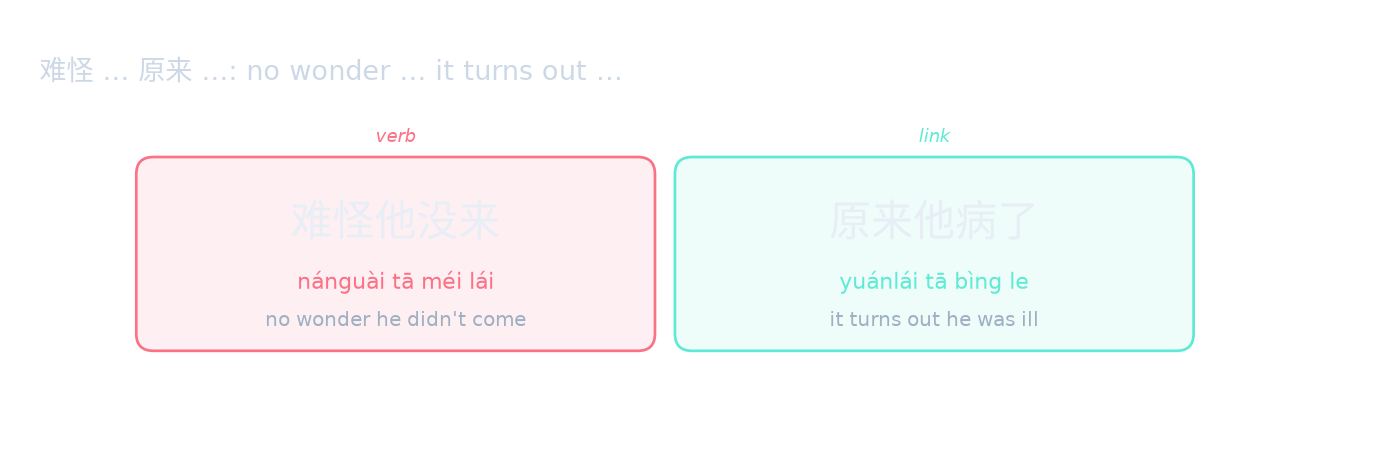
- Your friend missed class. Later you hear he was ill: no wonder难怪he他didn't come没来,it turns out原来he他illness / ill病(completed / change)了。 — "No wonder he didn't come — he was ill."
- Goal: react to something that now makes sense with no wonder难怪 ("no wonder"), often together with it turns out原来 ("so it turns out").
no wonder难怪 + what you noticed,it turns out原来 + the reason
- no wonder难怪 + result you noticed: now it makes sense. it turns out原来 + the reason you just learned. Either part can come first.
- it turns out原来you你at / in在to learn学piano钢琴,no wonder难怪finger手指so much这么flexible灵活。 — "So you're learning the piano. No wonder your fingers are so quick."
no wonder难怪he他didn't come没来,it turns out原来he他was ill病了。
Complete: “No wonder you're so tired — you worked all night.” ____你这么累,原来你工作了一个晚上。
Kesulitan 1/5 · 100 koin + bonus kecil pada penyelesaian pertama hari ini
难怪 + what you noticed, 原来 + reason.
Match each part to its job.
Kesulitan 2/5 · 140 koin + bonus kecil pada penyelesaian pertama hari ini
难怪 = no wonder; 原来 = it turns out / originally.
no wonder难怪 on its own
- As a short reply: A: he他to be / is是Beijing北京person人。 B: no wonder难怪! — "No wonder (his Mandarin is so good)!"
- no wonder!怪不得 means the same and is more spoken: no wonder!怪不得you你so much这么tired累。 — "No wonder you're so tired."
A: 他在中国住了十年。 B: 难怪! What does B mean?
Kesulitan 1/5 · 100 koin + bonus kecil pada penyelesaian pertama hari ini
难怪! alone = that explains it.
怪不得 and 难怪 mean the same.
Kesulitan 1/5 · 100 koin + bonus kecil pada penyelesaian pertama hari ini
怪不得 is a little more spoken.
The surprise comes before the reason
- no wonder难怪 goes with what you already noticed (he他didn't come没来), not with the reason: ✗ no wonder难怪he他illness / ill病(completed / change)了 when illness / ill病 is the new information.
- it turns out原来 also has another meaning: "originally, before" (I / me我it turns out原来to live (somewhere)住at / in在Shanghai municipality…上海 — "I used to live in Shanghai").
The streets are wet, then you learn it rained at night. Which is right?
Kesulitan 1/5 · 100 koin + bonus kecil pada penyelesaian pertama hari ini
难怪 goes with what you noticed (wet streets); 原来 with the reason.
Recap
- no wonder难怪 / no wonder!怪不得 + what you noticed = no wonder …; it turns out原来 + reason = it turns out ….
- no wonder难怪! alone = That explains it!
Read the full reference: HSK 5 grammar — Verbs & comparisons.
Your neighbour's flat has been very quiet all week. Then you learn they went on holiday. React with 难怪 and 原来.
Your answer need not copy the model. A partner or teacher must hear the spoken response to comment on pronunciation.