Rencana belajar Anda · Lanjut · Tinjau →
格外 (terutama / luar biasa)
DiperkenalkanPosisi tersimpan Anda tetap berada di browser ini. Melanjutkan tidak menyelesaikan pelajaran atau menjawab pertanyaannya.
 2:33
HSK 5 Tata Bahasa 16: Kata keterangan dengan kata sifat
Anda naik bus yang sama pulang setiap malam. Malam ini kota terlihat lebih tenang dari biasanya: 今天晚上,城市显得格外安静。 格外 berarti terutama atau luar biasa. Karakter 格 berarti…
Penjelasan bahasa Inggris + contoh Mandarin · caption mengikuti teks yang diucapkan
In this lesson
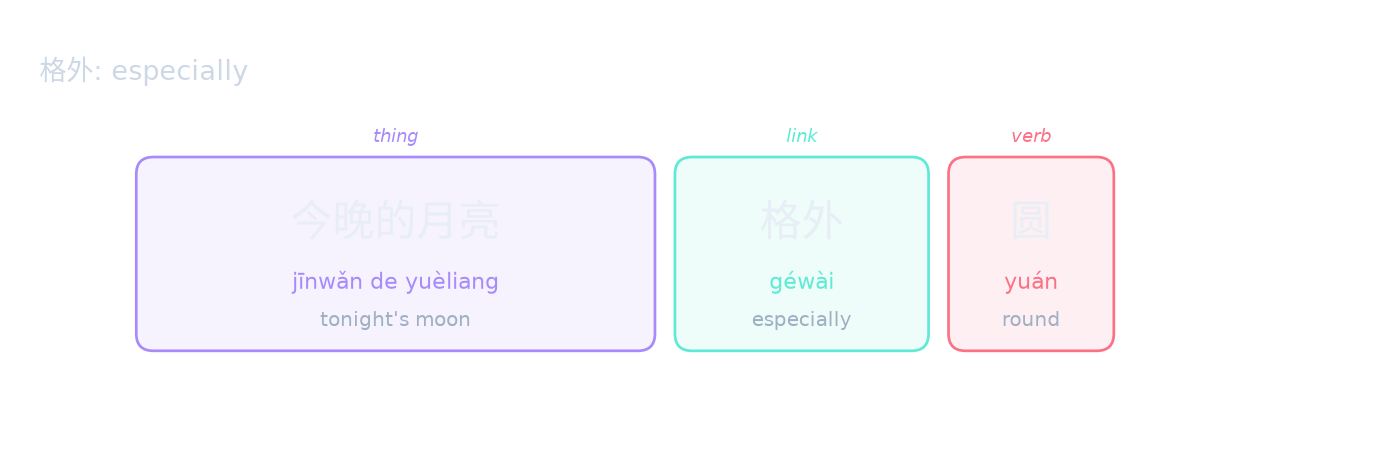
An especially bright moon
- At the Mid-Autumn Festival you look up and the moon is brighter than you've ever seen.
- tonight今晚(modifier / structural particle)的moon月亮especially格外round; circle圆,especially格外bright亮。 — "Tonight the moon is especially round and especially bright."
- Goal: say "especially" with especially格外 + adjective.
especially格外 + Adj / feeling verb
- especially格外 = "especially, exceptionally": more than usual, compared with other times or things.
- It goes before the adjective, like especially特别: especially格外happy高兴, especially格外careful小心.
rain雨after后的the air空气especially格外fresh清新。
Complete: “After the rain the air is especially fresh.” 雨后的空气____清新。
Kesulitan 1/5 · 100 koin + bonus kecil pada penyelesaian pertama hari ini
格外 + Adj = more than usual.
Compared with usual
- the first time第一次to depart离开home / family / (measure: shops)家,he他especially格外to miss想念mum; mother妈妈。 — "Away from home for the first time, he missed his mum especially."
- snow下雪(completed / change)了,driving开车must要especially格外careful小心。 — "It's snowing; drive extra carefully."
snow下雪了,driving开车must要extra格外careful小心。
Build: “It's snowing; drive extra carefully.”
Kesulitan 3/5 · 200 koin + bonus kecil pada penyelesaian pertama hari ini
要 + 格外 + Adj.
No degree / adjective linker很, a standard to compare with
- Do not add degree / adjective linker很 or very非常: especially格外happy高兴, not especially格外degree / adjective linker很happy高兴.
- especially格外 implies "more than usual"; it sounds odd when nothing is being compared.
- especially格外 compares with what is normal, even if the normal is not said: today今天especially格外cold冷。 — "It's unusually cold today."
Which sentence is correct?
Kesulitan 1/5 · 100 koin + bonus kecil pada penyelesaian pertama hari ini
今天格外冷 is right: 格外 ("especially") is a degree adverb, so it replaces 很 and goes before a bare adjective.
especially格外 versus especially特别 and very非常
- very非常 = very (no comparison needed): very非常good好.
- especially特别 and especially格外 both stress "more than usual"; especially格外 is a little more literary.
he他today今天especially特别happy高兴。
格外 is close in meaning to 特别.
Kesulitan 1/5 · 100 koin + bonus kecil pada penyelesaian pertama hari ini
Both stress “more than usual”.
Recap
- especially格外 + Adj / feeling verb = especially, exceptionally (more than usual).
- No degree / adjective linker很; close to especially特别, more literary.
Read the full reference: HSK 5 grammar — Adverbs with adjectives.
At the Mid-Autumn Festival you look up and the moon is brighter than you've ever seen. Close the examples. Say a Mandarin response, then write it in Chinese. Explain briefly in English what the lesson’s pattern adds. Compare with the model, then change one detail and try again.
This is supported productive practice. Compare meaning and structure; your answer need not copy the model. A partner or teacher must hear the spoken response to comment on pronunciation.