Rencana belajar Anda · Lanjut · Tinjau →
Kata Kerja + 着 (keadaan berkelanjutan)
DiperkenalkanPosisi tersimpan Anda tetap berada di browser ini. Melanjutkan tidak menyelesaikan pelajaran atau menjawab pertanyaannya.
 4:48
HSK 3 Tatarupa 5: Partikel, Kata Benda & Angka
Setengah, angka raksasa, dan beberapa samar. 半 mencerminkan urutan kata Inggris; 万 mengelompokkan digit dalam empat; kata tanya nada turun berarti beberapa. Aturannya sedikit; yang…
Penjelasan bahasa Inggris + contoh Mandarin · caption mengikuti teks yang diucapkan
Dalam pelajaran ini
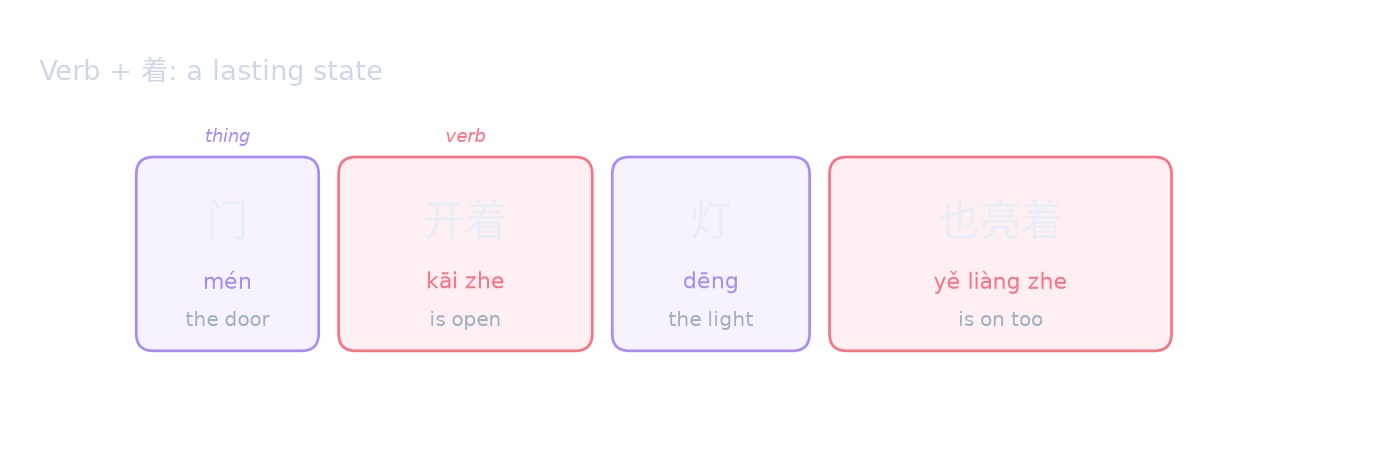
The door is open
- You come home and notice the door open and the lights on.
- 门开(ongoing)着,lamp灯also也bright亮(ongoing)着。 Mén kāi zhe, dēng yě liàng zhe. — "The door is open, and the lights are on too."
- Goal: use Verb + (ongoing)着 to describe a state that lasts (open, sitting, wearing, holding), and keep it apart from (in progress)在 + verb.
1 · Verb + (ongoing)着 = the state goes on
- An action happens once (to open; to drive开 — open), then a state lasts (to open; to drive开(ongoing)着 — is open). (ongoing)着 describes that lasting state.
- he他(in progress)在bed床up / on / last; to get on, attend上lie躺(ongoing)着。 Tā zài chuáng shang tǎng zhe. — "He is lying on the bed."
- Negative: not / haven't没 + verb (+ (ongoing)着): door门not / haven't没to open; to drive开(ongoing)着。 — "The door isn't open." ✗ 门不开(ongoing)着。
she她wear穿(ongoing)着a一(measure word)件red红top衣服。
“The window is open.” 窗户开____。
Kesulitan 1/5 · 100 koin + bonus kecil pada penyelesaian pertama hari ini
Verb + 着 = a lasting state.
“The TV isn't on.”
Kesulitan 1/5 · 100 koin + bonus kecil pada penyelesaian pertama hari ini
Negate 着 with 没.
2 · Describing a person in a picture
- In HSK picture tasks you often describe what someone wears, holds or how they stand. (ongoing)着 does this:
| Verb + (ongoing)着 | Example |
|---|---|
| attire穿着 — wearing | she她attire穿着a一(measure word)件red红top衣服。 — She's wearing a red top. |
| to put on or wear戴(ongoing)着 — wearing (glasses, a hat) | he他to put on or wear戴(ongoing)着spectacles眼镜。 — He's wearing glasses. |
| to take拿(ongoing)着 — holding | child孩子in hand手里to take拿(ongoing)着a一(measure word)个apple苹果。 — The child is holding an apple. |
| to stand站(ongoing)着 / to sit / to take (a bus …)坐(ongoing)着 — standing / sitting | teacher老师to stand站(ongoing)着,student学生(plural)们to sit / to take (a bus …)坐(ongoing)着。 — The teacher is standing; the students are sitting. |
- Worked description: a一(measure word)个erhua variant of 女孩女孩儿to sit / to take (a bus …)坐(ongoing)着to read看书,she她to put on or wear戴(ongoing)着spectacles眼镜,in hand手里to take拿(ongoing)着a一trophy cup杯tea茶。 — "A girl is sitting reading; she's wearing glasses and holding a cup of tea."
Match each phrase to the picture description.
Kesulitan 2/5 · 140 koin + bonus kecil pada penyelesaian pertama hari ini
戴 is for glasses and hats; 穿 for clothes; 拿 for holding.
3 · V1 (ongoing)着 + V2: doing one thing in a certain way
- The first verb with (ongoing)着 is the manner of the second action: he他smile笑(ongoing)着say说:"it doesn't matter没关系。" Tā xiào zhe shuō: "Méi guānxi." — "He said with a smile, 'It doesn't matter.'"
- we / us我们to sit / to take (a bus …)坐(ongoing)着to chat聊天。 — "We sat and chatted." 别站(ongoing)着to have a meal吃饭! — "Don't eat standing up!"
he他smile笑(while)着say说:it doesn't matter没关系。
Build: “He said with a smile …”
Kesulitan 3/5 · 200 koin + bonus kecil pada penyelesaian pertama hari ini
V1 着 + V2 = do V2 in the manner of V1.
4 · (ongoing)着 or (in progress)在?
- (in progress)在 + verb = in the middle of an action: he他(in progress)在wear穿top衣服。 Tā zài chuān yīfu. — "He's getting dressed."
- Verb + (ongoing)着 = the state after it: he他attire穿着a一(measure word)件白衬衫。 Tā chuān zhe yí jiàn bái chènshān. — "He's wearing a white shirt."
- Same with doors: he他(in progress)在to open a door (lit. and…开门 — he is opening the door. 门开(ongoing)着 — the door is open.
he他(in progress)在put on穿clothes衣服。
Which sentence means “She is putting on her coat (right now)”?
Kesulitan 1/5 · 100 koin + bonus kecil pada penyelesaian pertama hari ini
An action in progress → 在 + verb. 她穿着大衣 = she is wearing a coat (the state).
Common mistakes
- not不 with (ongoing)着: ✗ 灯不亮(ongoing)着 ✓ lamp灯not / haven't没bright亮(ongoing)着.
- (ongoing)着 for a finished action: ✗ I / me我to look at; to watch; to read看(ongoing)着to finish完(completed / change)了 ✓ I / me我to look at; to watch; to read看to finish完(completed / change)了. A finished action takes a result and (completed / change)了; (ongoing)着 is only for something that lasts.
灯不亮着 is the correct way to say “The light isn't on.”
Kesulitan 1/5 · 100 koin + bonus kecil pada penyelesaian pertama hari ini
着 takes 没: 灯没亮着。
Recap
- Verb + (ongoing)着 = a lasting state: 门开(ongoing)着, he他to put on or wear戴(ongoing)着spectacles眼镜, she她to take拿(ongoing)着a一trophy cup杯tea茶.
- V1 (ongoing)着 + V2 = do V2 in the manner of V1: smile笑(ongoing)着say说, to sit / to take (a bus …)坐(ongoing)着to chat聊天.
- (in progress)在 + verb = the action in progress. Negate (ongoing)着 with not / haven't没.
Read the full reference: HSK 3 grammar — Particles.
Look around the room you are in, or at a photo. Describe two people or things in Chinese with Verb + 着 (穿着, 戴着, 拿着, 坐着, 开着). Then compare with the model.
This is supported productive practice. Compare meaning and structure; your answer need not copy the model. A partner or teacher must hear the spoken response to comment on pronunciation.