Rencana belajar Anda · Lanjut · Tinjau →
Kata Kerja + 了 + Durasi (melakukan selama durasi tertentu)
DiperkenalkanPosisi tersimpan Anda tetap berada di browser ini. Melanjutkan tidak menyelesaikan pelajaran atau menjawab pertanyaannya.
 4:29
HSK 3 Tata Bahasa 3: Kata Kerja, Kemampuan & Pelengkap
Topik ini membahas apa yang dilaporkan oleh kata kerja. 着 (zhe) mempertahankan suatu keadaan. 了 (le) di akhir kalimat mengumumkan perubahan: hal itu kini benar. Pelengkap hasil melaporkan…
Penjelasan bahasa Inggris + contoh Mandarin · caption mengikuti teks yang diucapkan
In this lesson
How long did you wait?
- Your friend was very late for lunch, and now she asks how long you waited.
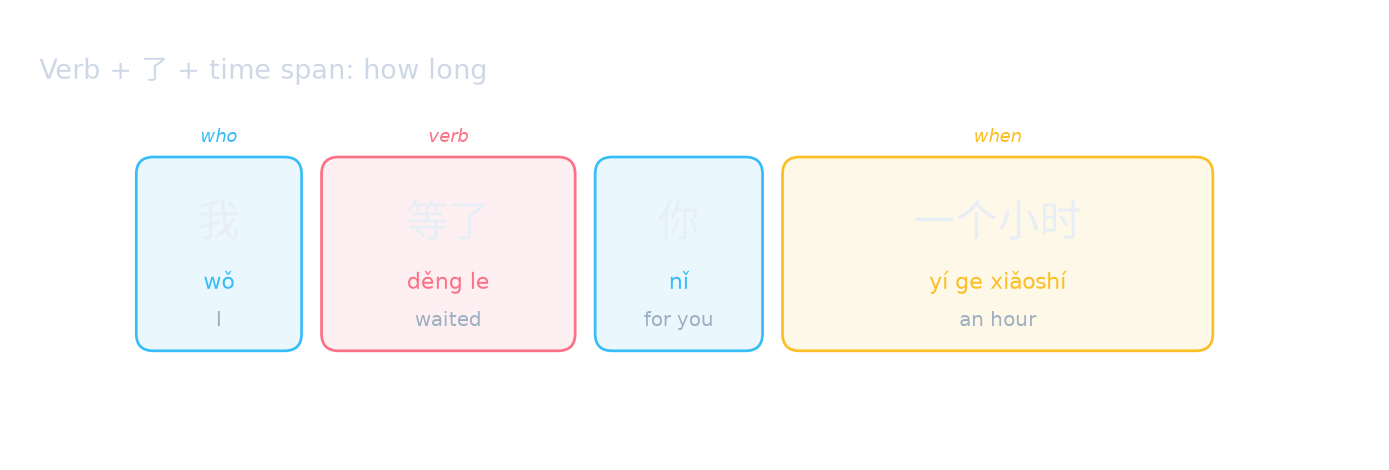
- I我to wait; and so on等(completed / change)了you你一个hours小时! Wǒ děng le nǐ yí ge xiǎoshí! — "I waited for you for an hour!"
- Goal: say how long something lasted (verb + (completed / change)了 + duration), ask about it, and keep it apart from when it happened.
Verb + (completed / change)了 + Duration
- Subject + Verb + (completed / change)了 + duration = did it for that long (finished): I我sleep睡(completed / change)了eight八个hours小时, he他study学(completed / change)了two years两年.
- The duration comes after the verb, as in English "slept eight hours". (In a negative such as 三天没吃肉(completed / change)了, the length of time comes first.)
I我sleep睡了eight八个hours小时。
Complete: “I slept for ten hours yesterday.” 我昨天睡____十个小时。
Kesulitan 1/5 · 100 koin + bonus kecil pada penyelesaian pertama hari ini
Verb + 了 + duration.
When it happened or how long it lasted?
| Time word | Example |
|---|---|
| When? — a point in time, before the verb | I我十一点to sleep睡觉。 — I go to bed at eleven. |
| How long? — a length of time, after the verb | I我sleep睡(completed / change)了eight八个hours小时。 — I slept for eight hours. |
- Ask how long with 多长时间 or (of time) how long?多久: you你to wait; and so on等(completed / change)了多长时间? Nǐ děng le duō cháng shíjiān? — "How long did you wait?"
- Both in one sentence: I我昨天晚上十一点to sleep睡觉,sleep睡(completed / change)了eight八个hours小时。
“I studied for two hours at seven o'clock.” Which is correct?
Kesulitan 1/5 · 100 koin + bonus kecil pada penyelesaian pertama hari ini
The point in time (七点) goes before the verb; the length of time (两个小时) after it.
With an object: two patterns
- Duration before the object noun: he他study学(completed / change)了three years三年Chinese中文。 — "He studied Chinese for three years."
- Or repeat the verb: he他study学middle / in中literature文学(completed / change)了three years三年。 A person object (you你, he他) goes before the duration: I我to wait; and so on等(completed / change)了you你一个hours小时.
he他study学Chinese中文study学了three years三年。
Build: “I waited for you for an hour.”
Kesulitan 3/5 · 200 koin + bonus kecil pada penyelesaian pertama hari ini
A pronoun object comes before the duration.
Where the duration goes
- Duration after the verb: I我study学(completed / change)了two years两年, not I我two years两年study学(completed / change)了.
- With a noun object, do not put the duration last: I我study学(completed / change)了two years两年Chinese中文 or I我study学middle / in中literature文学(completed / change)了two years两年, not I我study学(completed / change)了Chinese中文two years两年.
Which says “She studied piano for five years.”?
Kesulitan 1/5 · 100 koin + bonus kecil pada penyelesaian pertama hari ini
The duration goes between 了 and the noun object.
Finished, or still going?
- Verb + (completed / change)了 + duration with no final (completed / change)了 reports a finished period: I我in在Beijing北京live住(completed / change)了two years两年 — "I lived in Beijing for two years (then left)."
- Adding a final (completed / change)了 says it is still going on; that pattern is the next lesson.
I我in在Beijing北京live住了two years两年。
我在北京住了两年 can describe a stay that has ended.
Kesulitan 1/5 · 100 koin + bonus kecil pada penyelesaian pertama hari ini
With no final 了, the period is reported as complete.
Recap
- Verb + (completed / change)了 + duration = did it for that long: to wait; and so on等(completed / change)了一个hours小时.
- With an object: study学(completed / change)了three years三年Chinese中文 or study学middle / in中literature文学(completed / change)了three years三年; a pronoun object comes before the duration: to wait; and so on等(completed / change)了you你一个hours小时.
Read the full reference: HSK 3 grammar — Verb phrases.
Your friend was very late for lunch, and now she asks how long you waited. Close the examples. Say a Mandarin response, then write it in Chinese. Explain briefly in English what the lesson’s pattern adds. Compare with the model, then change one detail and try again.
This is supported productive practice. Compare meaning and structure; your answer need not copy the model. A partner or teacher must hear the spoken response to comment on pronunciation.