Conservation of Angular Momentum
Diperkenalkan| English | Makna |
|---|---|
| conservation of angular momentum/ˌkɒnsəˈveɪʃn ɒv ˈæŋɡjʊlə məʊˈmentəm/ | kekekalan momentum sudut |
The skater's secret
- A spinning figure skater pulls in her arms and suddenly spins about three times faster. Nothing pushes her, so where does the extra spin come from?
- The answer is conservation of angular momentum 角动量守恒: with no outside torque, a system's angular momentum $L$ stays the same, even when its shape changes.
Angular momentum of a system
- The total angular momentum of a system about an axis is the sum of its parts' angular momenta about that axis. A rigid object has $L=I\omega$; a small object moving in a line has $L=mvr_\perp$, where $r_\perp$ is the perpendicular distance from the axis to its line of motion.
- So a child running past a merry-go-round already has angular momentum about its axle, even before touching it.
A 0.2 kg ball moves at 5 m/s along a straight line that passes 0.6 m from an axis. What is its angular momentum about the axis, in kg·m²/s?
Kesulitan 2/5 · 140 koin + bonus kecil pada penyelesaian pertama hari ini
$L=mvr_\perp=(0.2)(5)(0.6)=0.6\ \text{kg}\cdot\text{m}^2/\text{s}$.
When is $L$ conserved?
- A system's angular momentum changes only through an external torque. The change equals the angular impulse 角冲量: $\Delta L=\tau\Delta t$.
- Torques inside the system come in equal and opposite pairs (Newton's third law), so their angular impulses cancel. Choose the system so that the outside torque is zero (or negligible); then $L_\text{before}=L_\text{after}$.
Angular momentum is conserved when there is no external:
Kesulitan 1/5 · 100 koin + bonus kecil pada penyelesaian pertama hari ini
With no external tork, $L$ cannot change: $I_1\omega_1 = I_2\omega_2$.
A student sits on a stool that turns without friction and holds a spinning bicycle wheel. She flips the wheel over. Which system has constant angular momentum about the stool's axis?
Kesulitan 1/5 · 100 koin + bonus kecil pada penyelesaian pertama hari ini
The torques between student and wheel are internal to the whole system and cancel. For the wheel alone or the student alone, they are external, so each part's $L$ changes.
Changing shape changes $\omega$
- A nonrigid system can change its angular speed without changing $L$ by moving mass closer to or farther from the axis: $I_1\omega_1=I_2\omega_2$. Smaller $I$ → larger $\omega$.
- Skaters pull in their arms; divers tuck to spin faster and open out before entering the water; a collapsing star spins faster as it shrinks.
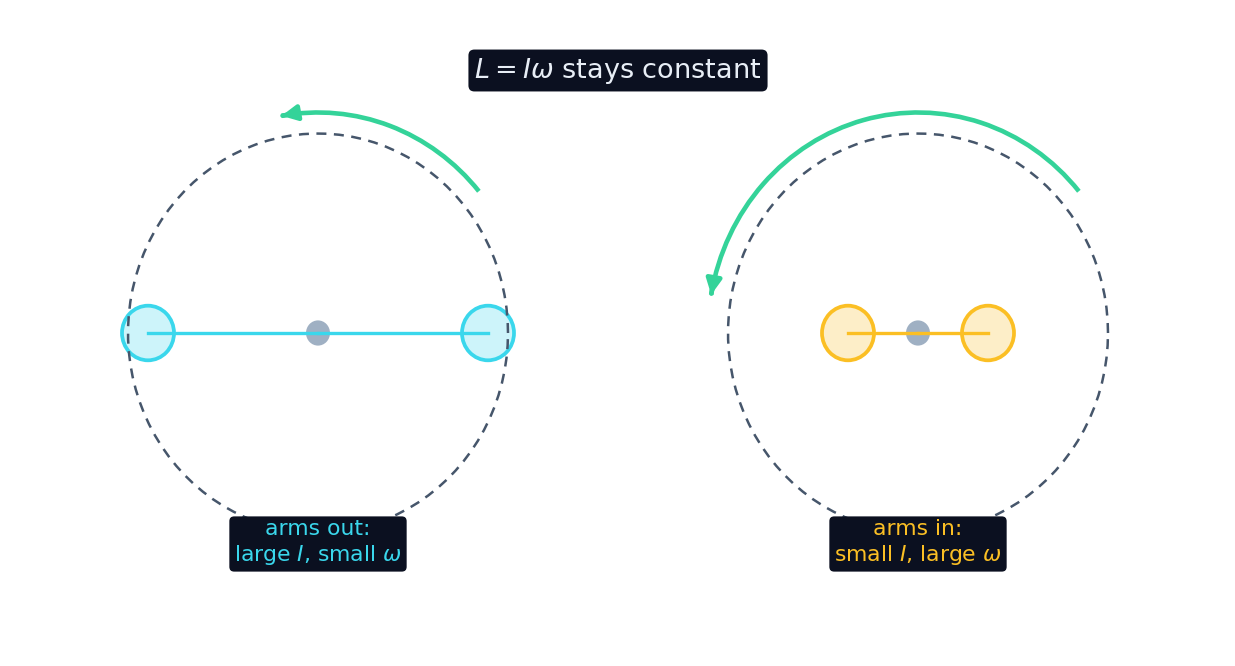
A skater has $I_1=6\ \text{kg}\cdot\text{m}^2$ and $\omega_1=2$ rad/s, then pulls in to $I_2=2\ \text{kg}\cdot\text{m}^2$. $6\times2=2\,\omega_2$, so $\omega_2=$ 6 rad/s, three times faster.
Conservation of angular momentum
With no external torque, a spinning skater speeds up by pulling in.
A skater with $I_1 = 8\ \text{kg}\cdot\text{m}^2$ spins at $1.5\ \tfrac{\text{rad}}{\text{s}}$, then pulls in to $I_2 = 3\ \text{kg}\cdot\text{m}^2$. What is her new $\omega$, in $\tfrac{\text{rad}}{\text{s}}$?
Kesulitan 2/5 · 140 koin + bonus kecil pada penyelesaian pertama hari ini
$I_1\omega_1 = I_2\omega_2 \Rightarrow 12 = 3\omega_2 \Rightarrow \omega_2 = 4\ \tfrac{\text{rad}}{\text{s}}$.
Pulling mass toward the axis (lowering $I$) makes a freely spinning object rotate faster.
Kesulitan 1/5 · 100 koin + bonus kecil pada penyelesaian pertama hari ini
To keep $L = I\omega$ constant, a smaller $I$ must be matched by a larger $\omega$.
Conservation of angular momentum for a reshaping object: $I_1\omega_1 = I_2\_\_$ (fill in the symbol).
Kesulitan 1/5 · 100 koin + bonus kecil pada penyelesaian pertama hari ini
$I_1\omega_1 = I_2\omega_2$ — the product $I\omega$ is unchanged.
Select semua examples explained by conservation of angular momentum.
Kesulitan 2/5 · 140 koin + bonus kecil pada penyelesaian pertama hari ini
Each spins faster as $I$ shrinks, keeping $I\omega$ fixed. A resting book is not spinning.
$L$ is conserved; kinetic energy may not be
- Rotational kinetic energy is $K=\tfrac12 I\omega^2$. For the skater: before, $\tfrac12(6)(2^2)=12$ J; after, $\tfrac12(2)(6^2)=36$ J. Her energy increases by 24 J, the work her muscles do pulling her arms in.
- In a rotational collision (objects that stick and turn together), $L$ is conserved but kinetic energy decreases: some becomes internal energy, like an inelastic collision in a straight line.
When a skater pulls her arms in, her rotational kinetic energy:
Kesulitan 1/5 · 100 koin + bonus kecil pada penyelesaian pertama hari ini
Angular momentum is conserved, but she does work pulling in, so her kinetic energy meningkat.
A disk spins at $\omega_0$ on a frictionless axle. An identical disk at rest is dropped onto it, on the same axle, and they turn together. What fraction of the original kinetic energy remains?
Kesulitan 1/5 · 100 koin + bonus kecil pada penyelesaian pertama hari ini
$L$ is conserved: $I\omega_0=2I\omega_f$, so $\omega_f=\omega_0/2$. $K_f=\tfrac12(2I)(\omega_0/2)^2=\tfrac14 I\omega_0^2$, half of $K_0=\tfrac12 I\omega_0^2$.
Worked FRQ: the merry-go-round
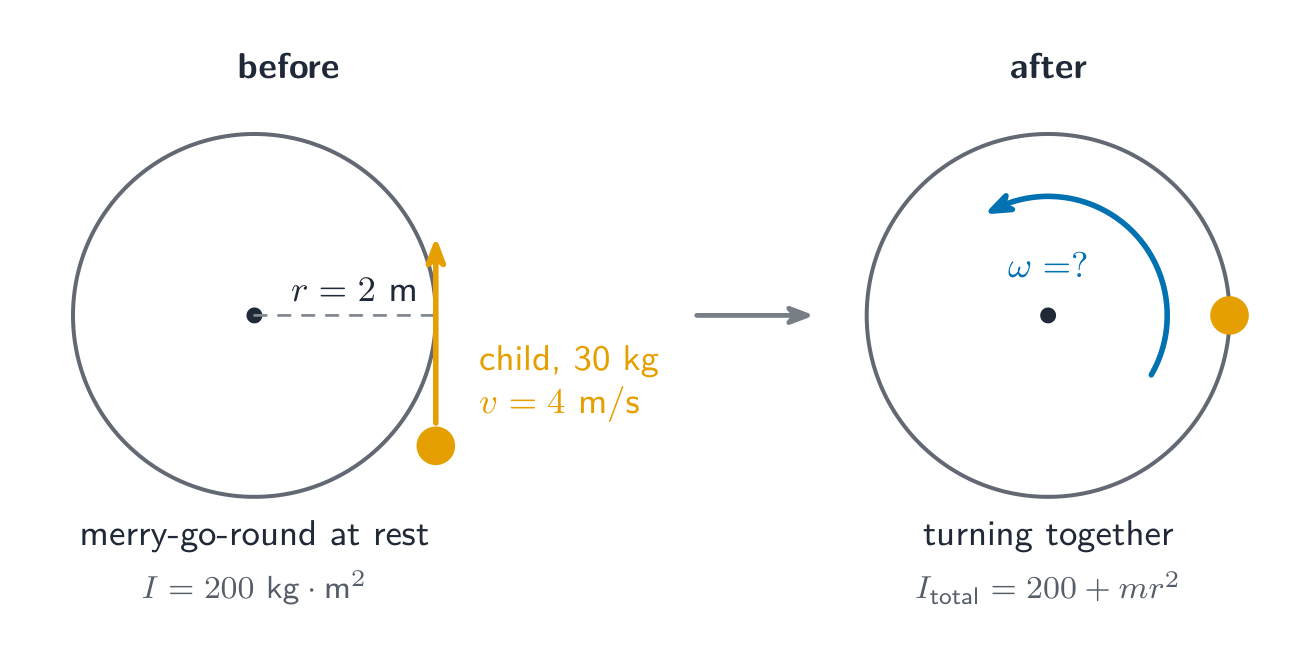
A merry-go-round ($I=200\ \text{kg}\cdot\text{m}^2$) is at rest. A 30 kg child runs at 4 m/s along a line tangent to its rim, 2 m from the axle, and jumps on. Friction at the axle is negligible.
(A) Find the angular speed just after the child lands. System: child + merry-go-round; no external torque about the axle. Units: $L$ in kg·m²/s, $I$ in kg·m².
(B) Is kinetic energy conserved? Justify. No. Before: $\tfrac12(30)(4^2)=240$ J. After: $\tfrac12(320)(0.75^2)=90$ J. 150 J becomes internal energy as the child's feet grip and slow.
(C) The axle pushes on the merry-go-round. Explain why $L$ is still conserved. The axle's force acts at the axis, so its lever arm is zero and it exerts no torque about the axle. (Linear momentum is not conserved: that force is external.)
- Why it scores: name the system and say why external torque is zero; include the child's $mr^2$ in the final $I$; compare energies with numbers, not just "it's inelastic".
A turntable ($I=0.50\ \text{kg}\cdot\text{m}^2$) spins at 4.0 rad/s. A 0.20 kg lump of clay is dropped straight down and sticks 0.50 m from the axis. Find the new angular speed, in rad/s.
Kesulitan 2/5 · 140 koin + bonus kecil pada penyelesaian pertama hari ini
$I_\text{after}=0.50+0.20(0.50^2)=0.55$. $\omega=\dfrac{0.50\times4.0}{0.55}\approx3.64$ rad/s. The clay falls straight down, so it brings no angular momentum about the axis.
- Conserved $L$ does not mean conserved energy. Pulling in adds energy (work by muscles); sticking together removes it.
- Use $L=mvr_\perp$ for an object moving in a straight line, with the perpendicular distance from the axis to its path, not its distance to the axis at some moment.
- Add the new mass to $I$ after objects join: $I_\text{after}=I_\text{disk}+mr^2$.
A system's total angular momentum is the sum of its parts' ($I\omega$ for rotating objects, $mvr_\perp$ for moving ones). It changes only by an external angular impulse, $\Delta L=\tau\Delta t$; internal torques cancel. With no external torque, $L_\text{before}=L_\text{after}$: changing shape trades $I$ for $\omega$, and rotational collisions conserve $L$ but lose kinetic energy.