Public and Private Goods
Diperkenalkan| English | Makna |
|---|---|
| rivalry/ˈraɪvəlri/ | persaingan |
| excludability/eksˌkluːdəˈbɪlɪti/ | keterkecualian |
| private good/ˈpraɪvət ɡʊd/ | barang swasta |
| club good/klʌb ɡʊd/ | barang klub |
| common resource/ˈkɒmən rɪˈzɔːs/ | sumber daya bersama |
| public good/ˈpʌblɪk ɡʊd/ | barang publik |
| free-rider problem/friː ˈraɪdə ˈprɒbləm/ | masalah penumpang gratis |
| free rider/friː ˈraɪdə/ | free rider |
| government/ˈɡʌvənmənt/ | pemerintah |
| marginal benefit/ˈmɑːdʒɪnl ˈbenɪfɪt/ | The additional benefit gained from consuming or undertaking one more unit of an activity. |
| tragedy of the commons/ˈtrædʒədi ɒvðə ˈkɒmənz/ | tragedi sumber daya bersama |
Why no company sells you a flood wall
- A town by a river needs a flood wall. Every house behind it is protected, whether the owner paid or not. A private firm could build it, but who would pay, when you are safe anyway once your neighbours pay?
- A sandwich, by contrast, is easy to sell: you pay, or you do not eat it. The difference comes down to two yes-or-no questions, and their answers tell us when a market works and when it fails.
Rivalry and excludability
- Rivalry 竞争性: does one person's use leave less for others? A sandwich is rival; a radio signal is non-rival. Excludability 排他性: can people who do not pay be kept out? A cinema is excludable; a fireworks display in the sky is not.
- Crossing the two questions gives four kinds of goods: a private good 私人物品 (rival and excludable), a club good 俱乐部物品 (excludable, non-rival), a common resource 公共资源 (rival, non-excludable) and a public good 公共物品 (neither rival nor excludable).
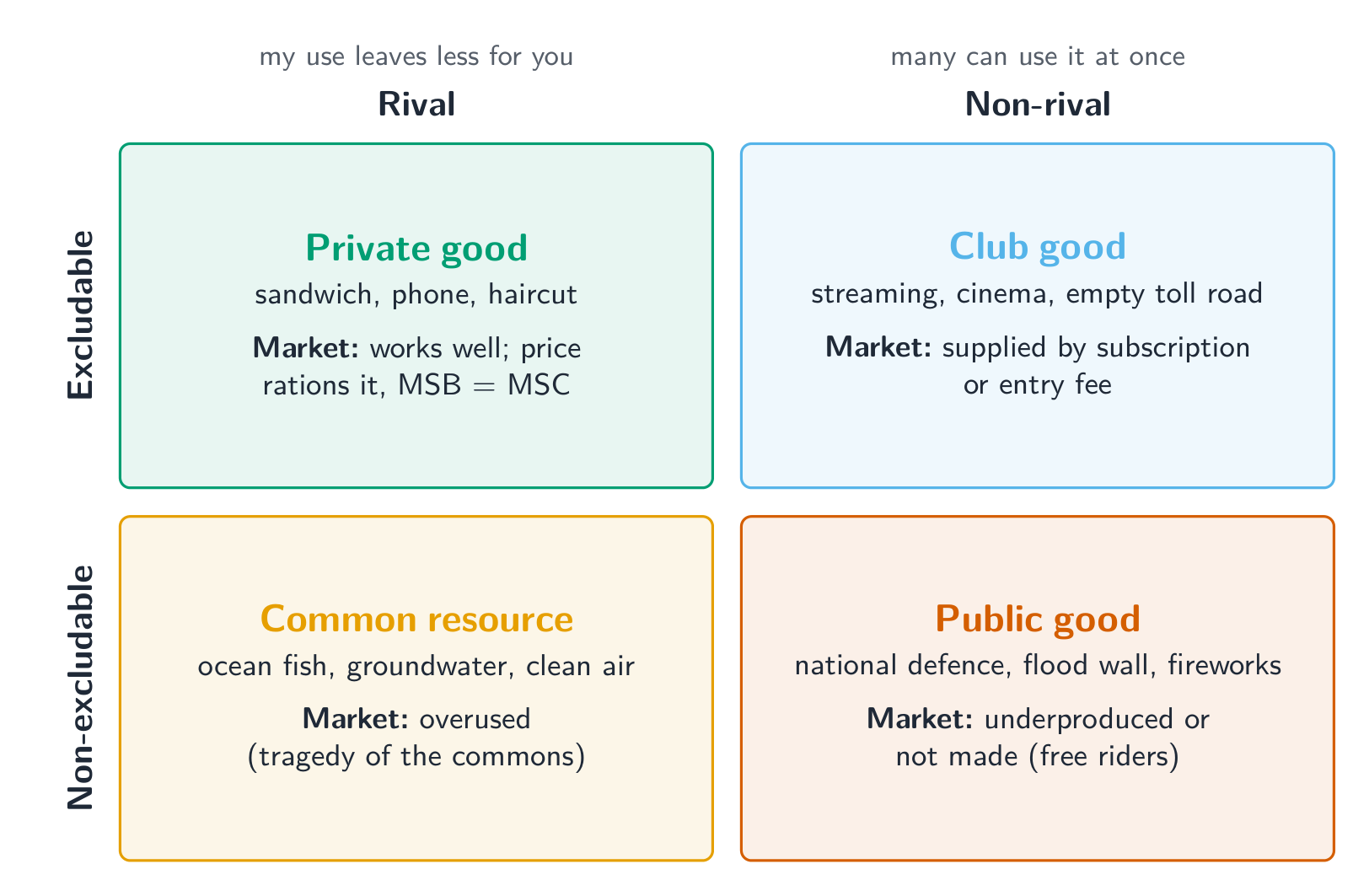
Which type of good?
Rivalry (does use it up?) and excludability (can non-payers be kept out?) sort goods into private, public, common resource, and club goods.
A good is "rival" when:
Kesulitan 1/5 · 100 koin + bonus kecil pada penyelesaian pertama hari ini
Rivalry is about using it up; excludability is about keeping non-payers out.
A public good, like national defence, is:
Kesulitan 1/5 · 100 koin + bonus kecil pada penyelesaian pertama hari ini
Everyone can use it at once (non-rival) and no one can be shut out (non-excludable).
Match each good to its type.
Kesulitan 2/5 · 140 koin + bonus kecil pada penyelesaian pertama hari ini
Rivalry and excludability place each good in one of the four boxes.
The free-rider problem
- If a public good is provided, nobody can be kept from using it. So each person has a reason to pay nothing and enjoy it anyway: a free rider 搭便车者. A private firm cannot charge enough to cover its costs, so the market makes too little of the good, or none.
- This free-rider problem 搭便车问题 is a market failure. The good is worth more to society than it costs, but the market does not produce it. That is why the government 政府 usually provides defence, flood walls and street lighting, and pays with taxes.
When everyone waits for someone else to pay for a public good, it is the ______-rider problem.
Kesulitan 1/5 · 100 koin + bonus kecil pada penyelesaian pertama hari ini
The free-rider problem leaves public goods underprovided, so the government steps in.
Worked example: adding up the benefits
Three neighbours share a street. Each streetlight costs 60 dollars a year. The table shows each person's marginal benefit 边际收益 from each light.
| Light | Ana | Ben | Chen | Total MSB |
|---|---|---|---|---|
| 1st | 50 | 30 | 20 | 100 |
| 2nd | 40 | 25 | 15 | 80 |
| 3rd | 30 | 20 | 10 | 60 |
| 4th | 20 | 10 | 5 | 35 |
- Because a light is non-rival, all three enjoy the same light. So the marginal social benefit of a light is the sum of their benefits. The efficient number is where total MSB = MC: the 3rd light (60 = 60). The 4th light is not worth it (35 < 60).
- Now leave it to the market. Even the 1st light is worth only 50 to Ana, the keenest buyer, and it costs 60. Nobody buys a light alone, so the market gives zero lights. The lost net benefit is (100 − 60) + (80 − 60) + (60 − 60) = 60 dollars.
Two neighbours value a 1st park bench at 35 and 25 dollars. A bench costs 50. What is the marginal social benefit of the 1st bench?
Kesulitan 2/5 · 140 koin + bonus kecil pada penyelesaian pertama hari ini
The bench is non-rival, so both enjoy it. MSB = 35 + 25 = 60, which is above the cost of 50, so it is efficient to build it, though neither would buy it alone.
In the streetlight example, why does the market provide zero lights when the efficient number is 3?
Kesulitan 1/5 · 100 koin + bonus kecil pada penyelesaian pertama hari ini
Ana values the 1st light at only 50, below its cost of 60. The total benefit is 100, but no one can charge Ben and Chen, who would free ride.
The tragedy of the commons
- A common resource is rival but open to everyone. Each fishing boat takes as many fish as it can, because fish it leaves behind may be caught by someone else. Each user ignores the cost their use puts on the others, so the private cost is below the social cost.
- The result is the tragedy of the commons 公地悲剧: the resource is overused and can collapse (Atlantic cod off Canada in 1992). Fixes add some excludability or a limit: catch quotas, tradable permits, licences, or clear property rights.
The tragedy of the commons happens because a common resource is rival but open to all.
Kesulitan 1/5 · 100 koin + bonus kecil pada penyelesaian pertama hari ini
Each user grabs as much as they can, so the resource is overused and depleted.
A good way to prevent the tragedy of the commons is to:
Kesulitan 1/5 · 100 koin + bonus kecil pada penyelesaian pertama hari ini
Limiting access (quota, fence, licence) stops the overuse that depletes the resource.
Each fishing boat on an open lake catches as many fish as it can. Which statement best explains why the lake is overfished?
Kesulitan 1/5 · 100 koin + bonus kecil pada penyelesaian pertama hari ini
Fish are rival (one boat's catch leaves less) but non-excludable. Each user's private cost is below the social cost, so the fish stock is overused.
Worked example: classifying four goods
Classify each and say whether a free market provides it well: (a) a sandwich; (b) a lighthouse; (c) fish in the open ocean; (d) a streaming service; (e) a free motorway in rush hour.
- (a) Private good: rival and excludable, so the market works well. (b) Public good: one ship seeing the light does not stop another (non-rival) and no ship can be kept from seeing it (non-excludable), so free riders mean the market under-provides it. (c) Common resource: rival but non-excludable, so it is overused.
- (d) Club good: excludable (you need an account) but non-rival, so a subscription works. (e) Common resource: nobody is charged, but at rush hour each extra car slows everyone else, so it is rival. The same road is close to a public good at 3 a.m., when it is empty.
Which is the best example of a public good?
Kesulitan 1/5 · 100 koin + bonus kecil pada penyelesaian pertama hari ini
It is non-rival and non-excludable.
Common resources tend to be overused because no one can be excluded but each use reduces what is left.
Kesulitan 1/5 · 100 koin + bonus kecil pada penyelesaian pertama hari ini
This is the tragedy of the commons.
Worked FRQ answer
Question: A town's New Year fireworks show can be seen by everyone in the town. (a) Identify the two characteristics that make the show a public good. (b) Explain why a private firm would produce fewer shows than is socially optimal. (c) The town council decides how many shows to fund. At the optimal number of shows, what is true about the sum of residents' marginal benefits?
(a) It is non-excludable (people who did not pay can still watch) and non-rival (one person watching does not reduce what others see).
(b) Because people cannot be excluded, many residents would watch without paying (the free-rider problem). The firm's revenue would be far below the true benefit to the town, so it would produce fewer shows than the quantity where marginal social benefit equals marginal social cost.
(c) The sum of all residents' marginal benefits from the last show equals the marginal cost of that show.
- Why it scores: (a) names both terms and says what each means for the show; (b) uses the phrase "free-rider problem" and links it to revenue below social benefit; (c) says "sum" of marginal benefits, because everyone enjoys the same show.
FRQ practice. A city has a public park with free entry. On summer weekends it becomes so crowded that each extra visitor makes the park less pleasant for everyone else. (a) On quiet weekdays, is the park closer to a public good or a common resource? Explain using rivalry. (b) On crowded weekends, which type of good is it? Explain. (c) Identify one policy that could reduce weekend overuse, and explain how it works.
The same good can change type when congestion makes it rival.
"Public good" does not mean "provided by the government". A state school lunch is still a private good: it is rival and excludable. And a public good is not a "good for the public": the test is only the two properties, rivalry and excludability.
Rivalry and excludability sort goods into private, club, common resource and public goods. Public goods suffer the free-rider problem: the market under-provides them, so governments often provide them. Their MSB is the sum of every user's marginal benefit. Common resources suffer the tragedy of the commons: they are overused unless access is limited.
Write from the data given
- A lake can sustain 15 boats. 40 boats are fishing.
- Name the overuse and the type of resource.
A lake can sustain 15 fishing boats, but 40 boats are out. How many boats are excess, and what kind of resource is the fish stock?
40 minus 15 is 25.
How many boats are above the sustainable number?
Kesulitan 1/5 · 100 koin + bonus kecil pada penyelesaian pertama hari ini
40 minus 15 is 25 extra boats. Other options — 40 (the boats currently fishing); 15 (the sustainable fleet).