Introduction to Factor Markets
Diperkenalkan 7:56
Pasar Faktor Produksi
Dua pekerja. Satu menjahit kemeja di pabrik pakaian. Yang lain membangun mobil di jalur perakitan. Yang kedua mendapat gaji jauh lebih tinggi. Mengapa? Dalam unit ini perusahaan adalah…
Narasi bahasa Inggris · takarir bahasa Inggris dan 中文 yang dapat dipilih
In this lesson
| English | Makna |
|---|---|
| factor market/ˈfæktə ˈmɑːkɪt/ | pasar faktor produksi |
| factors of production/ˈfæktəz ɒv prəˈdʌkʃn/ | faktor-faktor produksi |
| derived demand/dɪˈraɪvd dɪˈmænd/ | permintaan turunan |
| marginal revenue product/ˈmɑːdʒɪnl ˈrevənjuː ˈprɒdʌkt/ | produktivitas pendapatan marjinal |
| marginal factor cost/ˈmɑːdʒɪnl ˈfæktə kɒst/ | biaya faktor marjinal |
| hiring rule/ˈhaɪərɪŋ ruːl/ | aturan perekrutan |
| factor demand curve/ˈfæktə dɪˈmænd kɜːv/ | Kurva permintaan faktor |
Now the firm is the buyer
- Until now, firms have been sellers of goods.
- But to make those goods, a firm must first buy workers, land, and machines.
- In a factor market 要素市场 the firm is on the buying side.
- Here it hires the factors of production 生产要素 it needs.
Demand for a factor is derived
- No one wants a worker for their own sake — only for the goods that worker helps make.
- So factor demand is a derived demand 派生需求: it comes from the value of the product.
- When the product becomes more valuable, the demand for the workers who make it rises.
Factor demand is a "derived demand" because it comes from:
Kesulitan 1/5 · 100 koin + bonus kecil pada penyelesaian pertama hari ini
Firms want a factor only for the goods it produces, so demand is derived from the product.
Hire until MRP = MFC
- The marginal revenue product 边际收益产品 (MRP) is the extra revenue from one more unit of the factor: $MRP = MP \times P$.
- The marginal factor cost 边际要素成本 (MFC) is the extra cost of hiring one more unit.
- The hiring rule 雇佣法则: keep hiring until $MRP = MFC$.
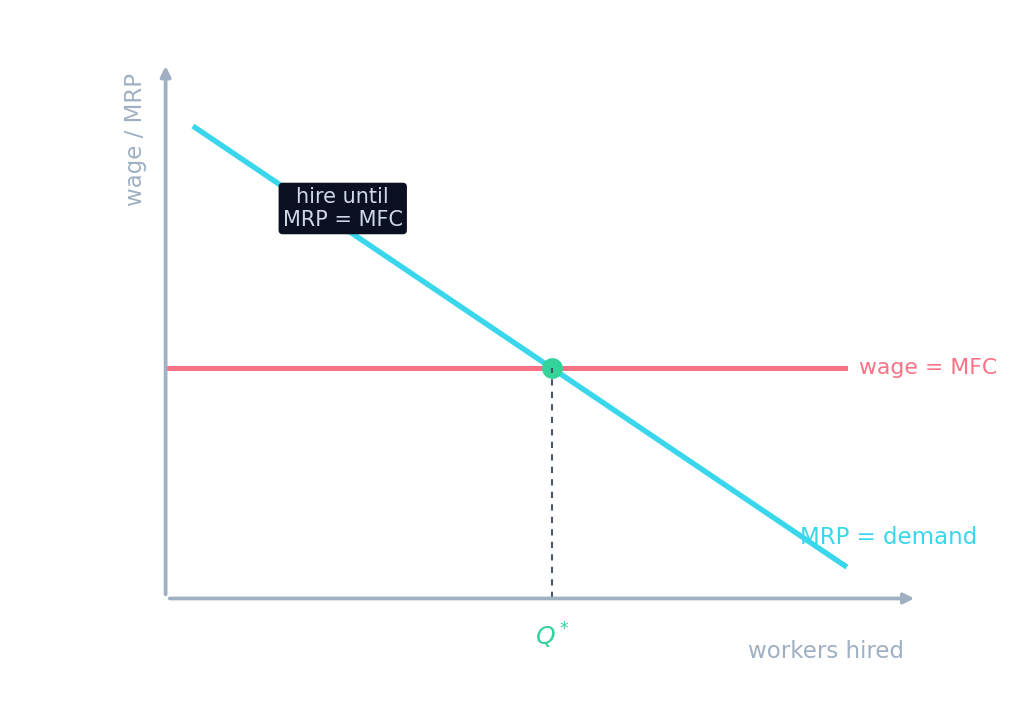
Hire, or don't?
A firm hires a worker only if the extra revenue (MRP) is at least the extra cost (the wage). Hire while MRP ≥ wage; stop when MRP falls below it.
For a competitive seller, MRP equals marginal product times the product ______.
Kesulitan 1/5 · 100 koin + bonus kecil pada penyelesaian pertama hari ini
MRP = MP × P — the extra output valued at the price it sells for.
A worker adds 8 loaves a day, and each loaf sells for 5. What is this worker's marginal revenue product?
Kesulitan 2/5 · 140 koin + bonus kecil pada penyelesaian pertama hari ini
MRP = MP × P = 8 × 5 = 40.
A firm keeps hiring workers until:
Kesulitan 1/5 · 100 koin + bonus kecil pada penyelesaian pertama hari ini
At MRP = MFC the last worker just pays for themselves; beyond it they cost more than they bring.
A sixth worker adds revenue (MRP) of 30, but the wage is 40. The firm should:
Kesulitan 1/5 · 100 koin + bonus kecil pada penyelesaian pertama hari ini
MRP (30) is below MFC (40), so hiring that worker would shrink profit.
The MRP curve is factor demand
- As more workers are added, marginal product falls (diminishing returns).
- So the MRP curve slopes downward — and that curve is the firm's factor demand curve 要素需求曲线.
The MRP curve slopes downward because marginal product falls as more workers are added.
Kesulitan 1/5 · 100 koin + bonus kecil pada penyelesaian pertama hari ini
Diminishing marginal product makes each extra worker's MRP smaller — a downward factor demand.
Worked example: how many workers to hire
A firm sells T-shirts at 10 dollars each in a competitive market and pays a wage of 60 dollars a day. Workers 1 to 5 add 12, 10, 8, 6 and 4 shirts a day. How many workers should it hire?
- MRP = marginal product × price: 120, 100, 80, 60, 40 dollars.
- Hire while MRP ≥ MFC (the wage of 60): workers 1–4. The 4th worker's MRP equals 60, so 4 workers; the 5th adds only 40 dollars of revenue but costs 60. If the shirt price rose to 15 dollars, every MRP would rise and the firm would hire more: derived demand.
A worker adds 8 units of output, each sold for 5 dollars. What is the worker's MRP, in dollars?
Kesulitan 2/5 · 140 koin + bonus kecil pada penyelesaian pertama hari ini
8 × 5 = 40 dollars.
If demand for houses falls, the demand for construction workers is likely to fall.
Kesulitan 1/5 · 100 koin + bonus kecil pada penyelesaian pertama hari ini
Labour demand is derived from demand for the product.
In a factor market the firm is a buyer, and its demand is derived from the product. Hire until $MRP = MFC$, where MRP $= MP \times P$. Because marginal product falls, the downward MRP curve is the firm's factor demand.
Write from the data: find the marginal revenue product
- A worker packs 6 boxes a day. Each box sells for 7 dollars.
- Find the worker's marginal revenue product.
A worker adds 6 boxes a day and each box sells for 7 dollars. What is the worker's marginal revenue product?
6 times 7 is 42.
What is the marginal revenue product?
Kesulitan 1/5 · 100 koin + bonus kecil pada penyelesaian pertama hari ini
6 times 7 is 42 dollars. Other options — 40 dollars (the lesson figure); 6 boxes (the extra output).