Monopoli
Diperkenalkan| English | Makna |
|---|---|
| price maker/praɪs ˈmeɪkə/ | pembuat harga |
| monopoly/məˈnɒpəli/ | monopoli |
| barriers to entry/ˈbærɪəz tʊ ˈentri/ | Obstacles that make it difficult for new firms to enter a market. |
| marginal revenue/ˈmɑːdʒɪnl ˈrevənjuː/ | Pendapatan marjinal |
| deadweight loss/ˈdedweɪt lɒs/ | kerugian tanpa berat |
| allocatively inefficient/ˈæləkətɪvli ɪnɪˈfɪʃənt/ | tidak efisien secara alokasi |
| natural monopoly/ˈnætʃərəl məˈnɒpəli/ | monopoli alami |
The only game in town
- One water company serves your city. One firm holds the patent on a new medicine. When a single firm is the only seller of a product with no close substitute, it does not take the market price: it is a price maker 价格制定者. That firm is a monopoly 垄断.
- A monopoly lasts only if others cannot enter. Barriers to entry 进入壁垒 include patents and copyrights, control of a key resource, government licences, and economies of scale so large that one firm can supply the whole market most cheaply.
Why marginal revenue is below price
- A monopoly faces the whole downward-sloping market demand curve. To sell one more unit it must lower the price on every unit, including the ones it could have sold at the higher price. So its marginal revenue 边际收入 is less than the price, and the MR curve lies below demand (for a straight-line demand, MR falls twice as fast).
| Q | P | Total revenue | MR |
|---|---|---|---|
| 1 | 10 | 10 | 10 |
| 2 | 9 | 18 | 8 |
| 3 | 8 | 24 | 6 |
| 4 | 7 | 28 | 4 |
- The 4th unit sells for 7, but MR is only 4: the firm gains 7 from the new sale and loses 1 on each of the first three units. A monopoly never produces where MR is negative, so it always operates on the elastic part of the demand curve.
Extra sales and the price cut on earlier units
Separate extra-unit receipts from the revenue lost on earlier units. Distinguish interval MR from the point derivative.
A monopoly is a price maker, which means it:
Kesulitan 1/5 · 100 koin + bonus kecil pada penyelesaian pertama hari ini
With no rivals, the monopolist picks the point on the demand curve that maximises profit.
For a monopoly, marginal revenue is below the price because it must cut the price on every unit to sell more.
Kesulitan 1/5 · 100 koin + bonus kecil pada penyelesaian pertama hari ini
Lowering the price on all units makes the extra revenue (MR) smaller than the price.
A monopoly can sell 5 units at 12 dollars each or 6 units at 11 dollars each. What is the marginal revenue of the 6th unit, in dollars?
Kesulitan 2/5 · 140 koin + bonus kecil pada penyelesaian pertama hari ini
Total revenue goes from 5 × 12 = 60 to 6 × 11 = 66, so MR = 6. The 6th unit sells for 11, but the price cut costs 1 on each of the first 5 units.
The monopoly outcome on one graph
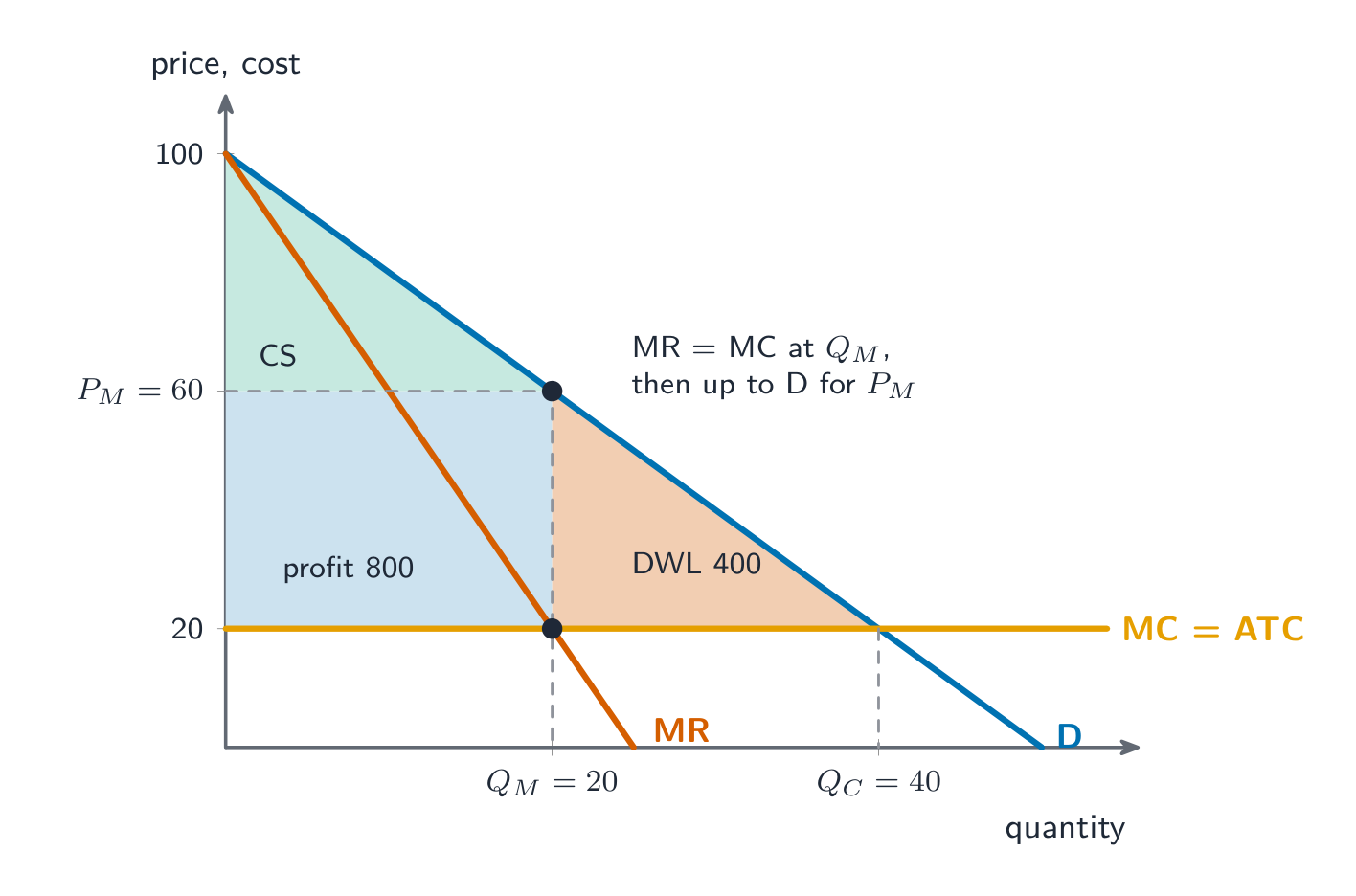
- Three steps: (1) find quantity where MR = MC, $Q_M$; (2) go straight up to the demand curve to read the price $P_M$; (3) compare with ATC at $Q_M$: profit per unit is $P_M - ATC$, and total profit is the rectangle $(P_M - ATC) \times Q_M$.
- Because $P_M > MC$, buyers value the next units more than they cost to make, but the monopoly will not make them. Those lost trades between $Q_M$ and the competitive $Q_C$ (where $P = MC$) are the deadweight loss 无谓损失: a monopoly is allocatively inefficient 配置无效率. It is usually not productively efficient either, because it does not produce at minimum ATC.
The firm's cost curves
A monopolist still produces where marginal revenue meets marginal cost — but then charges a higher price off its downward-sloping demand.
Demand is P = 100 − Q, so MR = 100 − 2Q. With MC = 20, what is the monopoly quantity where MR = MC?
Kesulitan 2/5 · 140 koin + bonus kecil pada penyelesaian pertama hari ini
Set 100 − 2Q = 20 → 2Q = 80 → Q = 40.
Using the same demand P = 100 − Q, what price does the monopolist charge at Q = 40?
Kesulitan 2/5 · 140 koin + bonus kecil pada penyelesaian pertama hari ini
Read the price off demand: P = 100 − 40 = 60. Since 60 > MC = 20, there is a deadweight loss.
A monopoly is allocatively inefficient because at its output:
Kesulitan 1/5 · 100 koin + bonus kecil pada penyelesaian pertama hari ini
P > MC means the last unit is worth more than it costs, yet it is not made — a deadweight loss.
On a monopoly graph, after finding Q_M where MR = MC, where do you read the profit-maximizing price?
Kesulitan 1/5 · 100 koin + bonus kecil pada penyelesaian pertama hari ini
Buyers pay what the demand curve says they will pay for Q_M units. The MR = MC point gives quantity only.
Worked example: the numbers behind the graph
A monopoly faces $P = 100 - 2Q$, so $MR = 100 - 4Q$. Its $MC = ATC = 20$ at every output. Find $Q_M$, $P_M$, profit, consumer surplus and deadweight loss.
- $MR = MC$: $100 - 4Q = 20$, so $Q_M = 20$. From the demand curve, $P_M = 100 - 2 \times 20 = 60$. Profit $= (60 - 20) \times 20 =$ 800. Consumer surplus $= \tfrac12 \times 20 \times (100 - 60) =$ 400.
- A competitive market would produce where $P = MC$: $100 - 2Q = 20$, so $Q_C = 40$. Deadweight loss $= \tfrac12 \times (40 - 20) \times (60 - 20) =$ 400. Under competition, consumer surplus would be $\tfrac12 \times 40 \times 80 = 1{,}600$: the monopoly turns 800 of it into profit and destroys 400.
Natural monopoly
- A natural monopoly 自然垄断 has such large fixed costs (water pipes, a power grid) that ATC keeps falling over the whole market demand. One firm can then supply the market more cheaply than two, so competition would waste resources by building a second network.
- Governments often regulate natural monopolies instead of breaking them up: a price set at $P = MC$ is allocatively efficient but may leave the firm with a loss; a price set at $P = ATC$ (a "fair return") lets it break even. Unit 6.4 covers this in detail.
A market best served by one firm because of huge fixed costs is a ______ monopoly.
Kesulitan 1/5 · 100 koin + bonus kecil pada penyelesaian pertama hari ini
A natural monopoly (like a water network) has one firm serve everyone at lower average cost.
Worked FRQ answer
Question: Glow Co. is an unregulated monopoly earning economic profit. (a) Draw a correctly labeled graph showing demand, MR, MC and ATC, and label the profit-maximizing quantity $Q_M$ and price $P_M$. (b) Shade the area of economic profit. (c) Is Glow Co. allocatively efficient? Explain using your graph. (d) Label the quantity $Q_E$ that would be allocatively efficient.
(a) Price on the vertical axis, quantity on the horizontal; downward-sloping D with MR below it; a U-shaped ATC and an MC crossing ATC at its minimum. $Q_M$ where MR = MC; $P_M$ read from the demand curve directly above $Q_M$.
(b) The rectangle from $P_M$ down to ATC at $Q_M$, across from the price axis to $Q_M$, with ATC below $P_M$.
(c) No. At $Q_M$, the price (marginal benefit to buyers) is greater than MC, so society would gain from more output.
(d) $Q_E$ where MC crosses the demand curve, to the right of $Q_M$.
- Why it scores: (a) $P_M$ is read from demand, not from the MR = MC point, the most common lost point; (b) the rectangle's height is $P_M$ minus ATC, not minus MC; (d) the efficient quantity uses demand (marginal benefit), not MR.
FRQ practice. A monopoly faces P = 80 − Q, so MR = 80 − 2Q. Its MC = ATC = 20. (a) Find the profit-maximizing quantity and price. (b) Calculate economic profit. (c) Find the allocatively efficient quantity. (d) Calculate the deadweight loss.
MR = MC for quantity, demand for price, P = MC for the efficient quantity.
Common errors. Reading the price at the MR = MC point instead of going up to demand. Drawing MR above or equal to demand. Using MC instead of ATC for the profit rectangle. Saying a monopoly charges "the highest possible price": it chooses the profit-maximizing price, and demand still limits what it can sell.
A monopoly is the only seller, protected by barriers to entry, and is a price maker. MR is below price because a lower price applies to every unit. It produces $Q_M$ where MR = MC, charges $P_M$ from the demand curve, and earns profit $(P_M - ATC) \times Q_M$. Since $P_M > MC$, output is too low: a deadweight loss, so it is allocatively inefficient. A natural monopoly has falling ATC across the market and is often regulated.
Write from the data: find the monopoly quantity
- Demand is P = 50 minus Q, so marginal revenue is 50 minus 2Q.
- Marginal cost is 10. Find quantity and price.
Demand is P = 50 minus Q, so marginal revenue is 50 minus 2Q. Marginal cost is 10. What quantity and price does a single-price monopoly choose?
40 divided by 2 is 20, and 50 minus 20 is 30.
What price does the monopolist charge?
Kesulitan 1/5 · 100 koin + bonus kecil pada penyelesaian pertama hari ini
Quantity 20 on the demand curve gives price 30. Other options — 60 (the lesson monopoly price); 10 (the marginal cost).