Types of Profit
Diperkenalkan| English | Makna |
|---|---|
| implicit costs/ɪmˈplɪsɪt kɒsts/ | Biaya implisit |
| explicit costs/ekˈsplɪsɪt kɒsts/ | Biaya eksplisit |
| opportunity cost/ɒpəˈtjuːnɪti kɒst/ | Biaya peluang |
| accounting profit/əˈkaʊntɪŋ ˈprɒfɪt/ | Laba akuntansi |
| economic profit/ˌiːkəˈnɒmɪk ˈprɒfɪt/ | Laba ekonomi |
| normal profit/ˈnɔːml ˈprɒfɪt/ | Laba normal |
Two ways to measure profit
- An accountant and an economist look at the same cafe and disagree about its profit.
- Neither is wrong — they simply count different costs.
- The gap between them is one of the most useful ideas in economics.
- It decides whether a business should keep going, or do something else entirely.
Explicit and implicit costs
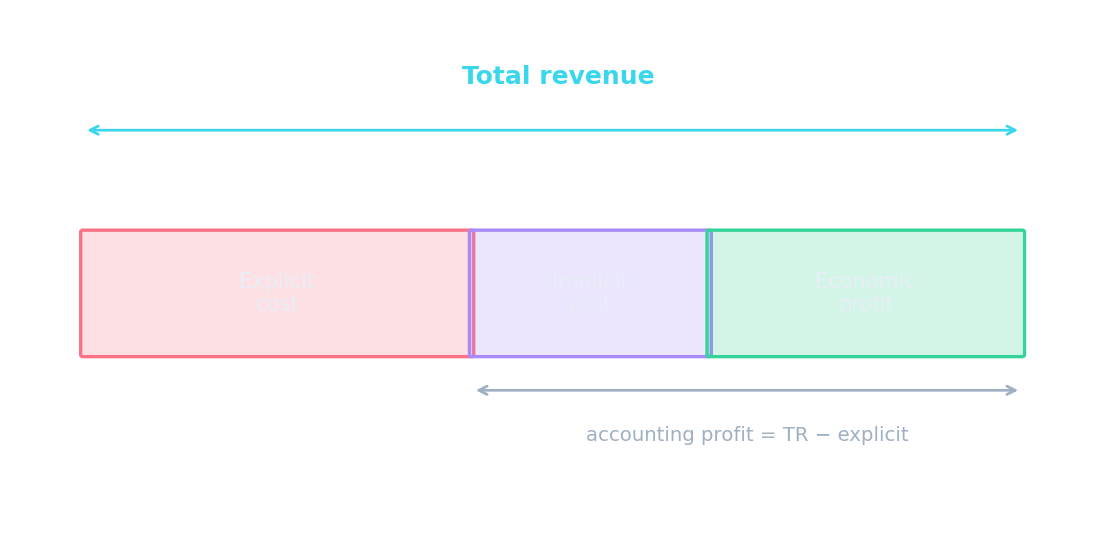
- Explicit costs 显性成本 are real money paid out — wages, rent, materials. They show up on a bill.
- Implicit costs 隐性成本 are the value of resources the owner already owns and uses — no money changes hands.
- The key implicit cost is the opportunity cost 机会成本 of the owner's own time and money.
Explicit atau implicit?
Explicit costs are money actually paid out; implicit costs are the opportunity cost of resources the owner already owns.
Accounting vs economic profit
- Accounting profit 会计利润 = total revenue − explicit costs only.
- Economic profit 经济利润 = total revenue − (explicit and implicit costs).
- So economic profit is always smaller than accounting profit.
- Normal profit 正常利润 is when economic profit is exactly zero — the owner covers every cost, including opportunity cost.
Accounting profit equals:
Kesulitan 1/5 · 100 koin + bonus kecil pada penyelesaian pertama hari ini
Accountants subtract only the explicit (paid-out) costs.
Economic profit is always smaller than (or equal to) accounting profit.
Kesulitan 1/5 · 100 koin + bonus kecil pada penyelesaian pertama hari ini
Economic profit subtracts implicit costs as well, so it cannot be larger.
Maria's revenue is 200,000; explicit costs are 130,000; the salary she gave up (implicit cost) is 50,000. What is her economic profit?
Kesulitan 2/5 · 140 koin + bonus kecil pada penyelesaian pertama hari ini
Economic profit = 200,000 − 130,000 − 50,000 = 20,000.
When economic profit is exactly zero, the firm earns ______ profit.
Kesulitan 1/5 · 100 koin + bonus kecil pada penyelesaian pertama hari ini
Normal profit means every cost — including opportunity cost — is just covered.
The signal to enter or exit
- Positive economic profit → the firm beats its next-best option, so new firms enter.
- Negative economic profit (a loss) → the owner could do better elsewhere, so firms exit.
- Zero economic profit (normal profit) → no reason to enter or leave.
Firms in a market are earning positive economic profit. Over time:
Kesulitan 1/5 · 100 koin + bonus kecil pada penyelesaian pertama hari ini
Positive economic profit beats the next-best option, so new firms are attracted to enter.
Match each economic-profit signal to what firms do.
Kesulitan 2/5 · 140 koin + bonus kecil pada penyelesaian pertama hari ini
Economic profit is the entry/exit signal because it already includes opportunity cost.
Worked example: is the café really profitable?
Lin's café earns revenue of 120,000 dollars a year. She pays 70,000 dollars in rent, wages and supplies. She left a job paying 45,000 dollars to run it, and her 50,000 dollars of savings in the café could earn 2,000 dollars a year in interest. Find both profits.
- Accounting profit = 120,000 − 70,000 = 50,000 dollars. Implicit costs = 45,000 + 2,000 = 47,000 dollars.
- Economic profit = 120,000 − (70,000 + 47,000) = 3,000 dollars. It is positive, so the café earns more than her next best alternative, and she should keep it open. If it were exactly zero, she would earn a normal profit.
Revenue is 200 thousand dollars, explicit costs 150 thousand and implicit costs 60 thousand. What is economic profit, in thousands of dollars?
Kesulitan 2/5 · 140 koin + bonus kecil pada penyelesaian pertama hari ini
200 − (150 + 60) = −10: an economic loss.
A firm earning zero economic profit is still covering all its opportunity costs.
Kesulitan 1/5 · 100 koin + bonus kecil pada penyelesaian pertama hari ini
Zero economic profit is a normal profit.
Three cases side by side
| Firm A | Firm B | Firm C | |
|---|---|---|---|
| Revenue | 100 | 100 | 100 |
| Explicit cost | 60 | 60 | 60 |
| Implicit cost | 30 | 40 | 50 |
| Accounting profit | 40 | 40 | 40 |
| Economic profit | 10 | 0 | −10 |
- All three firms show the same accounting profit, but only A earns more than its owner's next best option. B earns normal profit. C makes an economic loss: its owner would be better off elsewhere, even though the accounts show a profit of 40.
A shop has accounting profit of 25,000 dollars. Its owner gave up a job paying 30,000 dollars to run it. What is its economic profit, and what should the owner do in the long run, other things equal?
Kesulitan 1/5 · 100 koin + bonus kecil pada penyelesaian pertama hari ini
Economic profit = 25,000 − 30,000 = −5,000. The owner's next best option pays more.
Worked FRQ answer
Question: Firms in a perfectly competitive market each earn total revenue of 500,000 dollars, pay explicit costs of 380,000 dollars, and have implicit costs of 150,000 dollars. (a) Calculate a typical firm's accounting profit. (b) Calculate its economic profit. (c) In the long run, will firms enter or leave this market? Explain. (d) What happens to the market price as a result?
(a) 500,000 − 380,000 = 120,000 dollars.
(b) 500,000 − (380,000 + 150,000) = −30,000 dollars, an economic loss.
(c) Firms will leave. Their owners' resources could earn more in their next best use, so the market is not worth staying in, even though accounting profit is positive.
(d) As firms leave, market supply shifts left, so the price rises until the remaining firms earn zero economic profit (normal profit).
- Why it scores: (b) includes implicit costs; (c) bases the decision on economic, not accounting, profit; (d) links exit to a leftward supply shift and the price rising until economic profit is zero.
FRQ practice. A bakery earns revenue of 200,000 dollars. Explicit costs are 140,000 dollars. The owner could earn 50,000 dollars in another job, and her invested savings could earn 4,000 dollars elsewhere. (a) Calculate accounting profit. (b) Calculate economic profit. (c) Is the bakery earning a normal profit, more, or less? (d) If this is typical of the market, will firms enter or exit in the long run?
Implicit costs are the owner's forgone wage and forgone interest.
Common errors. Deciding entry or exit from accounting profit. Thinking zero economic profit means the owner earns nothing: they earn exactly what their next best option would pay (normal profit). Adding the opportunity cost of every alternative instead of the single best one.
Accounting profit subtracts only explicit costs; economic profit subtracts implicit costs too, so it is smaller. Normal profit = zero economic profit. Economic profit is the right signal: positive attracts entry, negative forces exit.
Write from the data: find the accounting profit
- Revenue is 80. Explicit costs are 45. The forgone wage is 20.
- Find accounting profit and economic profit.
Revenue is 80, explicit costs are 45 and the forgone wage is 20. What are accounting profit and economic profit?
80 minus 45 is 35, and 35 minus 20 is 15.
What is the economic profit?
Kesulitan 1/5 · 100 koin + bonus kecil pada penyelesaian pertama hari ini
Accounting profit 35 minus the forgone wage 20 is economic profit 15.