Short-Run Production Costs
Diperkenalkan| English | Makna |
|---|---|
| short run/ʃɔːt rʌn/ | A period in which at least one factor of production is fixed. |
| variable costs/ˈveərɪəbl kɒsts/ | variable costs |
| fixed costs/fɪkst kɒsts/ | fixed costs |
| raw materials/rɔː məˈtɪərɪəlz/ | raw materials |
| total cost/ˈtəʊtl kɒst/ | jumlah kos |
| average fixed cost/ˈævrɪdʒ fɪkst kɒst/ | average fixed cost |
| average variable cost/ˈævrɪdʒ ˈveərɪəbl kɒst/ | average variable cost |
| average total cost/ˈævrɪdʒ ˈtəʊtl kɒst/ | average total cost |
| marginal cost/ˈmɑːdʒɪnl kɒst/ | biaya marjinal |
| diminishing marginal returns/dɪˈmɪnɪʃɪŋ ˈmɑːdʒɪnl rɪˈtɜːnz/ | The eventual decline in additional output from extra units of one input when other inputs are held constant. |
Which costs move, and which don't
- A small bakery pays 60 dollars a day in rent whether it bakes 1 loaf or 500. Flour, electricity for the ovens and the bakers' hourly wages, though, rise with every extra batch.
- Sorting costs by how they behave as output changes tells the owner what each extra loaf really costs, and later, how many loaves to bake. In the short run 短期 at least one input (the building) is fixed.
Fixed and variable costs
- Fixed costs 固定成本 (FC) do not change with output: rent, insurance, a licence fee, loan repayments. You pay them even at zero output.
- Variable costs 可变成本 (VC) rise as output rises: hourly wages, raw materials 原材料, packaging. Together they make total cost 总成本: $TC = FC + VC$.
Total cost equals fixed cost plus ______ cost.
Kesulitan 1/5 · 100 koin + bonus kecil pada penyelesaian pertama hari ini
TC = FC + VC. Fixed costs stay put; variable costs rise with output.
Match each cost to its example.
Kesulitan 2/5 · 140 koin + bonus kecil pada penyelesaian pertama hari ini
Rent is fixed, wages/materials vary with output, and MC is the cost of the next unit.
Per-unit costs
- Average fixed cost 平均固定成本 $AFC = \tfrac{FC}{Q}$ always falls as output rises, because the same rent is spread over more units. Average variable cost 平均可变成本 $AVC = \tfrac{VC}{Q}$ and average total cost 平均总成本 $ATC = \tfrac{TC}{Q} = AFC + AVC$.
- Marginal cost 边际成本 is the extra cost of one more unit: $MC = \tfrac{\Delta TC}{\Delta Q}$. Fixed cost does not change, so MC is also $\tfrac{\Delta VC}{\Delta Q}$.
Total cost is 160 at 10 units and 175 at 11 units. What is the marginal cost of the 11th unit?
Kesulitan 2/5 · 140 koin + bonus kecil pada penyelesaian pertama hari ini
MC = ΔTC/ΔQ = (175 − 160)/1 = 15.
As output rises, average fixed cost:
Kesulitan 1/5 · 100 koin + bonus kecil pada penyelesaian pertama hari ini
The same fixed cost divided by a larger quantity keeps shrinking.
Worked example: a full cost table
The bakery's fixed cost is 60. Fill in the table from total cost (Q is batches per day).
| Q | TC | MC | AVC | ATC |
|---|---|---|---|---|
| 0 | 60 | – | – | – |
| 1 | 100 | 40 | 40 | 100 |
| 2 | 130 | 30 | 35 | 65 |
| 3 | 150 | 20 | 30 | 50 |
| 4 | 180 | 30 | 30 | 45 |
| 5 | 230 | 50 | 34 | 46 |
- MC is the change in TC: 130 − 100 = 30 for the 2nd batch. AVC = (TC − 60) ÷ Q: at Q = 3, VC = 90, so AVC = 30. ATC = TC ÷ Q: at Q = 4, 180 ÷ 4 = 45.
- Watch MC against ATC. Up to Q = 4, MC is below ATC, so ATC keeps falling. The 5th batch costs 50, above the average of 45, so ATC rises to 46. ATC is lowest at Q = 4.
A firm has fixed cost 50. Total cost is 110 at Q = 2 and 150 at Q = 3. What is average variable cost at Q = 3?
Kesulitan 2/5 · 140 koin + bonus kecil pada penyelesaian pertama hari ini
VC = 150 − 50 = 100, so AVC = 100 ÷ 3 ≈ 33.33.
Same firm. What is the marginal cost of the 3rd unit?
Kesulitan 2/5 · 140 koin + bonus kecil pada penyelesaian pertama hari ini
MC = 150 − 110 = 40. Fixed cost does not enter MC.
Why the curves are U-shaped
- MC first falls, then rises because of marginal product. With a fixed oven, the first few bakers add more and more output each (they can specialise), so each batch costs less. Then diminishing marginal returns 边际收益递减 set in: extra bakers crowd the kitchen, each adds less output, and MC rises.
- MC pulls the averages. When MC is below an average it pulls that average down; above, it pulls it up. So MC crosses AVC and ATC at their lowest points. The gap between ATC and AVC is AFC, which shrinks as output rises.
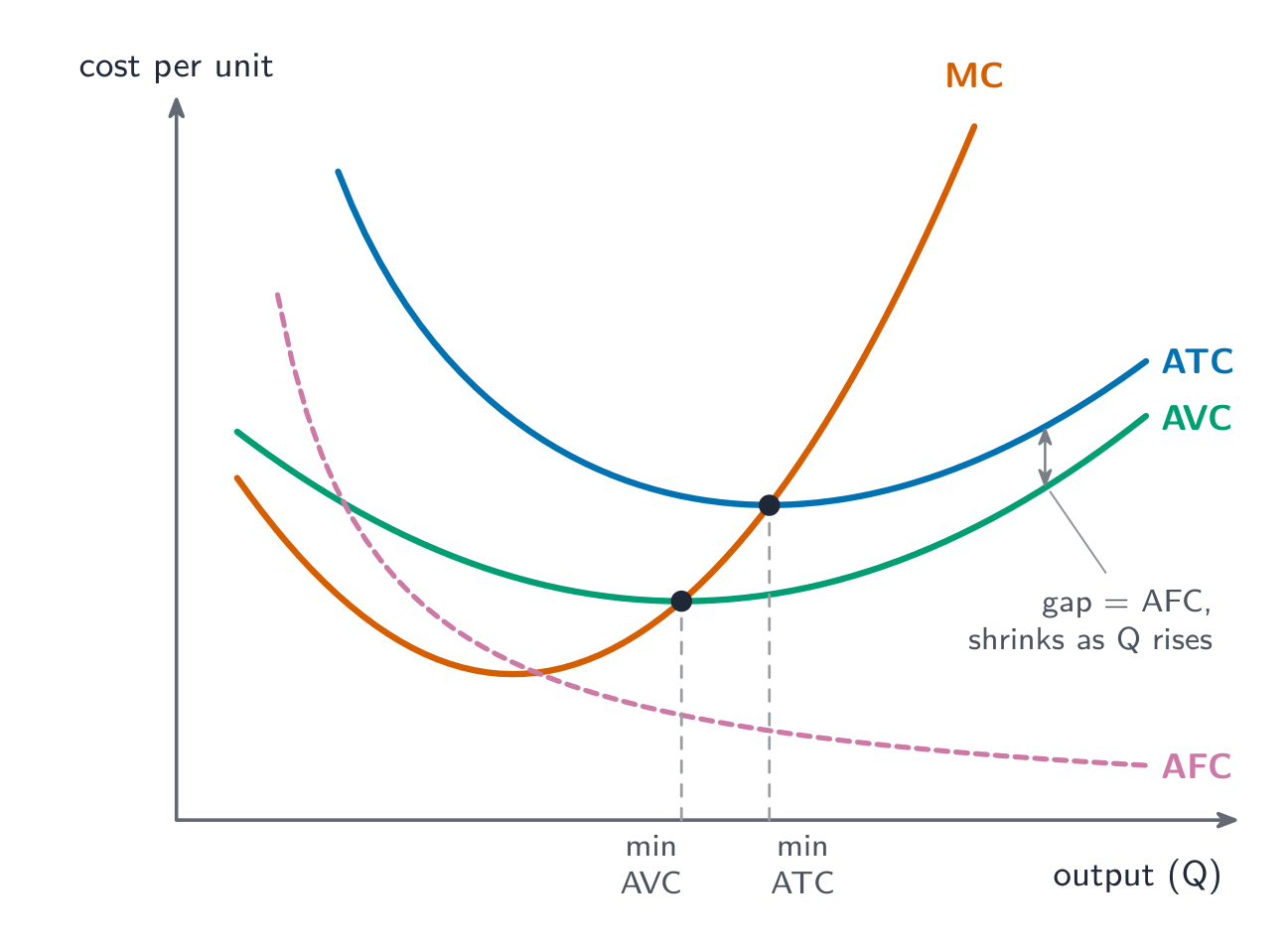
The firm's cost curves
Average cost is U-shaped, and marginal cost cuts it exactly at the minimum. Drag the output and watch marginal cost pull the average up or down.
The marginal cost curve crosses the average total cost curve at its lowest point.
Kesulitan 1/5 · 100 koin + bonus kecil pada penyelesaian pertama hari ini
Below the average MC pulls it down, above it pulls it up — so they cross at the minimum.
If the marginal cost of the next unit is below average total cost, then ATC will:
Kesulitan 1/5 · 100 koin + bonus kecil pada penyelesaian pertama hari ini
A below-average marginal cost pulls the average down.
In the short run, marginal cost eventually rises because
Kesulitan 1/5 · 100 koin + bonus kecil pada penyelesaian pertama hari ini
With a fixed building or machine, extra workers add less and less output, so each extra unit needs more labour and costs more.
What shifts which curve
| A change in… | Curves that shift up |
|---|---|
| fixed cost (rent, licence fee, lump-sum tax) | AFC and ATC only |
| variable cost (wages, materials, per-unit tax) | MC, AVC and ATC |
- A fixed-cost change does not move MC: the extra cost of one more unit is the same, whatever the rent. This is one of the most tested points in AP Microeconomics FRQs.
Match each change to the curves it shifts up.
Kesulitan 2/5 · 140 koin + bonus kecil pada penyelesaian pertama hari ini
Rent is fixed, so it does not change the cost of one more unit. A per-unit tax and wages are variable costs.
Worked FRQ answer
Question: A firm produces at the output where MC = ATC. (a) The government raises the firm's annual licence fee. What happens to the firm's marginal cost and average total cost? Explain. (b) Instead, the price of a raw material rises. What happens to marginal cost and average variable cost? Explain.
(a) Marginal cost does not change, because the licence fee is a fixed cost and does not depend on output, so the cost of one more unit is unchanged. Average total cost increases, because AFC rises at every output.
(b) Marginal cost increases and average variable cost increases, because the material is a variable cost: every extra unit now costs more to make.
- Why it scores: each answer gives a direction and names the cost type (fixed or variable) as the reason. Saying "MC rises in (a)" is the classic lost point.
FRQ practice. A firm's fixed cost is 40. Its total costs are: Q = 1, 70; Q = 2, 90; Q = 3, 120; Q = 4, 160. (a) Calculate the marginal cost of the 3rd unit. (b) Calculate average total cost at Q = 4. (c) The government places a per-unit tax of 5 on the firm. What happens to the marginal cost of the 3rd unit? Explain.
A lump-sum tax would have left MC at 30; only a per-unit tax changes MC.
Common errors. Calculating MC as TC ÷ Q (that is ATC). Thinking MC must cross ATC at its highest point. Shifting MC after a change in fixed cost. Drawing MC through the middle of the U instead of through the lowest points of AVC and ATC.
TC = FC + VC. AFC always falls; ATC = AFC + AVC. MC = ΔTC ÷ ΔQ falls with increasing returns, then rises with diminishing marginal returns. MC crosses AVC and ATC at their minimum points. A change in fixed cost shifts only AFC and ATC; a change in variable cost shifts MC, AVC and ATC.
Write from the data: find the marginal cost
- Total cost is 200 at 8 units and 232 at 9 units.
- Find the marginal cost of the 9th unit.
Total cost is 200 at 8 units and 232 at 9 units. What is the marginal cost of the 9th unit?
232 minus 200 is 32.
What is the marginal cost of the 9th unit?
Kesulitan 1/5 · 100 koin + bonus kecil pada penyelesaian pertama hari ini
232 minus 200 is 32. Other options — 15 (the lesson marginal cost); 232 (the new total cost).