Price Elasticity of Demand
Diperkenalkan| English | Makna |
|---|---|
| price elasticity of demand/praɪs ɪlæˈstɪsɪti ɒv dɪˈmænd/ | elastisitas harga permintaan |
| midpoint method/ˈmɪdpɔɪnt ˈmeθəd/ | metode titik tengah |
| absolute value/ˈæbsəluːt ˈvæljuː/ | nilai mutlak |
| elastic/ɪˈlæstɪk/ | elastis |
| inelastic/ɪnɪˈlæstɪk/ | inelastis |
| unit elastic/ˈjuːnɪt ɪˈlæstɪk/ | unit elastis |
| total revenue/ˈtəʊtl ˈrevənjuː/ | pendapatan total |
Should the cinema cut its price?
- A cinema cuts tickets from 12 to 10 dollars. If attendance rises from 300 to 330, revenue falls from 3,600 to 3,300. If it rises to 400, revenue grows to 4,000. The same price cut can help or hurt.
- What decides it is how strongly buyers respond to price: the price elasticity of demand 需求价格弹性 (PED).
Measuring PED with the midpoint method
- $\text{PED} = \dfrac{\%\,\Delta\,\text{quantity demanded}}{\%\,\Delta\,\text{price}}$. Price and quantity demanded move in opposite directions, so PED is negative; we use its absolute value 绝对值.
- The midpoint method 中点法 divides each change by the average of the start and end values, so the answer is the same whether price rises or falls: $\%\Delta Q = \dfrac{Q_2 - Q_1}{(Q_1 + Q_2)/2}$, and the same for price.
Price elasticity of demand is calculated as:
Kesulitan 1/5 · 100 koin + bonus kecil pada penyelesaian pertama hari ini
PED divides the percentage change in quantity by the percentage change in price.
Put the midpoint-method steps to find PED in order.
Kesulitan 3/5 · 200 koin + bonus kecil pada penyelesaian pertama hari ini
The midpoint method divides each change by the average of the two values, then you take |PED|.
Elastic, inelastic, unit elastic, and the extremes
- Elastic 富有弹性: $|\text{PED}| > 1$, quantity changes by a larger percentage than price. Inelastic 缺乏弹性: $|\text{PED}| < 1$, a smaller percentage. Unit elastic 单位弹性: $|\text{PED}| = 1$, the same percentage.
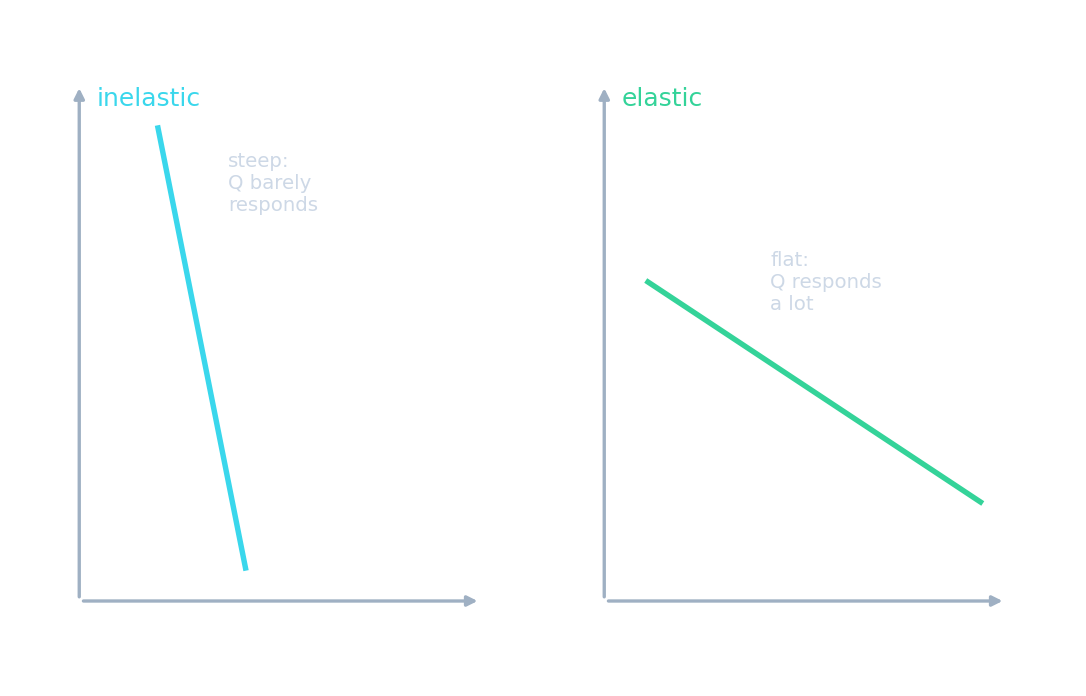
- The extremes: perfectly inelastic ($|\text{PED}| = 0$, a vertical demand curve: quantity does not change at all, as for a life-saving drug with no substitute) and perfectly elastic (infinite, a horizontal demand curve: any price rise loses all buyers, as for one wheat farmer's crop).
Price rises from 4 to 6; quantity demanded falls from 120 to 80. Using the midpoint method, what is |PED|?
Kesulitan 2/5 · 140 koin + bonus kecil pada penyelesaian pertama hari ini
%ΔQ = -40/100 = -0.40 and %ΔP = 2/5 = 0.40, so PED = -1 and |PED| = 1 (unit elastic).
When |PED| equals exactly 1, demand is said to be ______ elastic.
Kesulitan 1/5 · 100 koin + bonus kecil pada penyelesaian pertama hari ini
Unit elastic means the two percentage changes are equal; total revenue is at its maximum.
Slope is not elasticity
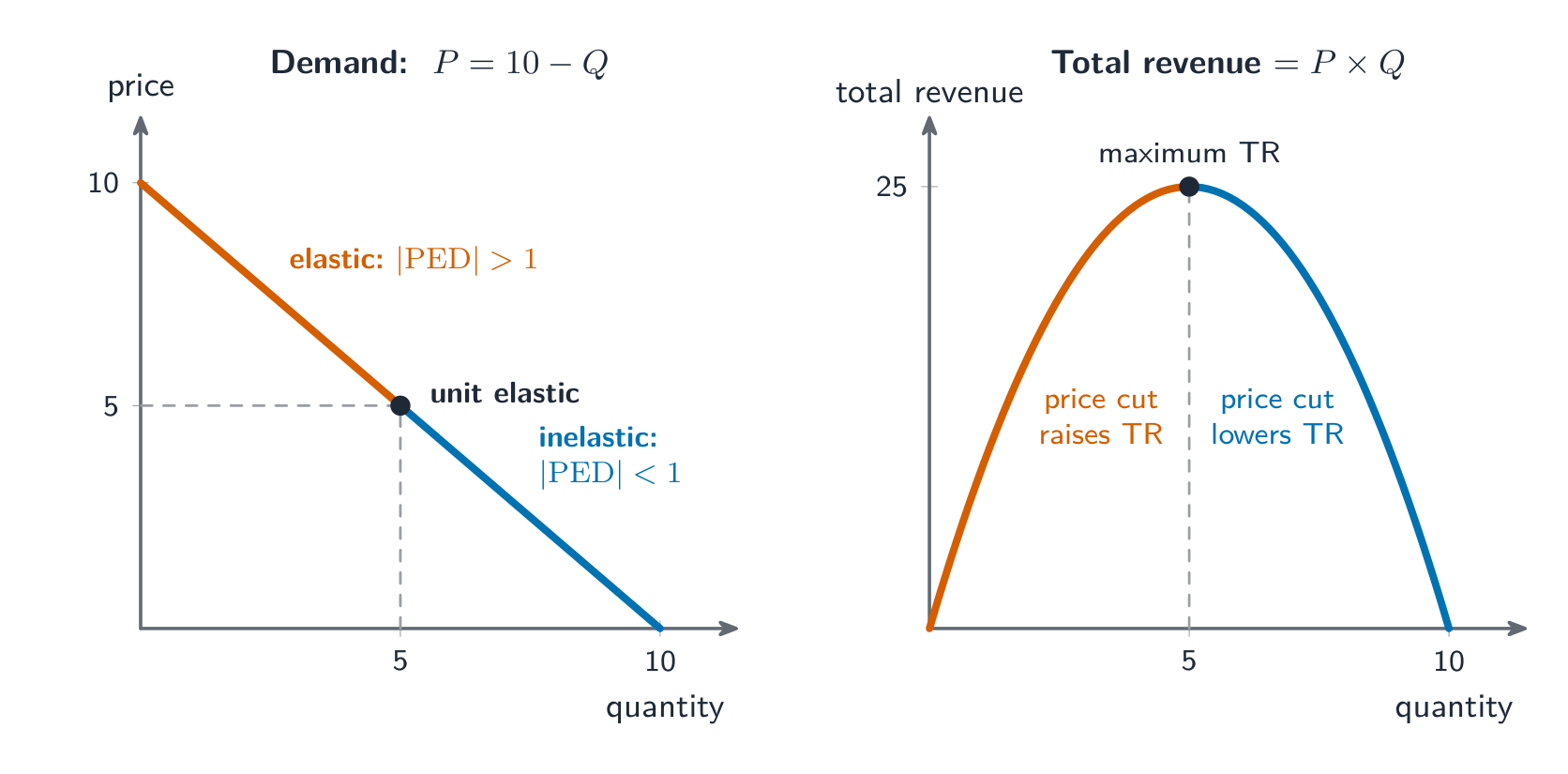
- Along a straight-line demand curve the slope is the same everywhere, but elasticity is not. At high prices and low quantities, a 1-dollar change is a small % of price but a large % of quantity: demand is elastic. At low prices it is the reverse: inelastic. The midpoint of the line is unit elastic.
- So you can only compare elasticity by steepness for two curves through the same point. On one line, the upper half is elastic and the lower half inelastic.
Demand is P = 20 − Q. At a price of 15, demand is
Kesulitan 1/5 · 100 koin + bonus kecil pada penyelesaian pertama hari ini
The midpoint is at P = 10. Above it, a 1-dollar change is a small % of price but a large % of quantity, so demand is elastic.
PED and total revenue
- Total revenue 总收入 $= P \times Q$. The total revenue test: if demand is elastic, price and TR move in opposite directions (cut the price, TR rises). If demand is inelastic, they move in the same direction (raise the price, TR rises).
- If demand is unit elastic, a small price change leaves TR unchanged: TR is at its maximum. In the cinema hook, 300 → 330 is inelastic (TR fell), 300 → 400 is elastic (TR rose).
Demand for a good is inelastic. To raise total revenue, the firm should:
Kesulitan 1/5 · 100 koin + bonus kecil pada penyelesaian pertama hari ini
With inelastic demand, price and total revenue move together — raising price raises TR.
A firm's demand is elastic. It cuts its price by 5%. What happens to total revenue?
Kesulitan 1/5 · 100 koin + bonus kecil pada penyelesaian pertama hari ini
With elastic demand, price and total revenue move in opposite directions.
What makes demand more elastic
- More close substitutes (one brand of cola vs drinks in general); the good is a luxury rather than a necessity; it takes a large share of income (a car vs salt); and more time to adjust (petrol demand is more elastic over years than over a week).
- A broadly defined market ("food") is less elastic than a narrow one ("apples"), because there are fewer substitutes for the whole category.
Percentage responsiveness and total revenue
State the percentage base and compare both revenue totals. PED magnitude measures percentage responsiveness, not slope alone.
Select semua that make demand more elastic.
Kesulitan 2/5 · 140 koin + bonus kecil pada penyelesaian pertama hari ini
Substitutes, a big income share and more time raise elasticity; a necessity with no substitute is inelastic.
Worked examples
1. The price rises from 4 to 6 and quantity demanded falls from 100 to 80. Midpoint method: $\%\Delta Q = \dfrac{80-100}{90} = -22.2\%$ and $\%\Delta P = \dfrac{6-4}{5} = 40\%$, so $|\text{PED}| = \dfrac{22.2}{40} = 0.56$: inelastic.
2. Check with the total revenue test: TR rises from $4 \times 100 = 400$ to $6 \times 80 = 480$. With inelastic demand, price and TR move in the same direction.
Worked FRQ answer
Question: A city bus company raises the fare from 2.00 to 2.50 dollars. Daily riders fall from 10,000 to 9,000. (a) Using the midpoint method, calculate the price elasticity of demand. Show your work. (b) Is demand elastic, inelastic or unit elastic? (c) What happens to the company's total revenue? Explain using your answer to (b). (d) Explain why demand for bus rides might become more elastic over several years.
(a) $\%\Delta Q = \dfrac{9{,}000 - 10{,}000}{9{,}500} = -10.5\%$; $\%\Delta P = \dfrac{2.50 - 2.00}{2.25} = 22.2\%$; $|\text{PED}| = \dfrac{10.5}{22.2} \approx 0.47$.
(b) Inelastic, because $|\text{PED}| < 1$.
(c) Total revenue rises (from 20,000 to 22,500). With inelastic demand, the percentage fall in riders is smaller than the percentage rise in price, so price and total revenue move in the same direction.
(d) Over time, riders can find substitutes: buying a bike or car, moving closer to work, or sharing rides. More substitutes make demand more elastic.
- Why it scores: (a) shows the averages in both denominators; (c) links the direction of TR to inelastic demand, not just the arithmetic; (d) names a specific substitute and the time to adjust.
FRQ practice. A bakery cuts the price of a cake from 30 to 20 dollars, and daily sales rise from 10 to 20 cakes. (a) Using the midpoint method, calculate the price elasticity of demand. (b) Is demand elastic or inelastic? (c) What happens to total revenue? Explain using (b). (d) Give one reason why demand for this bakery's cakes might be elastic.
Show both averages, then use the total revenue test.
Common errors. Calling a steep curve inelastic everywhere, or a flat line elastic everywhere: elasticity changes along one straight line. Dividing price change by quantity change (the formula is %ΔQ ÷ %ΔP). Forgetting the midpoint averages. Saying "raise the price whenever demand is elastic": that lowers revenue.
PED = %ΔQ ÷ %ΔP, in absolute value, with the midpoint method. $|\text{PED}| > 1$ elastic, $< 1$ inelastic, $= 1$ unit elastic; vertical = perfectly inelastic, horizontal = perfectly elastic. Along a straight-line demand curve, the upper half is elastic and the lower half inelastic. Total revenue test: elastic → price and TR move opposite; inelastic → same direction; TR peaks at unit elasticity. Substitutes, luxuries, a large income share and time raise elasticity.
Write from the data: find the midpoint elasticity
- Price rises from 10 to 14. Quantity demanded falls from 90 to 60.
- Find the absolute price elasticity with the midpoint method.
Price rises from 10 to 14 and quantity demanded falls from 90 to 60. Using the midpoint method, what is the absolute price elasticity of demand, and what happens to total revenue if price rises?
0.40 divided by one third is 1.2, which is above 1.
What is the absolute elasticity, and the revenue effect of a higher price?
Kesulitan 1/5 · 100 koin + bonus kecil pada penyelesaian pertama hari ini
0.40 divided by one third is 1.2, so the price rise cuts revenue.