Permintaan
Diperkenalkan| English | Makna |
|---|---|
| law of demand/lɔː ɒv dɪˈmænd/ | hukum permintaan |
| demand/dɪˈmænd/ | Permintaan |
| quantity demanded/ˈkwɒntɪti dɪˈmændɪd/ | Jumlah permintaan |
| inverse relationship/ɪnˈvɜːs rɪˈleɪʃənʃɪp/ | Hubungan terbalik |
| movement along/ˈmuːvmənt əˈlɒŋ/ | pergerakan sepanjang kurva |
| shift/ʃɪft/ | pergeseran |
| diminishing marginal utility/dɪˈmɪnɪʃɪŋ ˈmɑːdʒɪnl juːˈtɪlɪti/ | diminishing marginal utility |
| substitution effect/ˌsʌbstɪˈtjuːʃn ɪˈfekt/ | efek substitusi |
| income effect/ˈɪŋkʌm ɪˈfekt/ | efek pendapatan |
| income/ˈɪŋkʌm/ | pendapatan |
| tastes/teɪsts/ | selera |
| normal good/ˈnɔːml ɡʊd/ | A good for which demand increases as consumer income rises, with other factors held constant. |
| inferior good/ɪnˈfɪərɪə ɡʊd/ | A good for which demand falls as consumer income rises, with other factors held constant. |
| substitute/ˈsʌbstɪtjuːt/ | substitusi |
| complement/ˈkɒmplɪmənt/ | komplementer |
Why a sale empties the shelves
- A bubble-tea shop cuts its price from 5 to 3 dollars for one afternoon, and the queue runs out of the door. The next week the price goes back up and the queue shrinks. Buyers react to price in a predictable way.
- That pattern, the law of demand 需求定律, is the starting point of every market model in AP Microeconomics.
Demand and quantity demanded
- Demand 需求 is the whole relationship between price and the amount buyers are willing and able to buy, shown in a schedule or a curve. Quantity demanded 需求量 is one number: the amount bought at one price.
- The law of demand: when price rises, quantity demanded falls, and when price falls, quantity demanded rises (other things equal). Price and quantity demanded have an inverse relationship 反向关系, so the demand curve slopes down.
| Price | Ana | Ben | Market (Ana + Ben) |
|---|---|---|---|
| 5 | 1 | 0 | 1 |
| 4 | 2 | 1 | 3 |
| 3 | 3 | 3 | 6 |
- Market demand is the sum of all buyers' quantities at each price: add sideways (horizontally), never add the prices.
Permintaan dan Penawaran
The permintaan curve slopes down — a lower price, more is wanted. A change in income or tastes shifts the whole curve.
The law of demand says that, other things equal, when price rises the quantity demanded:
Kesulitan 1/5 · 100 koin + bonus kecil pada penyelesaian pertama hari ini
Price and quantity demanded move in opposite directions — an inverse relationship.
The amount buyers will buy at one particular price is called:
Kesulitan 1/5 · 100 koin + bonus kecil pada penyelesaian pertama hari ini
Quantity demanded is one number; demand is the whole price–quantity relationship.
At a price of 2 dollars, Ana wants 5 cups, Ben wants 4 and Chen wants 6. What is market quantity demanded at 2 dollars?
Kesulitan 2/5 · 140 koin + bonus kecil pada penyelesaian pertama hari ini
Market demand adds every buyer's quantity at the same price, 5 + 4 + 6 = 15.
Why the curve slopes down
- Diminishing marginal utility 边际效用递减: each extra cup of tea gives less extra satisfaction than the one before, so buyers will buy more only at a lower price.
- The substitution effect 替代效应: when tea gets cheaper, it becomes cheaper compared with other drinks, so people switch towards it. The income effect 收入效应: a lower price raises what your income can buy (your real income), so you can afford more.
Why are you willing to pay less for a third slice of pizza than for the first?
Kesulitan 1/5 · 100 koin + bonus kecil pada penyelesaian pertama hari ini
Extra satisfaction falls with each unit, so buyers will buy more only at lower prices. This is one reason demand slopes down.
Movement vs shift
- A change in the good's own price → a movement along 沿曲线移动 the curve (a change in quantity demanded).
- A change in anything else → a shift 移动 of the whole curve (a change in demand).
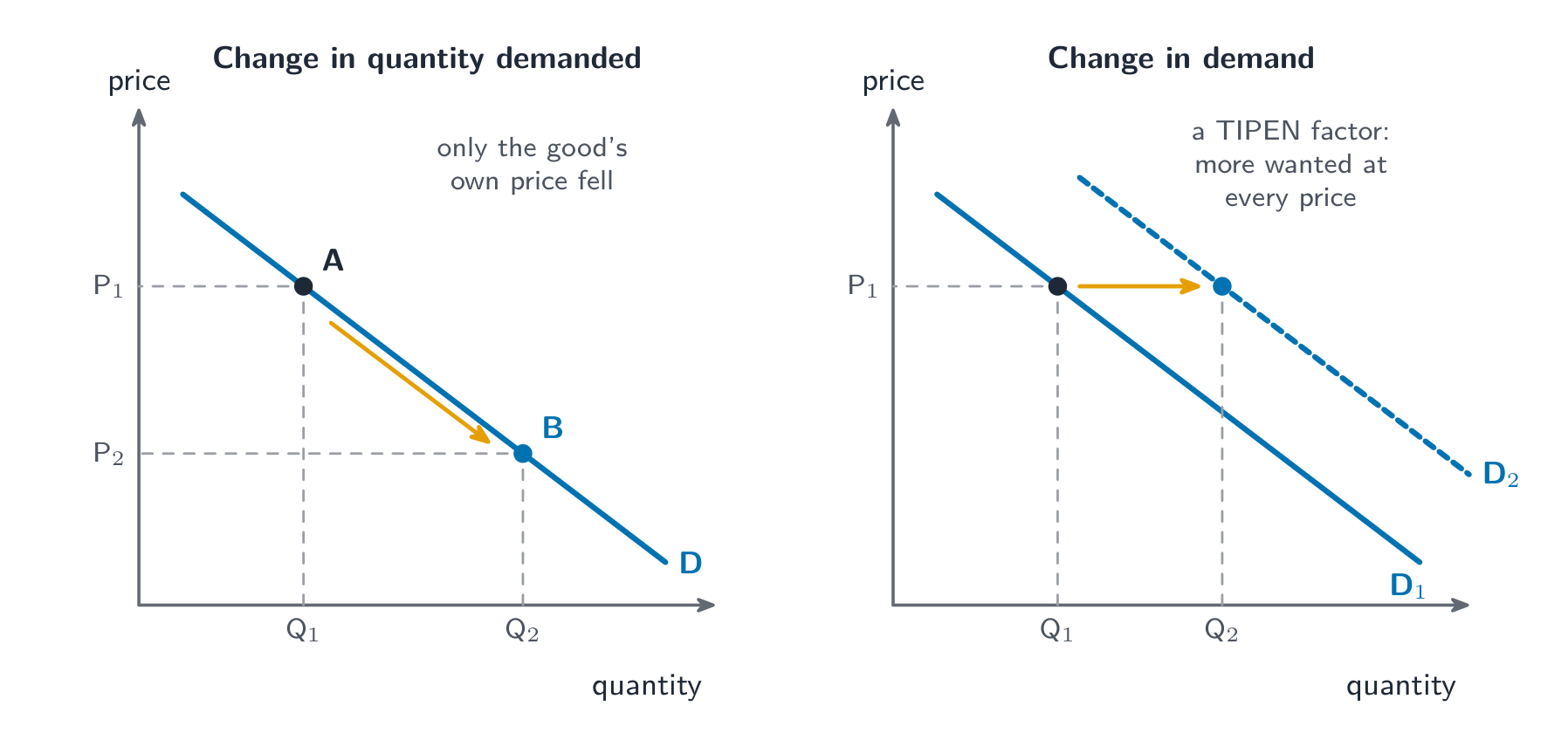
This distinction wins marks. Only the good's own price moves you along the curve. Income, tastes, or other prices shift it. Mixing these up is the classic exam mistake.
A change in the good's own price causes a movement along the demand curve, not a shift.
Kesulitan 1/5 · 100 koin + bonus kecil pada penyelesaian pertama hari ini
Own price → movement along; every other factor → shift of the whole curve.
What shifts demand: TIPEN
- Tastes 偏好 (what buyers like); Income 收入: for a normal good 正常品, higher income shifts demand right; for an inferior good 低档品 (instant noodles, bus rides, second-hand clothes), higher income shifts demand left, because people switch to better options.
- Prices of related goods: a cheaper substitute 替代品 shifts this good's demand left; a cheaper complement 互补品 shifts it right. Expectations of higher future prices raise demand now; a larger Number of buyers shifts demand right.
Match each change to its effect on the demand for coffee.
Kesulitan 2/5 · 140 koin + bonus kecil pada penyelesaian pertama hari ini
Income, substitutes and complements shift the curve; the good's own price only moves you along it.
Two goods used together, like printers and ink, are called ______.
Kesulitan 1/5 · 100 koin + bonus kecil pada penyelesaian pertama hari ini
A rise in the price of one lowers demand for the other.
Select semua that shift the demand curve (rather than move along it).
Kesulitan 2/5 · 140 koin + bonus kecil pada penyelesaian pertama hari ini
TIPEN factors shift the curve; the good's own price only causes a movement along it.
Incomes in a city rise, and the demand for bus rides falls. Bus rides in this city are
Kesulitan 1/5 · 100 koin + bonus kecil pada penyelesaian pertama hari ini
When higher income shifts demand left, the good is inferior; people switch to driving or taxis.
Worked example: movement or shift?
For the market for coffee, decide whether each causes a movement along the demand curve or a shift, and in which direction: (a) the price of coffee rises from 3 dollars to 4 dollars; (b) the price of tea (a substitute) falls; (c) a study reports coffee improves health.
- (a) The good's own price changes, so there is a movement up along the curve: quantity demanded falls. Demand itself does not change.
- (b) Cheaper tea pulls buyers away, so demand for coffee shifts left. (c) A change in tastes in coffee's favour shifts demand right: more is wanted at every price.
Incomes rise and pizza is a normal good. What happens to the demand curve for pizza?
Kesulitan 1/5 · 100 koin + bonus kecil pada penyelesaian pertama hari ini
Buyers want more of a normal good at every price.
A fall in the price of a good shifts its demand curve to the right.
Kesulitan 1/5 · 100 koin + bonus kecil pada penyelesaian pertama hari ini
It causes a movement along the curve, an increase in quantity demanded.
Worked FRQ answer
Question: Assume instant noodles are an inferior good and the market is perfectly competitive. (a) Draw a correctly labeled graph of the market for instant noodles and show the effect of a rise in consumers' incomes. (b) Explain why the curve moves in that direction. (c) Separately, the price of instant noodles rises. Does demand for noodles change? Explain.
(a) Price on the vertical axis, quantity on the horizontal; a downward-sloping D₁ and a new curve D₂ to the left of D₁.
(b) For an inferior good, higher income makes buyers switch to goods they prefer (fresh meals, restaurants), so they want fewer noodles at every price.
(c) No. A change in the good's own price causes a movement along the demand curve: quantity demanded falls, but demand (the whole curve) does not change.
- Why it scores: (a) both axes labeled and the shift drawn left, the opposite of a normal good; (b) the reason is about buyers' choices at every price; (c) uses the words "quantity demanded" and "movement along", not "demand falls".
FRQ practice. Peanut butter and jam are complements, and peanut butter is a normal good. (a) The price of jam rises. Show and explain the effect on the demand for peanut butter. (b) Consumers' incomes fall. What happens to the demand for peanut butter? (c) The price of peanut butter falls. Explain whether demand for peanut butter changes.
Only the good's own price moves along the curve.
Demand is the whole price–quantity relationship; quantity demanded is one point on it. The law of demand makes the curve slope down, because of diminishing marginal utility and the substitution and income effects. Market demand adds every buyer's quantity at each price. The good's own price gives a movement along; any TIPEN factor shifts the curve. Higher income shifts demand right for a normal good and left for an inferior good.
Write from the data: find the movement
- The price of noodles falls from 8 dollars to 6 dollars.
- Quantity demanded rises from 10 bowls to 14 bowls.
The price of noodles falls from 8 dollars to 6 dollars and quantity demanded rises from 10 bowls to 14. Is this a movement or a shift, and by how many bowls does quantity demanded change?
14 minus 10 is 4, and only the good's own price changed.
What happens to demand in this noodle example?
Kesulitan 1/5 · 100 koin + bonus kecil pada penyelesaian pertama hari ini
A lower own price raises quantity demanded along the same curve.