The Sequence of Steps
Diperkenalkan| English | Makna |
|---|---|
| rate-determining step/reɪt dɪˈtɜːmɪnɪŋ step/ | langkah penentu laju |
The slowest link sets the pace
- On a factory line, cars leave only as fast as the slowest station works. Reaction mechanisms behave the same way.
- The slowest elementary step, the rate-determining step 决速步, sets the overall rate, so the rate law is a clue to the mechanism.
The rate-determining step
- The rate-determining step 决速步 is the slowest elementary step.
- It is the bottleneck of the whole mechanism.
- The overall rate can go no faster than this step.
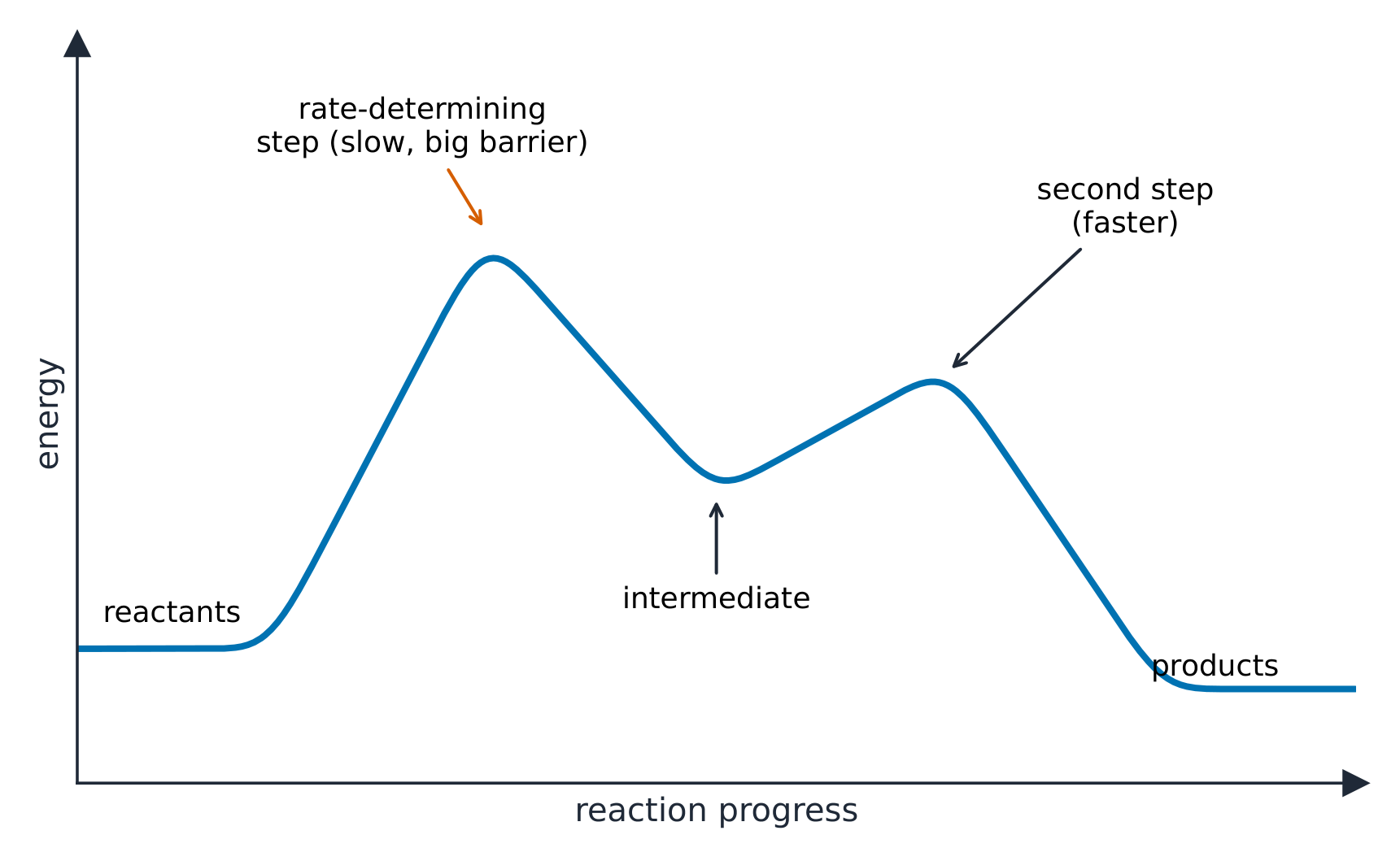
The slow step with the higher barrier is rate-determining
The rate-determining step is the...
Kesulitan 1/5 · 100 koin + bonus kecil pada penyelesaian pertama hari ini
The slowest step is the bottleneck controlling the overall rate.
The overall reaction can go no faster than its ____ step.
Kesulitan 1/5 · 100 koin + bonus kecil pada penyelesaian pertama hari ini
The slowest (rate-determining) step caps the overall rate.
The rate law follows it
- Start with the slow elementary step's rate law, then replace any intermediate using a justified relation before predicting an observable overall rate law.
- A step's own coefficients are its orders, unlike the overall reaction.
- So the mechanism predicts the experimental rate law.
For a slow step $A + A \to C$, the rate law is...
Kesulitan 1/5 · 100 koin + bonus kecil pada penyelesaian pertama hari ini
Two A's collide in the slow step, giving second order in A.
The coefficients of any overall balanced equation can be used as reaction orders.
Kesulitan 1/5 · 100 koin + bonus kecil pada penyelesaian pertama hari ini
False. Coefficients give orders only for elementary steps. Overall rate laws must be found by experiment or from the mechanism.
How fast steps can matter
- In a simple mechanism with one dominant bottleneck and rapid product formation, later fast steps have little effect on the overall rate.
- A preceding fast equilibrium can affect rate by changing the concentration of an intermediate feeding the slow step.
- For fast $A+B\rightleftharpoons I$ before slow $I+C\to P$, use $[I]=K[A][B]$ in $\text{rate}=k_2[I][C]$ to obtain $k_2K[A][B][C]$.
The rate-determining step
Follow a two-step mechanism and spot the slow step that controls the rate.
In a simple mechanism with an irreversible slow first step and all later steps much faster, speeding up a later fast step appreciably changes the overall rate.
Kesulitan 1/5 · 100 koin + bonus kecil pada penyelesaian pertama hari ini
False under these assumptions: the slow first step controls throughput. This does not mean all fast steps are irrelevant; a fast pre-equilibrium can control an intermediate concentration.
Slow step: $A + A \to C$. Fast step: $C + B \to D$.
- The slow step's reactants are two A's.
- So $\text{rate} = k[A]^2$, set entirely by the slow step.
The experimental rate law is best predicted from...
Kesulitan 1/5 · 100 koin + bonus kecil pada penyelesaian pertama hari ini
Begin with the slow elementary step, then substitute any intermediate using a justified relation such as fast pre-equilibrium. The result must match the observed rate law; the overall equation alone is insufficient.
A fast equilibrium first. For $2\text{NO} + \text{O}_2 \rightarrow 2\text{NO}_2$ the mechanism is: (1) $2\text{NO} \rightleftharpoons \text{N}_2\text{O}_2$ (fast equilibrium); (2) $\text{N}_2\text{O}_2 + \text{O}_2 \rightarrow 2\text{NO}_2$ (slow).
- From the slow step: rate $= k_2[\text{N}_2\text{O}_2][\text{O}_2]$. But N₂O₂ is an intermediate, so it cannot stay in the rate law.
- The fast equilibrium gives $[\text{N}_2\text{O}_2] = K[\text{NO}]^2$, so rate $= k_2K[\text{NO}]^2[\text{O}_2]$: third order overall, matching experiment.
Mechanism: (1) NO₂ + NO₂ → NO₃ + NO (slow); (2) NO₃ + CO → NO₂ + CO₂ (fast). What happens to the rate if [CO] is doubled?
Kesulitan 1/5 · 100 koin + bonus kecil pada penyelesaian pertama hari ini
Rate = k[NO₂]². CO is zero order because it reacts in the fast step after the bottleneck.
Is a mechanism acceptable?
| Check | Question to ask |
|---|---|
| 1 | Do the steps add up to the overall equation? |
| 2 | Is each step plausible (uni- or bimolecular)? |
| 3 | Does the rate law from the slow step (with no intermediates) match the experimental rate law? |
- A mechanism that passes all three is consistent with the data; it is never proved.
The experimental rate law is rate = k[A][B]. Which slow step is consistent with it?
Kesulitan 1/5 · 100 koin + bonus kecil pada penyelesaian pertama hari ini
An elementary slow step A + B gives rate = k[A][B], first order in each.
- The rate law comes from the slow step, not from the overall equation.
- Remove intermediates from the rate law, using a fast equilibrium before the slow step.
- Data can support a mechanism or rule it out, but never prove it.
The rate-determining step is the slowest elementary step, and it sets the overall rate and rate law. Because it is elementary, its coefficients are its orders. Fast steps can control intermediate concentrations; a preceding equilibrium may therefore appear in the final rate law.