Properties of Solids
Diperkenalkan| English | Makna |
|---|---|
| crystalline solid/ˈkrɪstəlaɪn ˈsɒlɪd/ | crystalline solid |
| amorphous solid | amorphous solid |
| ionic solids/aɪˈɒnɪk ˈsɒlɪdz/ | padatan ion |
| brittle/ˈbrɪtl/ | brittle |
| malleable/ˈmæləbl/ | malleable |
| molecular solids/məˈlekjʊlə ˈsɒlɪdz/ | padatan molekul |
| metallic solids/məˈtælɪk ˈsɒlɪdz/ | padatan logam |
| covalent-network solids/ˈkəʊvələnt ˈnetwɜːk ˈsɒlɪdz/ | padatan jaringan kovalen |
Four kinds of solid
- Diamond scratches glass, yet candle wax melts in your hand. Salt shatters when you hit it, but a copper wire just bends.
- These differences come from the particles and what holds them together. AP questions ask you to explain a property from that particle picture.
Crystalline or amorphous?
- In a crystalline solid 晶体 the particles repeat in a regular pattern, so it melts sharply at one temperature (quartz, salt, ice).
- In an amorphous solid 无定形固体 the particles have no long-range order, so it softens over a range of temperatures (glass, most plastics, candle wax).
Glass softens gradually over a range of temperatures instead of melting at one temperature. This shows that glass is...
Kesulitan 1/5 · 100 koin + bonus kecil pada penyelesaian pertama hari ini
Without a repeating pattern, different parts need different energies to break free, so an amorphous solid softens over a range.
Ionic solids
- Ionic solids 离子固体 are a lattice of cations and anions held by strong electrostatic attractions: high melting points, hard but brittle 易碎的.
- They do not conduct as solids (ions are locked in place) but conduct when molten or dissolved, because the ions can then move.

Solid NaCl does not conduct electricity, but molten NaCl does. Why?
Kesulitan 1/5 · 100 koin + bonus kecil pada penyelesaian pertama hari ini
The ions are there in both states, but only in the liquid (or in solution) can they move. NaCl has ionic, not covalent, bonding.
Brittle or malleable?
- Push one layer of an ionic crystal sideways by one ion: like charges now sit next to each other, repel, and the crystal cracks.
- In a metal, the cations slide but the sea of delocalized electrons still holds them together, so the metal bends instead: it is malleable 有延展性的 and ductile.
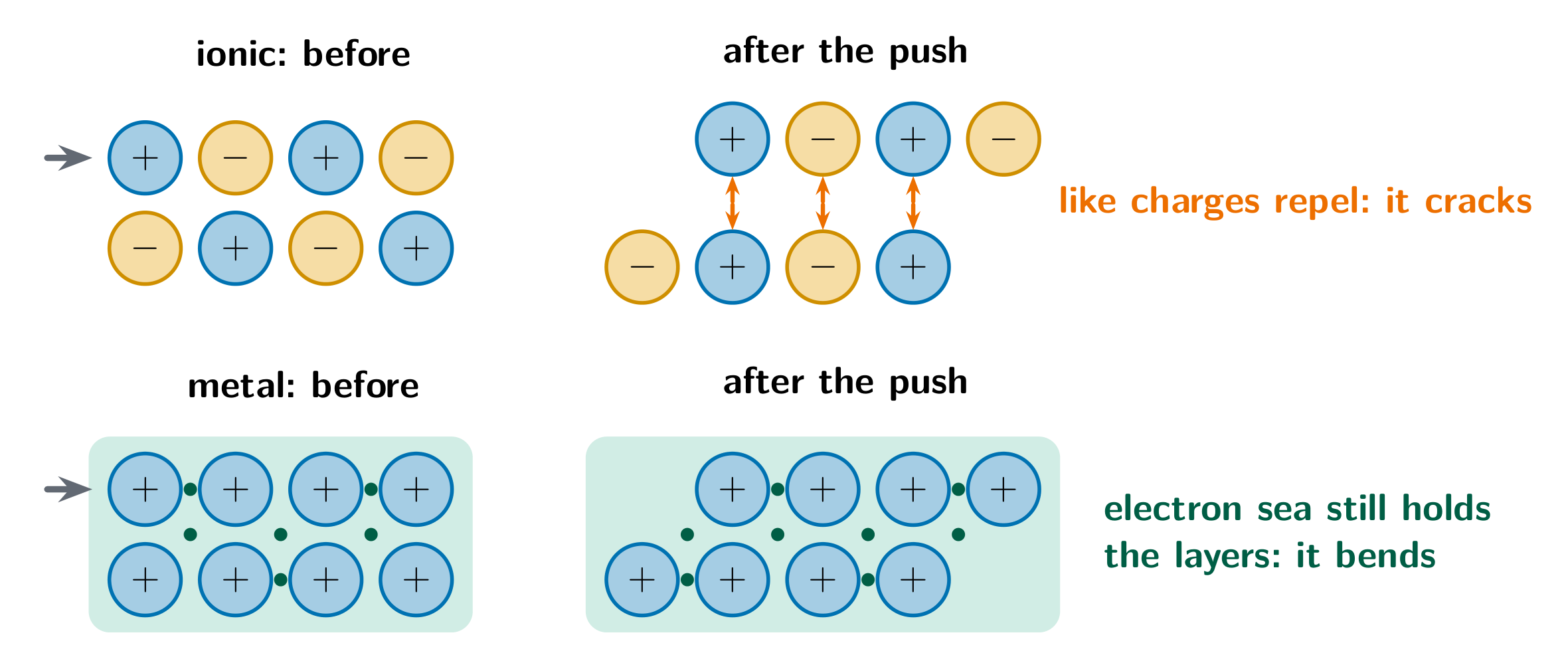
An ionic solid is hard but ____, shattering when a layer shifts.
Kesulitan 1/5 · 100 koin + bonus kecil pada penyelesaian pertama hari ini
Shifting a layer aligns like charges, which repel and crack it.
Molecular solids
- Molecular solids 分子固体 are molecules held by intermolecular forces. Melting separates whole molecules; the covalent bonds inside them stay intact.
- Their melting points follow the strength of those forces: $\text{CH}_4$ ($-182$ °C, weak dispersion), ice (0 °C, hydrogen bonds), $\text{I}_2$ (114 °C, large electron cloud, strong dispersion). They do not conduct.
Molecular solids tend to be very hard with high melting points.
Kesulitan 1/5 · 100 koin + bonus kecil pada penyelesaian pertama hari ini
False. Molecular solids are held by weak intermolecular forces, so they tend to be soft with low melting points. Hard, high-melting solids are usually covalent network or ionic.
Which molecular solid has the highest melting point?
Kesulitan 1/5 · 100 koin + bonus kecil pada penyelesaian pertama hari ini
Larger, more polarizable electron clouds give stronger dispersion forces. I2 melts at 114 °C; CH4 at −182 °C.
Covalent-network and metallic solids
- Covalent-network solids 共价网络固体 are one giant lattice of covalent bonds: diamond, $\text{SiO}_2$ (quartz), silicon. To melt them you must break covalent bonds, so they are very hard with very high melting points.
- Metallic solids 金属固体 are cations in a sea of delocalized electrons. The mobile electrons let them conduct as solids, and their melting points range widely (mercury is a liquid; tungsten melts at 3422 °C).
Diamond is very hard with a very high melting point. It is a...
Kesulitan 1/5 · 100 koin + bonus kecil pada penyelesaian pertama hari ini
One giant lattice of strong covalent bonds makes it hard and high-melting.
Which type of solid conducts electricity in the solid state?
Kesulitan 1/5 · 100 koin + bonus kecil pada penyelesaian pertama hari ini
Among these choices, metals conduct as solids through mobile electrons. Some covalent networks, such as graphite, also conduct; ionic solids require mobile ions when molten or dissolved.
Match each solid to its type.
Kesulitan 2/5 · 140 koin + bonus kecil pada penyelesaian pertama hari ini
Salt = ionic, diamond = covalent network, copper = metallic.
Identify each solid from its properties.
| Solid | Melting point | Conducts? | Other |
|---|---|---|---|
| A | 801 °C | only when molten | brittle |
| B | 114 °C | no | soft, purple vapour |
| C | 3550 °C | no | extremely hard |
| D | 1085 °C | yes, as a solid | bends into wire |
- A: high melting point, conducts only when its ions can move: ionic (NaCl).
- B: low melting point, no conduction: molecular ($\text{I}_2$).
- C: very high melting point, very hard, no conduction: covalent network (diamond).
- D: conducts as a solid and is malleable: metallic (copper).
What kind of solid?
Match each solid's properties to its structure type.
Diamond or dry ice? Why does turning diamond into separate atoms need far more energy than turning dry ice into $\text{CO}_2$ gas?
- Diamond is a covalent network: every atom is held by strong C–C covalent bonds, and these must be broken.
- Dry ice is a molecular solid. When it sublimes, only the weak dispersion forces between $\text{CO}_2$ molecules are overcome; the C=O bonds stay intact.
When dry ice (solid $\text{CO}_2$) sublimes at atmospheric pressure, it overcomes...
Kesulitan 1/5 · 100 koin + bonus kecil pada penyelesaian pertama hari ini
It is a molecular solid, so only the weak intermolecular forces break.
- Do not confuse the strong bonds inside a molecule with the weak forces between molecules: melting a molecular solid breaks only the weak forces.
- Graphite is a covalent network that conducts, because each layer has delocalized electrons. Ionic solids conduct only when molten or dissolved.
- "Hard" is not "tough": ionic solids are hard but brittle.
- Ionic: ion lattice, high melting, brittle, conducts only when molten or dissolved.
- Molecular: weak forces between molecules, low melting, no conduction.
- Covalent network: giant covalent lattice, very hard, very high melting.
- Metallic: cations in an electron sea, conducts as a solid, malleable.