Aliran Energi Melalui Ekosistem
Diperkenalkan| English | Makna |
|---|---|
| producer/prəˈdjuːsə/ | produsen |
| consumer/kənˈsuːmə/ | konsumen |
| food chain/fuːd tʃeɪn/ | rantai makanan |
| trophic level/ˈtrəʊfɪk ˈlevl/ | tingkat trofik |
| autotroph/ˌɔːtəʊˈtrɒf/ | autotrof |
| heterotroph/ˈhetrətrɒf/ | heterotrof |
| endotherm/ˈendəʊθɜːm/ | endoterm |
| ectotherm/ˈektəðɜːm/ | ekstoterm |
How can a food web survive in the dark?
- A deep-sea vent receives no sunlight, but chemosynthetic producers 生产者 capture energy from chemical reactions. Consumers 消费者 obtain that stored energy by feeding.
- Compare this with a sunlit food web. Energy sources can differ, yet each organism still needs an energy budget and each feeding transfer is incomplete.
Producers capture the energy
- A producer makes organic food using light or chemical energy.
- Producers form the base of every food chain 食物链.
- They store the Sun's energy as chemical energy in sugar.
- Everything else in the ecosystem depends on this stored energy.
Dari mana energi di sebagian besar ekosistem berasal pada awalnya?
Kesulitan 1/5 · 100 koin + bonus kecil pada penyelesaian pertama hari ini
Sinar matahari ditangkap oleh produsen (tanaman) melalui fotosintesis, memberi makan seluruh ekosistem.
Produsen dalam ekosistem adalah organisme yang…
Kesulitan 1/5 · 100 koin + bonus kecil pada penyelesaian pertama hari ini
Produsen membuat makanannya sendiri (fotosintesis); konsumen memakan organisme lain.
Consumers and trophic levels 营养级
- A consumer eats other organisms to get energy.
- Each feeding step is a trophic level: producer, then primary consumer, then secondary, and so on.
- Energy passes up a food chain from level to level.
- But only a fraction of it makes it to the next step.
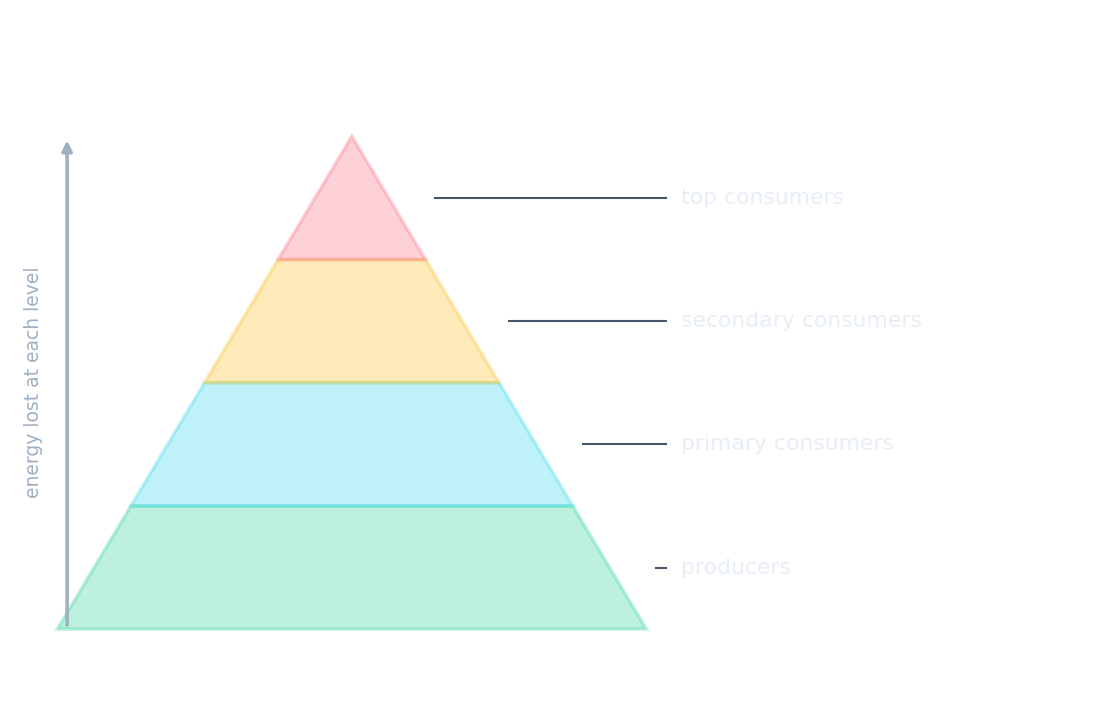
Bangun piramida energi
Tarik energi yang ditangkap tumbuhan dan saksikan hanya sepersepuluh yang naik ke tingkat berikutnya — sehingga predator puncak hampir tidak tersisa energinya.
Asumsikan efisiensi transfer adalah 10% dalam contoh ini. Dari 10,000 unit, berapa banyak yang mencapai tingkat trofik berikutnya?
Kesulitan 2/5 · 140 koin + bonus kecil pada penyelesaian pertama hari ini
Di bawah asumsi 10% yang diberikan, 10,000 × 0.1 = 1,000. Efisiensi transfer nyata bervariasi.
Setiap langkah makan dalam rantai makanan — produsen, lalu konsumen — adalah tingkat ____.
Kesulitan 1/5 · 100 koin + bonus kecil pada penyelesaian pertama hari ini
Tingkat trofik adalah satu langkah makan; energi menurun di setiap tingkat yang lebih tinggi.
Transfer is incomplete
- An illustrative transfer efficiency is 10%; measured efficiencies vary.
- The rest is lost, mostly as heat from respiration.
- So each higher level holds far less energy than the one below.
- This is why food chains are short and top predators are rare.
Pilih semua pernyataan benar tentang aliran energi.
Kesulitan 2/5 · 140 koin + bonus kecil pada penyelesaian pertama hari ini
Energi masuk melalui produsen dan ditransfer secara tidak lengkap. Energi pada akhirnya tersebar sebagai panas, alih-alih berputar terus-menerus melalui jaring-jaring makanan.
Sunlight is not the only entry point
- An autotroph 自养生物 builds organic molecules using an external energy source. Photosynthetic organisms capture light; chemosynthetic organisms capture energy from reactions involving inorganic chemicals, such as those available near some deep-sea vents.
- A heterotroph 异养生物 obtains organic matter from other organisms and metabolizes carbohydrates, lipids or proteins. Decomposers and scavengers are heterotrophs too, not a separate source of new energy.
Sebuah produsen di dekat celah gelap menggunakan energi dari reaksi kimia anorganik. Organisme ini…
Kesulitan 1/5 · 100 koin + bonus kecil pada penyelesaian pertama hari ini
Autotrof dapat menggunakan energi kimia serta cahaya.
Energy budgets affect survival and reproduction
- An endotherm 内温动物 generates substantial metabolic heat to regulate body temperature. An ectotherm 外温动物 relies more on environmental heat and can move into sun or shade; both still use energy for cellular work.
- Energy gained minus maintenance costs is available for growth, storage and reproduction. If costs exceed intake, body reserves and reproductive output can fall. Seasonal breeding or switching reproductive strategies can reflect changing energy availability.
Asupan energi berkelanjutan di bawah biaya pemeliharaan dapat mengurangi hasil reproduksi.
Kesulitan 1/5 · 100 koin + bonus kecil pada penyelesaian pertama hari ini
Lebih sedikit energi tersisa untuk pertumbuhan atau reproduksi, dan cadangan yang disimpan mungkin dikonsumsi.
Worked example: use measured transfer efficiency
- Producer production is 20,000 kJ over a stated area and time; primary-consumer production is 2,400 kJ over the same area and time. Transfer efficiency = 2,400 ÷ 20,000 × 100 = 12%.
- If secondary-consumer production is 240 kJ, the next transfer is 10%. Efficiencies differ; do not impose a universal 10% rule. Lower producer production can support less consumer production unless another resource compensates.
Produksi produsen adalah 20,000 kJ dan produksi konsumen adalah 2,400 kJ. Berapa persentase efisiensi transfer?
Kesulitan 2/5 · 140 koin + bonus kecil pada penyelesaian pertama hari ini
2400 ÷ 20000 × 100 = 12%.
Energy flows; atoms cycle
- Energy changes form and ultimately disperses as heat; it is not destroyed or recycled back into sunlight. New energy input sustains the ecosystem. Matter moves between living organisms and nonliving reservoirs.
- Follow water, carbon, nitrogen and phosphorus in Matter cycling through ecosystems. Distinguish a reservoir, where matter is stored, from a process that moves it.
Respirasi menghancurkan energi sehingga energi tersebut tidak lagi ada dalam bentuk apa pun.
Kesulitan 1/5 · 100 koin + bonus kecil pada penyelesaian pertama hari ini
Energi terpelihara tetapi menjadi panas yang tersebar dan tidak tersedia untuk transfer trofik berikutnya.
Energy is not recycled through a food chain — it is steadily lost. Some energy is dispersed as heat; uneaten or undigested organic matter can enter detrital pathways. A 10% transfer is a useful example, not a fixed law. Unlike nutrients, energy makes a one-way trip and requires continuing input from sunlight or chemical sources.
Following 10,000 units of energy:
- Plants capture 10,000 units of the Sun's energy.
- The primary consumers that eat them get about 1,000 (10%).
- The secondary consumers get about 100 — so little is left that a fourth or fifth level can barely be fed.
Energy enters an ecosystem as sunlight, captured by producers. It flows up a food chain through consumers, one trophic level at a time. Transfer is incomplete and variable; much energy ultimately disperses as heat — so food chains are short and top predators are few.
Write from the data given
- Producers store 5000 kilojoules.
- Transfer efficiency in this example is 10 percent. The lesson's 10000 units give 1000, and 2400 of 20000 is 12 percent.
Berapa banyak kilojoule yang mencapai tingkat trofik berikutnya?
Transfer 10 persen menyisakan satu per sepuluh energi produsen.
Berapa banyak dari 5000 kilojoule yang mencapai tingkat berikutnya pada 10 persen?
Kesulitan 1/5 · 100 koin + bonus kecil pada penyelesaian pertama hari ini
Satu per sepuluh dari 5000 adalah 500. Opsi lain — 1000 (contoh lainnya); 12 (persentase efisiensi lainnya).