Skip to content · ⁨Lompat ke konten⁩
Subjects · ⁨Materi⁩

GAC Science · ⁨GAC Sains⁩

Tips

GAC Science terdiri dari dua modul yang memiliki fungsi berbeda. GAC013 membahas tentang ilmu pengetahuan itu sendiri, sejarahnya, metode ilmiah, bahasa satuan dan notasi, bagaimana disiplin ilmu ini diorganisir, serta isu-isu yang ditimbulkannya. GAC023 merupakan konten mata pelajaran gabungan, mencakup biologi dan klasifikasi, ekosistem, sumber daya bumi, kimia dan dampaknya terhadap lingkungan, serta gerak gelombang dalam fisika.

Penyelidikan adalah pusat perhatian. Perencanaan dan pelaksanaan eksperimen, kemudian penulisan laporan sesuai konvensi ilmiah dan akademik, muncul sebagai hasil belajar pada kedua modul dan membawa bobot penilaian yang signifikan.

Satuan dan notasi dinilai secara eksplisit. Menulis besaran dengan simbol yang tepat, satuan yang benar, dan jumlah angka penting yang wajar merupakan hasil belajar yang ditetapkan, bukan sekadar detail penyajian.

Cakupan materi disengaja. GAC023 melintasi biologi, kimia, ilmu bumi, dan fisika dalam satu semester, sehingga tujuannya adalah penguasaan ilmu pengetahuan umum yang percaya diri dalam bahasa Inggris, bukan keahlian mendalam pada satu subjek tertentu.

Latihan di situs ini bersifat orisinal, dan konten sainsnya mengutip penjelasan serta diagram dari materi IGCSE dan A-Level kami ketika topik tersebut memang sama persis.

  • 1

    GAC013 Science II: Scientific Principles · ⁨GAC013 Sains II: Prinsip Sains⁩

    1.1

    What this module is, and how it is marked · ⁨Apa modul ini, dan bagaimana ia dinilai⁩

    English

    Two paper samples retain different amounts of water. Does that mean one is best for every cleaning task? To answer well, a scientist asks how the comparison was made, which properties were tested and what remains unknown.

    This guide supports GAC013: the development of scientific ideas, investigation, scientific language, the organisation of research and scientific issues. Science includes evidence, methods, explanations and a growing body of knowledge. Its questions connect physics, chemistry, biology and other fields.

    A practical investigation 探究实验 needs a safe, permitted method that fits its question. An investigation report 实验报告 records that method, the actual observations and a conclusion limited by the evidence. Follow your teacher's current brief for assessment criteria, structure and deadlines. The original companion sheets are practice, not official assessment papers. No result or phrase guarantees a mark. Never replace an unexpected observation with a predicted answer.

    Bahasa Indonesia

    Dua sampel kertas menahan jumlah air yang berbeda. Apakah itu berarti yang terbaik untuk setiap tugas pembersihan? Untuk menjawab dengan baik, seorang ilmuwan bertanya bagaimana perbandingan dilakukan, sifat apa saja yang diuji, dan apa yang belum diketahui.

    Panduan ini mendukung GAC013: pengembangan ide ilmiah, penyelidikan, bahasa ilmiah, organisasi penelitian, dan isu-isu ilmiah. Sains mencakup bukti, metode, penjelasan, dan kumpulan pengetahuan yang terus berkembang. Pertanyaannya menghubungkan fisika, kimia, biologi, dan bidang lainnya.

    Sebuah penyelidikan praktik memerlukan metode yang aman dan diizinkan yang sesuai dengan pertanyaannya. Laporan penyelidikan mencatat metode tersebut, observasi aktual, dan kesimpulan yang dibatasi oleh bukti. Ikuti brief guru Anda saat ini mengenai kriteria penilaian, struktur, dan tenggat waktu. Lembar pendamping asli hanyalah latihan, bukan soal penilaian resmi. Tidak ada hasil atau frasa yang menjamin nilai. Jangan pernah mengganti observasi tak terduga dengan jawaban yang diprediksi.

    1.1

    The history of science · ⁨Sejarah sains⁩

    Syllabus · ⁨Silabus⁩
    English

    Unit 1 of 5 in GAC013 Science II: Scientific Principles (Level II). The module is taught over about 40 class hours plus 20 hours of independent study, and is assessed at the teaching centre and moderated by ACT — there is no external exam.

    Module purpose: On completion of this module, students should be able to demonstrate knowledge and understanding of the basic laws, theories and principles of contemporary science.

    The module outcomes this unit works towards:

    Learning Objective GAC013.1: Demonstrate knowledge and understanding of the historical development of scientific ideas, and apply that knowledge to differentiate between the different areas of science.

    Bahasa Indonesia

    Unit 1 dari 5 dalam GAC013 Sains II: Prinsip Sains (Tingkat II). Modul ini diajarkan selama sekitar 40 jam pelajaran ditambah 20 jam belajar mandiri, dan dinilai di pusat pengajaran serta dimoderasi oleh ACT — tidak ada ujian eksternal.

    Tujuan modul: Setelah menyelesaikan modul ini, siswa seharusnya mampu menunjukkan pengetahuan dan pemahaman tentang hukum, teori, dan prinsip sains kontemporer yang mendasar.

    Hasil pembelajaran yang dicapai unit ini:

    Tujuan Pembelajaran GAC013.1: Menunjukkan pengetahuan dan pemahaman tentang perkembangan historis ide-ide ilmiah, dan menerapkan pengetahuan tersebut untuk membedakan antara bidang-bidang sains yang berbeda.

    Source: Cambridge International syllabus · ⁨Sumber: Silabus Cambridge International⁩

    English

    A paradigm 范式 is a broad framework shaping explanations and questions. A paradigm shift 范式转换 is a substantial change in that framework. Not every revised number or new observation is a shift of this scale.

    Scientific explanations are provisional 暂定的: they remain open to evidence-led revision. This does not mean that every explanation is equally uncertain. A model represents selected features of a system; observations test how well its predictions and explanations work within a stated scope.

    Worked example: separate event dates from award dates

    Thomson identified the electron in 1897. Rutherford's 1911 atomic-structure analysis drew on scattering measurements, including work by Geiger and Marsden. Chadwick established evidence for the neutron in 1932. These are selected developments, not a complete history of science. A scientist's award year is not automatically the discovery or publication year.

    Sources checked 2 October 2026: Nobel atomic-history timeline, electron discovery, and Chadwick facts.

    Physics studies matter and energy. Chemistry studies substances and their changes. Biology studies living systems. A plant-growth investigation can be biological while using physical measurements of light and chemical ideas about materials. Naming its main field does not supply its result.

    Bahasa Indonesia

    Sebuah paradigma adalah kerangka kerja luas yang membentuk penjelasan dan pertanyaan. Pergeseran paradigma adalah perubahan substansial dalam kerangka kerja tersebut. Tidak setiap angka yang direvisi atau observasi baru merupakan pergeseran sebesarnya itu.

    Penjelasan ilmiah bersifat sementara: mereka tetap terbuka untuk revisi yang dipimpin oleh bukti. Ini tidak berarti setiap penjelasan sama-sama tidak pasti. Sebuah model mewakili fitur terpilih dari suatu sistem; observasi menguji seberapa baik prediksi dan penjelasannya bekerja dalam ruang lingkup yang ditetapkan.

    Bukti terpilih tentang elektron, struktur atom, dan neutron berkontribusi pada perubahan ide tentang atom.

    Contoh terpecahkan: pisahkan tanggal peristiwa dari tanggal penghargaan

    Thomson mengidentifikasi elektron pada tahun 1897. Analisis struktur atom Rutherford pada tahun 1911 memanfaatkan pengukuran hamburan, termasuk karya Geiger dan Marsden. Chadwick menetapkan bukti untuk neutron pada tahun 1932. Ini adalah perkembangan yang dipilih, bukan sejarah sains yang lengkap. Tahun penghargaan seorang ilmuwan tidak otomatis merupakan tahun penemuan atau publikasi.

    Sumber dicek pada 2 Oktober 2026: Garis waktu sejarah atom Nobel, penemuan elektron, dan fakta Chadwick.

    Fisika mempelajari materi dan energi. Kimia mempelajari zat dan perubahannya. Biologi mempelajari sistem hidup. Penyelidikan pertumbuhan tanaman bisa bersifat biologis sambil menggunakan pengukuran fisik cahaya dan ide-ide kimia tentang material. Menentukan bidang utamanya tidak memberikan hasilnya.

    Vocabulary · ⁨Kosa kata⁩ Train · ⁨Latih⁩
    English Bahasa Indonesia
    practical investigation/ˈpræktɪkl ɪnˌvestɪˈɡeɪʃn/ Investigasi praktis
    investigation report/ɪnˌvestɪˈɡeɪʃn rɪˈpɔːt/ Laporan investigasi
    paradigm/ˈpærədaɪm/ paradigma
    paradigm shift/ˈpærədaɪm ʃɪft/ pergeseran paradigma
    provisional/prəˈvɪʒənl/ sementara
    hypothesis/haɪˈpɒθəsɪs/ hipotesis
    independent variable/ˌɪndɪˈpendənt ˈveərɪəbl/ variabel independen
    dependent variable/dɪˈpendənt ˈveərɪəbl/ variabel dependen
    control variables/kənˈtrəʊl ˈveərɪəblz/ variabel kontrol
    control group/kənˈtrəʊl ɡruːp/ kelompok kontrol
    Repeat/rɪˈpiːt/ Ulangi
    1.2

    The scientific method · ⁨Metode ilmiah⁩

    Syllabus · ⁨Silabus⁩
    English

    Unit 2 of 5 in GAC013 Science II: Scientific Principles (Level II). The module is taught over about 40 class hours plus 20 hours of independent study, and is assessed at the teaching centre and moderated by ACT — there is no external exam.

    The module outcomes this unit works towards:

    Learning Objective GAC013.2: Apply the scientific method to plan and conduct scientific investigations.

    Learning Objective GAC013.3: Create an investigation report following scientific and academic conventions.

    Bahasa Indonesia

    Unit 2 dari 5 dalam GAC013 Sains II: Prinsip Sains (Tingkat II). Modul ini diajarkan selama sekitar 40 jam pelajaran ditambah 20 jam belajar mandiri, dan dinilai di pusat pengajaran serta dimoderasi oleh ACT — tidak ada ujian eksternal.

    Hasil pembelajaran yang dicapai unit ini:

    Tujuan Pembelajaran GAC013.2: Menerapkan metode ilmiah untuk merencanakan dan conducting penyelidikan ilmiah.

    Tujuan Pembelajaran GAC013.3: Membuat laporan penyelidikan mengikuti konvensi ilmiah dan akademik.

    Source: Cambridge International syllabus · ⁨Sumber: Silabus Cambridge International⁩

    English

    A hypothesis 假设 is a testable proposed explanation or prediction. Identify what observations would support or challenge it. Research can involve controlled experiments, observation, modelling and revision; it does not always follow one straight sequence.

    In a controlled experiment, the independent variable 自变量 is deliberately changed, the dependent variable 因变量 is the measured response, and control variables 控制变量 are kept comparable. A control group 对照组 can provide a comparison without the treatment where the design requires it. Comparing two materials is not automatically a treatment-versus-no-treatment design.

    Repeat 重复 trials to examine variation and reduce dependence on one reading. Repeats do not repair a systematically unequal procedure, and a single careful observation is not automatically worthless. Report what the evidence permits and what further checking would help.

    Worked example: controlled conditions and a mean

    In the fictional written task, fresh squares of two paper types have the same area. Each is immersed for 60 seconds, drained for 10 seconds without squeezing, and weighed using the same checked balance. Retained-water mass is wet mass minus dry mass. Type A records 3.0, 3.2 and 2.8 grams; B records 4.2, 4.0 and 4.4 grams.

    The mean summarises the three trials:

    $$\bar m=\frac{m_1+m_2+m_3}{3}$$
    $$\bar m_A=\frac{3.0+3.2+2.8}{3}=3.0\ \text{g}$$
    $$\bar m_B=\frac{4.2+4.0+4.4}{3}=4.2\ \text{g}$$

    The difference between means is 1.2 grams. Individual trials vary. Squeezing only A adds another changed condition and undermines a comparison of paper type. Strength, price and other uses were not tested, so “B is always best” is unsupported. Any real practical activity requires the teacher's approved procedure and supervision.

    Bahasa Indonesia

    Sebuah hipotesis adalah penjelasan atau prediksi yang diusulkan dan dapat diuji. Identifikasi observasi apa yang akan mendukung atau menentangnya. Penelitian dapat melibatkan eksperimen terkendali, observasi, pemodelan, dan revisi; tidak selalu mengikuti satu urutan lurus.

    Dalam eksperimen terkendali, variabel bebas diubah secara sengaja, variabel terikat adalah respons yang diukur, dan variabel kontrol dijaga tetap Comparable. Kelompok kontrol dapat menyediakan perbandingan tanpa perlakuan di mana desain membutuhkannya. Membandingkan dua bahan tidak otomatis merupakan desain perlakuan versus tanpa perlakuan.

    Ulangi percobaan untuk examining variasi dan mengurangi ketergantungan pada satu pembacaan. Pengulangan tidak memperbaiki prosedur yang tidak setara secara sistematis, dan satu observasi yang hati-hati tidak otomatis tidak berharga. Laporkan apa yang diperbolehkan oleh bukti dan apa lagi yang perlu dicek.

    Perbandingan kertas menjaga area dan waktu tetap comparable sebelum mengukur massa basah dikurangi kering.

    Contoh terpecahkan: keadaan terkawal dan purata

    Dalam tugasan bertulis fiktif, kepingan kertas segar dua jenis mempunyai luas yang sama. Setiapnya direndam selama 60 saat, dikeringkan selama 10 saat tanpa diperah, dan ditimbang menggunakan penimbang seimbang yang sama. Jisim air tertahan ialah jisim basah tolak jisim kering. Jenis A merekodkan 3.0, 3.2 dan 2.8 gram; B merekodkan 4.2, 4.0 dan 4.4 gram.

    Purata merumuskan tiga ujian tersebut:

    $$\bar m=\frac{m_1+m_2+m_3}{3}$$
    $$\bar m_A=\frac{3.0+3.2+2.8}{3}=3.0\ \text{g}$$
    $$\bar m_B=\frac{4.2+4.0+4.4}{3}=4.2\ \text{g}$$

    Perbezaan antara purata ialah 1.2 gram. Ujian individu berbeza-beza. Memerah hanya A menambah satu lagi keadaan berubah dan melemahkan perbandingan jenis kertas. Kekuatan, harga dan kegunaan lain tidak diuji, jadi “B sentiasa terbaik” tidak disokong. Sebarang aktiviti praktikal sebenar memerlukan prosedur kelulusan guru dan pengawasan.

    1.3

    The language of science · ⁨Bahasa sains⁩

    Syllabus · ⁨Silabus⁩
    English

    Unit 3 of 5 in GAC013 Science II: Scientific Principles (Level II). The module is taught over about 40 class hours plus 20 hours of independent study, and is assessed at the teaching centre and moderated by ACT — there is no external exam.

    The module outcomes this unit works towards:

    Learning Objective GAC013.5: Demonstrate knowledge of scientific concepts and terminology from the different areas of science.

    Learning Objective GAC013.6: Demonstrate familiarity with and ability to use scientific language, units and notation correctly.

    Bahasa Indonesia

    Unit 3 dari 5 dalam GAC013 Sains II: Prinsip Sains (Tingkat II). Modul ini diajarkan selama sekitar 40 jam pelajaran ditambah 20 jam belajar mandiri, dan dinilai di pusat pengajaran serta dimoderasi oleh ACT — tidak ada ujian eksternal.

    Hasil pembelajaran yang dicapai unit ini:

    Tujuan Pembelajaran GAC013.5: Menunjukkan pengetahuan tentang konsep dan terminologi sains dari berbagai bidang sains.

    Tujuan Pembelajaran GAC013.6: Menunjukkan kesenangan dan kemampuan menggunakan bahasa sains, satuan, dan notasi dengan benar.

    Source: Cambridge International syllabus · ⁨Sumber: Silabus Cambridge International⁩

    English

    Units 单位 identify the scale of a physical quantity. Some quantities, such as a count or a ratio, are dimensionless but still need a clear definition. A unit conversion changes representation, not the physical quantity. For area, square the length conversion factor.

    Accuracy 准确度 concerns closeness to a suitable reference or true value. Precision 精密度 concerns closeness of repeated readings. An instrument can give close repeats with a systematic offset. Significant figures help communicate the supported numerical precision; calculator output is not evidence for extra digits.

    Uncertainty 不确定度 describes limitations on a measurement or estimate. Instrument resolution, procedure and variation can contribute. Do not invent an uncertainty range or confidence level that was never established.

    Worked example: average speed is not constant speed

    For the supplied trolley record, travelled distance is 3.60 metres and elapsed time is 48.0 seconds. Average speed is distance per elapsed time:

    $$v_{\text{avg}}=\frac{d}{t}$$
    $$v_{\text{avg}}=\frac{3.60\ \text{m}}{48.0\ \text{s}}=0.0750\ \frac{\text{m}}{\text{s}}$$

    This is an interval average, not a speed at every moment. Separately, timer repeats of 10.1, 10.1 and 10.2 seconds are close, but they disagree with a supplied 12.0-second reference. Investigate the timing procedure instead of claiming accuracy from closeness alone.

    Bahasa Indonesia

    Unit mengenal pasti skala kuantiti fizikal. Sesetengah kuantiti, seperti bilangan atau nisbah, adalah tak dimensi tetapi masih memerlukan definisi yang jelas. Penukaran unit mengubah perwakilan, bukan kuantiti fizikal itu sendiri. Untuk luas, kuasa duakan faktor penukaran panjang.

    Ketepatan berkaitan dengan kedekatan kepada rujukan sesuai atau nilai sebenar. Ketelitian berkaitan dengan kedekatan bacaan berulang. Alat boleh memberikan bacaan berulang yang dekat dengan sesat sistematik. Angka bererti membantu mengkomunikasikan ketelitian numerik yang disokong; keluaran kalkulator bukan bukti untuk digit tambahan.

    Ketidakpastian menerangkan had pada ukuran atau anggaran. Resolusi alat, prosedur dan variasi boleh menyumbang. Jangan cipta julat ketidakpastian atau tahap keyakinan yang tidak pernah ditetapkan.

    Jarak dan masa yang telah berlalu menentukan kelajuan purata; ketelitian berulang tetap memerlukan semakan ketepatan.

    Contoh terpecahkan: kelajuan purata bukanlah kelajuan malar

    Untuk rekod troli yang dibekalkan, jarak ditempuh ialah 3.60 meter dan masa yang telah berlalu ialah 48.0 saat. Kelajuan purata ialah jarak bahagi masa yang telah berlalu:

    $$v_{\text{avg}}=\frac{d}{t}$$
    $$v_{\text{avg}}=\frac{3.60\ \text{m}}{48.0\ \text{s}}=0.0750\ \frac{\text{m}}{\text{s}}$$

    Ini adalah purata selang, bukan kelajuan pada setiap saat. Secara berasingan, waktu ulang jam 10.1, 10.1 dan 10.2 saat adalah dekat, tetapi mereka tidak bersetuju dengan rujukan 12.0 saat yang dibekalkan. Siasat prosedur pemasaan bukannya mendakwa ketepatan berdasarkan kedekatan semata-mata.

    Vocabulary · ⁨Kosa kata⁩ Train · ⁨Latih⁩
    English Bahasa Indonesia
    Units/ˈjuːnɪts/ Unit
    Accuracy/ˈækjʊrəsi/ Akurasi
    precision/prɪˈsɪʒn/ presisi
    Uncertainty/ʌnˈsɜːtənti/ Ketidakpastian
    Peer review/pɪə rɪˈvjuː/ Peninjauan sejawat
    Replication/ˌreplɪˈkeɪʃn/ Replikasi
    institutions/ˌɪnstɪˈtjuːʃnz/ institusi
    Risk/rɪsk/ Risiko
    Communicating uncertainty/kəˈmjuːnɪkeɪtɪŋ ʌnˈsɜːtənti/ Mengkomunikasikan ketidakpastian
    1.4

    The organization of science · ⁨Organisasi sains⁩

    Syllabus · ⁨Silabus⁩
    English

    Unit 4 of 5 in GAC013 Science II: Scientific Principles (Level II). The module is taught over about 40 class hours plus 20 hours of independent study, and is assessed at the teaching centre and moderated by ACT — there is no external exam.

    The module outcomes this unit works towards:

    Learning Objective GAC013.1: Demonstrate knowledge and understanding of the historical development of scientific ideas, and apply that knowledge to differentiate between the different areas of science.

    Learning Objective GAC013.5: Demonstrate knowledge of scientific concepts and terminology from the different areas of science.

    Bahasa Indonesia

    Unit 4 dari 5 dalam GAC013 Sains II: Prinsip Sains (Tingkat II). Modul ini diajarkan selama sekitar 40 jam pelajaran ditambah 20 jam belajar mandiri, dan dinilai di pusat pengajaran serta dimoderasi oleh ACT — tidak ada ujian eksternal.

    Hasil pembelajaran yang dicapai unit ini:

    Tujuan Pembelajaran GAC013.1: Menunjukkan pengetahuan dan pemahaman tentang perkembangan historis ide-ide ilmiah, dan menerapkan pengetahuan tersebut untuk membedakan antara bidang-bidang sains yang berbeda.

    Tujuan Pembelajaran GAC013.5: Menunjukkan pengetahuan tentang konsep dan terminologi sains dari berbagai bidang sains.

    Source: Cambridge International syllabus · ⁨Sumber: Silabus Cambridge International⁩

    English

    Peer review 同行评审 asks relevant specialists to examine a study's methods and reasoning. It can identify weaknesses, but is not automatic product certification. Replication 可重复性 obtains new observations using an appropriately comparable procedure to investigate a finding. Checking calculations on the same readings is useful, but does not supply a new independent experiment.

    Research institutions 机构 provide people, resources and rules. Disclose funding and relevant interests. Examine whether they affect design, analysis or reporting; funding alone proves neither honesty nor dishonesty. Transparent records and independent scrutiny help readers judge a claim.

    Worked example: a review finds a condition that matters

    A fictional insulating-sleeve report compares cups starting at different temperatures. A reviewer flags that difference. A second calculation cannot remove the unequal starting condition. A second school's independent experiment could improve checking, but it supplies no confirmation until performed. Keep the original record and explain its limit rather than inventing a successful replication.

    Bahasa Indonesia

    Semakan rakan sejawat meminta pakar relevan meneliti kaedah dan alasan sebuah kajian. Ia boleh mengenal pasti kelemahan, tetapi bukan pensijilan produk automatik. Pengulangan memperoleh pemerhatian baharu menggunakan prosedur yang boleh dibandingkan dengan sesuai untuk menyelidik temuan. Memeriksa pengiraan pada bacaan yang sama berguna, tetapi tidak menyediakan eksperimen bebas baharu.

    Lembaga penyelidikan menyediakan orang, sumber dan peraturan. Nyatakan pembiayaan dan kepentingan yang relevan. Semak apakah ia mempengaruhi reka bentuk, analisis atau pelaporan; pembiayaan semata-mata membuktikan neither kejujuran juga kemungkiran. Rekod telus dan pemeriksaan bebas membantu pembaca menilai suatu tujahan.

    Kajian asal, semakan pakar dan ujian bebas yang dirancang mempunyai peranan bukti yang berbeza.

    Contoh terpecahkan: semakan mendapati suatu keadaan yang penting

    Laporan sleeve penebat fiktif membandingkan cawan bermula pada suhu yang berbeza. Seorang peninjau memberi amaran tentang perbezaan itu. Pengiraan kedua tidak dapat menghapuskan keadaan permulaan yang tidak sama. Eksperimen bebas sekolah kedua boleh meningkatkan pemeriksaan, tetapi ia tidak menyediakan pengesahan sehingga dilaksanakan. Simpan rekod asal dan jelaskan hadnya bukannya mencipta pengulangan berjaya.

    1.5

    Scientific issues · ⁨Isu saintifik⁩

    Syllabus · ⁨Silabus⁩
    English

    Unit 5 of 5 in GAC013 Science II: Scientific Principles (Level II). The module is taught over about 40 class hours plus 20 hours of independent study, and is assessed at the teaching centre and moderated by ACT — there is no external exam.

    The module outcomes this unit works towards:

    Learning Objective GAC013.4: Discuss the contribution of scientific advances.

    Bahasa Indonesia

    Unit 5 dari 5 dalam GAC013 Sains II: Prinsip Sains (Tingkat II). Modul ini diajarkan selama sekitar 40 jam pelajaran ditambah 20 jam belajar mandiri, dan dinilai di pusat pengajaran serta dimoderasi oleh ACT — tidak ada ujian eksternal.

    Hasil pembelajaran yang dicapai unit ini:

    Tujuan Pembelajaran GAC013.4: Membahas kontribusi kemajuan ilmiah.

    Source: Cambridge International syllabus · ⁨Sumber: Silabus Cambridge International⁩

    English

    Scientific work can inform decisions about technologies and their effects. Evidence does not by itself decide every value, cost or acceptable trade-off. A risk 风险 concerns both the chance and seriousness of harm; a possible harm is not automatically frequent, and uncertainty is not proof of zero risk.

    Communicating uncertainty 传达不确定性 means describing the assumptions, scope and unknowns accurately. Use an established range where available, but do not invent one because a single number looks insufficient. A bounded estimate can still be useful.

    Worked example: an energy benefit is one decision input

    Assume a lamp operates 5 hours daily for 20 days: 100 hours. Compare constant powers of 60 watts and 10 watts. Convert to kilowatts because the requested energy unit is kilowatt-hours:

    $$E=Pt$$
    $$E_{old}=0.060\ \text{kW}\times100\ \text{h}=6.0\ \text{kWh}$$
    $$E_{new}=0.010\ \text{kW}\times100\ \text{h}=1.0\ \text{kWh}$$

    The estimated reduction is 5.0 kilowatt-hours under those assumptions. No tariff establishes a monetary saving, and no lighting measurement establishes equal brightness. Check required performance, purchase and installation costs, compatibility and reliability. Replacement needs school approval and authorised personnel. Students should analyse the supplied data, not carry out electrical installation.

    Bahasa Indonesia

    Kerja saintifik boleh memberi maklumat mengenai keputusan tentang teknologi dan kesannya. Bukti sendiri tidak memutuskan setiap nilai, kos atau pertukaran yang boleh diterima. Risiko berkaitan dengan peluang dan keseriusan bahaya; kemungkinan bahaya tidak secara automatik kerap, dan ketidakpastian bukan bukti risiko sifar.

    Mengomunikasikan ketidakpastian bermaksud menerangkan asumsi, skop dan perkara yang tidak diketahui dengan tepat. Gunakan julat yang mapan jika ada, tetapi jangan cipta satu kerana nombor tunggal kelihatan tidak mencukupi. Anggaran terhad masih boleh berguna.

    Anggaran kuasa dan masa memberi maklumat perbandingan lampu sebelum keputusan kesesuaian dan kelulusan.

    Contoh terpecahkan: faedah tenaga adalah satu input keputusan

    Anggapkan sebuah lampu beroperasi 5 jam sehari selama 20 hari: 100 jam. Bandingkan kuasa malar 60 watt dan 10 watt. Tukarkan kepada kilowatt kerana unit tenaga diminta ialah kilowatt-jam:

    $$E=Pt$$
    $$E_{old}=0.060\ \text{kW}\times100\ \text{h}=6.0\ \text{kWh}$$
    $$E_{new}=0.010\ \text{kW}\times100\ \text{h}=1.0\ \text{kWh}$$

    Pengurangan anggaran ialah 5.0 kilowatt-jam di bawah assumption itu. Tiada tarif menetapkan penjimatan wang, dan tiada pengukuran pencahayaan menetapkan kecerahan yang sama. Semak prestasi yang diperlukan, kos pembelian dan pemasangan, kompatibiliti dan kebolehpercayaan. Penggantian memerlukan kelulusan sekolah dan kakitangan yang dibenarkan. Murid harus menganalisis data yang dibekalkan, bukan melakukan pemasangan elektrik.

    Additional notes PDF

    From readings to an investigation report

    A paper holds more water in one comparison. What should its report actually claim? A strong report lets the reader trace the conclusion back to the method and readings. These extra notes develop the reporting outcome alongside the original GAC013 handout. Your teacher's actual brief sets the required structure and assessment criteria.

    Plan, conduct and record

    A research question 研究问题 identifies what you want to find out. For example: which of two paper types retains more water under the stated procedure? A hypothesis 假设 gives a testable prediction or explanation. Predict a difference between paper types, then identify which readings could challenge that prediction.

    Specify the independent variable 自变量, measured response and relevant controlled conditions before starting. Here, paper type is the independent variable. Retained-water mass, measured as wet mass minus dry mass, is the dependent variable 因变量. Use fresh squares with the same area, the same immersion and draining times, and the same checked balance. Do not squeeze only one paper type. State how the order of trials will be chosen. A change in procedure must be recorded; it cannot be repaired by hiding a reading.

    Obtain teacher agreement on a safe, permitted method before conducting any practical activity. Keep a dated record of materials, instructions, units, readings and changes to the plan. Record what happened, including unexpected observations and missing readings. Do not invent completed trials.

    Show the evidence and the calculation

    The following table repeats the original handout's fictional data. It is written practice, not a new completed investigation.

    Trial A retained-water mass / g B retained-water mass / g
    1 3.0 4.2
    2 3.2 4.0
    3 2.8 4.4
    Mean 平均值 3.0 4.2

    A mean summarises the readings. Show enough calculation for a reader to check it:

    $$\bar m_A=\frac{3.0+3.2+2.8}{3}=3.0\ \text{g}$$
    $$\bar m_B=\frac{4.2+4.0+4.4}{3}=4.2\ \text{g}$$

    The difference between these means is $4.2-3.0=1.2\ \text{g}$. Each paper's readings span 0.4 grams. This spread is not automatically the full measurement uncertainty 测量不确定度. The balance, timing and draining procedure may also contribute to uncertainty. No statistical test 统计检验 or confidence level 置信水平 has been supplied; do not invent one.

    Write a conclusion that fits the test

    A conclusion 结论 answers the research question using the recorded evidence. For these fictional readings, B retained more water on average under the supplied conditions. The observed difference is 1.2 grams. Both types show variation between trials.

    Do not write “B is best for every task”. Strength, price and performance in other uses were not tested. Do not claim that repeats repaired an unequal procedure. Repeats help examine variation, not remove systematic bias 系统性偏差. A limitation should identify a specific problem and explain its effect on the interpretation. An improvement should address that problem, not promise perfect results.

    Worked evaluation. One trial used a longer draining time for A. Its reading may be lower because of the changed draining procedure, rather than paper type alone. Keep the original record and flag the departure from the plan. A later permitted trial using the agreed timing can add evidence; it does not make the earlier event disappear.

    Organise and reference the report

    Report part What the reader needs
    Question and background The question, prediction and relevant scientific ideas
    Method Materials, variables, procedure, safety and reasons for key choices
    Results Actual observations, units, tables and checked calculations
    Discussion and conclusion The answer, alternative explanations, limits and justified improvements
    References and supporting material Sources of background claims and the records needed to check the work

    A reference 参考文献 identifies where a borrowed fact, idea or image came from. Use the reference style required by your brief. Keep enough information to locate each source. Mark supplied case data as supplied data. Distinguish research you propose from work actually completed. Copying a claim from a website is not independent confirmation of it. Check who produced the source, which evidence it provides and whether it addresses your question.

    Practice and explained answers

    1. Identify the changed variable and measured response.
    2. Why do three repeats not repair squeezing only A?
    3. Calculate the mean difference and each set's range.
    4. Write a conclusion without a universal product claim.
    5. How should a report describe a test that is only planned?

    Answers.

    1. Change paper type; measure wet mass minus dry mass, in grams.
    2. Squeezing changes another condition. Repeats do not isolate paper type.
    3. Mean difference: 1.2 g. Each range: 0.4 g, not the whole uncertainty.
    4. B retained more water under these conditions; other properties were not tested.
    5. Label it as planned; it adds no observations or confirmation until performed.
  • 2

    GAC023 Science III: General Science · ⁨GAC023 Sains III: Sains Umum⁩

    2.1

    What this module is, and how it is marked · ⁨Apa modul ini, dan bagaimana ia dinilai⁩

    English

    A pond contains organisms, water, minerals and energy transfers. Understanding it needs several kinds of science, and no single observation answers every question. A plant can be present without proving drinking-water safety. A lower chemical concentration can be useful without proving that a substance has been destroyed.

    This guide supports GAC023: biology, classification, ecosystems, Earth resources, chemistry, environmental chemistry and waves. A collaborative investigation 合作探究 assigns clear roles and uses a safe, approved procedure. Its report connects recorded observations with a question, method and bounded conclusion. Follow your actual assignment brief; the companion exercise sheets are original practice, not official assessment papers. Invented case data are labelled separately from cited background facts.

    Bahasa Indonesia

    Sebuah kolam mengandungi organisma, air, mineral dan pemindahan tenaga. Memahaminya memerlukan beberapa jenis sains, dan tiada satu pemerhatian menjawab setiap soalan. Tumbuhan boleh hadir tanpa membuktikan keselamatan air minum. Kepekatan kimia yang lebih rendah boleh berguna tanpa membuktikan bahawa bahan telah dimusnahkan.

    Panduan ini menyokong GAC023: biologi, klasifikasi, ekosistem, sumber Bumi, kimia, kimia persekitaran dan gelombang. Siasatan kolaboratif menetapkan peranan yang jelas dan menggunakan prosedur selamat dan diluluskan. Laporannya menghubungkan pemerhatian yang direkodkan dengan soalan, kaedah dan kesimpulan terhad. Ikuti brief tugasan sebenar anda; lembaran latihan pendamping adalah latihan asli, bukan kertas penilaian rasmi. Data kes yang dicipta diberi label berasingan daripada fakta latar belakang yang dirujuk.

    2.1

    The history, nature and practice of biology · ⁨Sejarah, sifat dan amalan biologi⁩

    Syllabus · ⁨Silabus⁩
    English

    Unit 1 of 7 in GAC023 Science III: General Science (Level III). The module is taught over about 40 class hours plus 20 hours of independent study, and is assessed at the teaching centre and moderated by ACT — there is no external exam.

    Module purpose: On completion of this module, students should be able to demonstrate a sound understanding of the laws, theories and principles of Biology, Chemistry, Physics, Environmental Science and Earth Sciences.

    The module outcomes this unit works towards:

    Learning Objective GAC023.1: Demonstrate knowledge and understanding of major biological concepts and ideas.

    Learning Objective GAC023.7: Collaboratively plan and implement a scientific investigation following scientific and academic conventions.

    Bahasa Indonesia

    Unit 1 dari 7 dalam GAC023 Sains III: Sains Umum (Tingkat III). Modul ini diajarkan selama sekitar 40 jam pelajaran ditambah 20 jam belajar mandiri, dan dinilai di pusat pengajaran serta dimoderasi oleh ACT — tidak ada ujian eksternal.

    Tujuan modul: Setelah menyelesaikan modul ini, siswa seharusnya mampu menunjukkan pemahaman yang kuat tentang hukum, teori, dan prinsip Biologi, Kimia, Fisika, Sains Lingkungan, dan Sains Bumi.

    Hasil pembelajaran yang dicapai unit ini:

    Tujuan Pembelajaran GAC023.1: Menunjukkan pengetahuan dan pemahaman tentang konsep-konsep utama biologi dan gagasan-gagasan.

    Tujuan Pembelajaran GAC023.7: Merencanakan dan melaksanakan penyelidikan ilmiah secara kolaboratif sesuai dengan konvensi ilmiah dan akademik.

    Source: Cambridge International syllabus · ⁨Sumber: Silabus Cambridge International⁩

    English

    Biology 生物学 studies living systems, including structure, function and change. A cell 细胞 is the basic structural and functional unit of organisms. Prokaryotic 原核 cells have DNA without a membrane-bound nucleus. Eukaryotic 真核 cells typically contain a nucleus and other membrane-bound structures, with specialised exceptions. Do not infer that a structure is absent simply because one poor image does not show it.

    Homeostasis 稳态 is regulation of internal conditions within suitable limits as external conditions vary. It does not mean every internal value stays exactly constant. Biological observations should distinguish what is seen, what is inferred and what would need another method.

    Historical context and a scale check

    Hooke's Micrographia, published in 1665, used “cell” for the tiny spaces observed in cork. This is a selected historical development, not the whole history of cell theory. Sources checked 2 October 2026: Royal Society account and digitised Micrographia.

    In the supplied case, a printed cell is 30.0 millimetres long and its stated actual length is 0.0500 millimetres. Use the same units in the ratio:

    $$M=\frac{L_{image}}{L_{actual}}$$
    $$M=\frac{30.0\ \text{mm}}{0.0500\ \text{mm}}=600$$

    The magnification is ×600, not a length. Shape and scale alone do not establish growth rate. A permitted growth study needs a specified measure, comparable organisms, conditions and observation period.

    Bahasa Indonesia

    Biologi mempelajari sistem hidup, termasuk struktur, fungsi dan perubahan. Sel adalah unit struktural dan fungsional dasar organisme. Sel prokariotik memiliki DNA tanpa inti yang dibungkus membran. Sel eukariotik biasanya mengandung inti dan struktur lain yang dibungkus membran, dengan pengecualian khusus. Jangan menyimpulkan bahwa suatu struktur tidak ada hanya karena satu gambar buruk tidak menampilkannya.

    Homeostasis adalah pengaturan kondisi internal dalam batas yang sesuai saat kondisi eksternal berubah. Ini tidak berarti setiap nilai internal tetap persis konstan. Observasi biologis harus membedakan apa yang terlihat, apa yang disimpulkan dan apa yang memerlukan metode lain.

    Konteks historis dan pengecekan skala

    Micrographia Hooke, diterbitkan pada tahun 1665, menggunakan istilah "sel" untuk ruang-ruang kecil yang diamati pada gabus. Ini adalah perkembangan sejarah yang dipilih, bukan seluruh sejarah teori sel. Sumber diverifikasi 2 Oktober 2026: Riwayat Royal Society dan Micrographia terdigitalisasi.

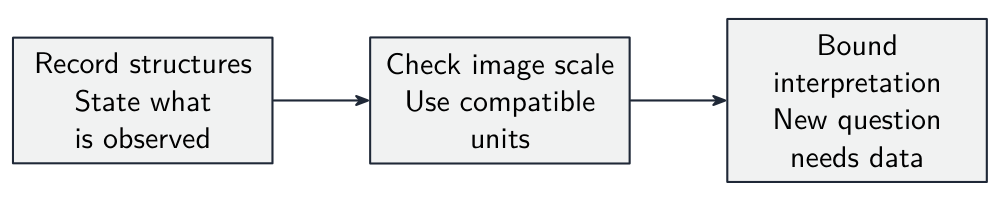
    Struktur terekam dan pengecekan skala mendukung interpretasi, sementara pertanyaan baru memerlukan bukti baru.

    Dalam kasus yang disediakan, sel yang dicetak panjangnya 30,0 milimeter dan panjang sebenarnya yang dinyatakan adalah 0,0500 milimeter. Gunakan satuan yang sama dalam rasio:

    $$M=\frac{L_{image}}{L_{actual}}$$
    $$M=\frac{30.0\ \text{mm}}{0.0500\ \text{mm}}=600$$

    Pembesaran adalah ×600, bukan panjang. Bentuk dan skala saja tidak menetapkan laju pertumbuhan. Studi pertumbuhan yang diizinkan memerlukan ukuran yang ditentukan, organisme yang dapat dibandingkan, kondisi dan periode observasi.

    Vocabulary · ⁨Kosa kata⁩ Train · ⁨Latih⁩
    English Bahasa Indonesia
    collaborative investigation/kəˈlæbrətɪv ɪnˌvestɪˈɡeɪʃn/ Investigasi kolaboratif
    Biology/baɪˈɒlədʒi/ Biologi
    cell/sel/ sel
    Prokaryotic/ˌprɒkərɪˈɒtɪk/ Prokariotik
    eukaryotic/ˌjuːkərɪˈɒtɪk/ eukariotik
    Homeostasis/ˌhəʊmiːəˈstɑːsiz/ Homeostasis
    2.2

    The classification of living things · ⁨Klasifikasi makhluk hidup⁩

    Syllabus · ⁨Silabus⁩
    English

    Unit 2 of 7 in GAC023 Science III: General Science (Level III). The module is taught over about 40 class hours plus 20 hours of independent study, and is assessed at the teaching centre and moderated by ACT — there is no external exam.

    The module outcomes this unit works towards:

    Learning Objective GAC023.1: Demonstrate knowledge and understanding of major biological concepts and ideas.

    Bahasa Indonesia

    Unit 2 dari 7 dalam GAC023 Ilmu Pengetahuan III: Sains Umum (Level III). Modul ini diajarkan selama sekitar 40 jam pelajaran ditambah 20 jam studi mandiri, dan dinilai di pusat pengajaran serta dimoderasi oleh ACT — tidak ada ujian eksternal.

    Hasil pembelajaran yang dicapai unit ini:

    Tujuan Pembelajaran GAC023.1: Menunjukkan pengetahuan dan pemahaman tentang konsep-konsep utama biologi dan gagasan-gagasan.

    Source: Cambridge International syllabus · ⁨Sumber: Silabus Cambridge International⁩

    English

    Classification 分类 organises organisms using evidence about relationships, including inherited traits and molecular information. A traditional hierarchy is kingdom, phylum, class, order, family, genus and species 物种. Broader groups can contain several groups at the next level. A visible feature helps identification but does not alone establish ancestry.

    Binomial nomenclature 双名法 gives a species a genus name and a specific epithet. Capitalise the genus, use lower case for the epithet and italicise both words in print. When handwriting, underline both as required by the task. The epithet alone is not the full species name.

    Worked example: one genus, different species

    The supplied table places lion, tiger and domestic cat in Felidae. Lion and tiger share Panthera, but their species names are Panthera leo and Panthera tigris. The domestic cat is Felis catus, a different genus within that family. Names checked 2 October 2026 against ITIS records.

    A classroom leaf key can separate needle-like leaves from broad leaves, then smooth margins from toothed margins. This identifies prepared cards from stated features. The key's branch order is not evidence that plants evolved in that order.

    Bahasa Indonesia

    Klasifikasi mengorganisasikan organisme berdasarkan bukti hubungan, termasuk sifat warisan dan informasi molekuler. Hierarki tradisional adalah kerajaan, filum, kelas, ordo, famili, genus dan spesies. Kelompok yang lebih luas dapat memuat beberapa kelompok pada tingkat berikutnya. Fitur yang terlihat membantu identifikasi tetapi tidak sendiri yang menetapkan nenek moyang.

    Nomenklatur binomial memberikan nama genus dan epithet spesifik pada spesies. Huruf kapital pada genus, gunakan huruf kecil untuk epithet dan cetak miring kedua kata dalam cetakan. Saat menulis tangan, garis bawahi keduanya sesuai tugas. Epithet saja bukan nama spesies lengkap.

    Suatu famili dapat memuat beberapa genus, masing-masing dapat memuat beberapa spesies.

    Contoh terpecah: satu genus, spesies berbeda

    Tabel yang disediakan menempatkan singa, harimau dan kucing domestik dalam Felidae. Singa dan harimau berbagi Panthera, tetapi nama spesies mereka adalah Panthera leo dan Panthera tigris. Kucing domestik adalah Felis catus, genus berbeda dalam famili tersebut. Nama diverifikasi 2 Oktober 2026 terhadap rekaman ITIS.

    Kunci daun kelas dapat memisahkan daun seperti jarum dari daun lebar, kemudian margin halus dari margin bergerigi. Ini mengidentifikasi kartu yang disiapkan berdasarkan fitur yang stated. Ur percabangan kunci bukan bukti bahwa tanaman berevolusi dalam urutan itu.

    Vocabulary · ⁨Kosa kata⁩ Train · ⁨Latih⁩
    English Bahasa Indonesia
    Classification/ˌklæsɪfɪˈkeɪʃn/ Klasifikasi
    species/ˈspiːsiːz/ spesies
    Binomial nomenclature/baɪˈnəʊmɪəl nəˈmeŋklətʃə/ Nomenklatur binomial
    2.3

    Ecosystems · ⁨Ekosistem⁩

    Syllabus · ⁨Silabus⁩
    English

    Unit 3 of 7 in GAC023 Science III: General Science (Level III). The module is taught over about 40 class hours plus 20 hours of independent study, and is assessed at the teaching centre and moderated by ACT — there is no external exam.

    The module outcomes this unit works towards:

    Learning Objective GAC023.2: Describe the main components of an ecosystem and the main processes that take place in it.

    Bahasa Indonesia

    Unit 3 dari 7 dalam GAC023 Ilmu Pengetahuan III: Sains Umum (Level III). Modul ini diajarkan selama sekitar 40 jam pelajaran ditambah 20 jam studi mandiri, dan dinilai di pusat pengajaran serta dimoderasi oleh ACT — tidak ada ujian eksternal.

    Hasil pembelajaran yang dicapai unit ini:

    Tujuan Pembelajaran GAC023.2: Menjelaskan komponen utama ekosistem dan proses-proses utama yang terjadi di dalamnya.

    Source: Cambridge International syllabus · ⁨Sumber: Silabus Cambridge International⁩

    English

    An ecosystem 生态系统 includes organisms and nonliving conditions. Producers 生产者 make organic material using an energy source. Consumers 消费者 obtain it from other organisms. Decomposers 分解者 break down dead material and waste, helping return nutrients to available forms.

    Food-chain arrows point from food to consumer. Energy enters and transfers through the system, with dissipation through respiration and other pathways. It does not disappear from existence or cycle indefinitely back to the producer. Matter can cycle through living and nonliving parts, although a local system can also gain or lose matter across its boundary.

    Biodiversity 生物多样性 concerns the variety of life. Species richness and distributions of abundance are possible measures, depending on the question. Counting only one species does not describe all this variety. Diversity may affect ecosystem responses, but it does not guarantee resistance to every disturbance.

    Worked example: transfer percentages are case-specific

    For the separate meadow record, grass has 5,000 joules in its defined level, grasshoppers receive 600 and frogs receive 60. The efficiency relation is:

    $$\eta=\frac{E_{next}}{E_{previous}}\times100\%$$
    $$\eta_1=\frac{600}{5000}\times100\%=12\%$$
    $$\eta_2=\frac{60}{600}\times100\%=10\%$$

    Neither result makes ten percent a universal law. Not all material is eaten or assimilated, and energy is used and dissipated. This period's budget contains no population trend, so it cannot predict an exact frog decline the next week.

    Bahasa Indonesia

    Sebuah ekosistem mencakup organisme dan kondisi takhidup. Produsen membuat bahan organik menggunakan sumber energi. Konsumen mendapatkannya dari organisme lain. Dekomposer memecah materi mati dan limbah, membantu mengembalikan nutrisi ke bentuk yang tersedia.

    Panah rantai makanan menunjuk dari makanan ke konsumen. Energi masuk dan ditransfer melalui sistem, dengan dissipasi melalui respirasi dan jalur lain. Energi tidak hilang dari eksistensi atau berputar tak terbatas kembali ke produsen. Materi dapat berputar melalui bagian hidup dan takhidup, meskipun sistem lokal juga bisa mendapatkan atau kehilangan materi melintasi batasnya.

    Keanekaragaman hayati berkaitan dengan keragaman kehidupan. Kekayaan spesies dan distribusi kelimpahan adalah ukuran yang mungkin, tergantung pada pertanyaan. Menghitung hanya satu spesies tidak menggambarkan semua keragaman ini. Keragaman dapat memengaruhi respons ekosistem, tetapi tidak menjamin ketahanan terhadap setiap gangguan.

    Rantai alga ilustratif menggunakan nilai energi yang disediakan, bukan aturan transfer universal.

    Contoh terpecah: persentase transfer bersifat spesifik kasus

    Untuk catatan padang rumput terpisah, rumput memiliki 5,000 joule pada tingkat yang ditentukan, belalang receiving 600 dan katak menerima 60. Hubungan efisiensi adalah:

    $$\eta=\frac{E_{next}}{E_{previous}}\times100\%$$
    $$\eta_1=\frac{600}{5000}\times100\%=12\%$$
    $$\eta_2=\frac{60}{600}\times100\%=10\%$$

    Tidak ada hasil yang menjadikan sepuluh persen sebagai hukum universal. Tidak semua materi dimakan atau diasimilasi, dan energi digunakan serta didissipasi. Anggaran periode ini tidak berisi tren populasi, sehingga tidak dapat memprediksi penurunan katak yang tepat minggu depan.

    Vocabulary · ⁨Kosa kata⁩ Train · ⁨Latih⁩
    English Bahasa Indonesia
    ecosystem/ˈiːkəʊsɪstəm/ ekosistem
    Producers/prəˈdjuːsəz/ Produsen
    consumers/kənˈsuːməz/ konsumen
    decomposers/ˌdiːkəmˈpəʊzəz/ pengurai
    Biodiversity/ˌbaɪəʊdaɪˈvɜːsɪti/ Keanekaragaman Hayati
    rock cycle/rɒk ˈsaɪkl/ siklus batuan
    Renewable/rɪˈnjuːəbl/ Terbarukan
    non-renewable/nɒn rɪˈnjuːəbl/ tidak dapat diperbarui
    water cycle/ˈwɔːtə ˈsaɪkl/ siklus air
    2.4

    Earth resources · ⁨Sumber daya bumi⁩

    Syllabus · ⁨Silabus⁩
    English

    Unit 4 of 7 in GAC023 Science III: General Science (Level III). The module is taught over about 40 class hours plus 20 hours of independent study, and is assessed at the teaching centre and moderated by ACT — there is no external exam.

    The module outcomes this unit works towards:

    Learning Objective GAC023.3: Identify and describe the physical, chemical and biological features of the local environment.

    Learning Objective GAC023.8: Create a written report following scientific and academic conventions using Internet research.

    Bahasa Indonesia

    Unit 4 dari 7 dalam GAC023 Ilmu Pengetahuan III: Sains Umum (Level III). Modul ini diajarkan selama sekitar 40 jam pelajaran ditambah 20 jam studi mandiri, dan dinilai di pusat pengajaran serta dimoderasi oleh ACT — tidak ada ujian eksternal.

    Hasil pembelajaran yang dicapai unit ini:

    Tujuan Pembelajaran GAC023.3: Mengidentifikasi dan menjelaskan ciri-ciri fisik, kimia, dan biologis lingkungan setempat.

    Tujuan Pembelajaran GAC023.8: Membuat laporan tertulis mengikuti konvensi ilmiah dan akademik menggunakan riset Internet.

    Source: Cambridge International syllabus · ⁨Sumber: Silabus Cambridge International⁩

    English

    The rock cycle 岩石循环 connects formation and change. Cooling and solidification form igneous rock; sediment deposition, compaction and cementation can form sedimentary rock; heat and pressure can alter rock into metamorphic rock without melting it. Weathering and erosion produce sediment, while melting and later cooling form another route. These processes are not one compulsory circular sequence for every rock.

    Renewable 可再生 resources can be replenished on a relevant timescale. Non-renewable 不可再生 resources are not replenished fast enough on human-use timescales. Renewable does not mean unlimited: demand can exceed replacement, and ecosystem needs also matter.

    The water cycle 水循环 includes evaporation, condensation, precipitation and movement or storage through runoff, infiltration and groundwater. A local pond is open to inputs and losses. A report should combine physical layout, dated chemical measurements and non-destructive biological records, citing their sources and methods.

    Worked example: renewal versus extraction

    In the simplified supplied budget, inputs are 30 cubic metres, outlet loss is 18 and evaporation is 7. Other changes are excluded by assumption:

    $$\Delta S=I-O-E$$
    $$\Delta S=30-18-7=5\ \text{m}^3$$

    With a proposed additional extraction of 12 cubic metres:

    $$\Delta S=I-O-E-X$$
    $$\Delta S=30-18-7-12=-7\ \text{m}^3$$

    That period's estimate does not establish long-term sustainability, initial storage or permission to extract. Reeds do not prove drinking-water safety. A rock photograph does not establish every rock's type or exact age.

    Bahasa Indonesia

    Siklus batuan menghubungkan pembentukan dan perubahan. Pendinginan dan pembekuan membentuk batuan beku; deposisi sedimen, pemadatan dan pengikatan dapat membentuk batuan sedimen; panas dan tekanan dapat mengubah batuan menjadi batuan metamorfik tanpa melelehkannya. Pelapukan dan erosi menghasilkan sedimen, sementara pelelehan dan pendinginan selanjutnya membentuk rute lain. Proses-proses ini bukan satu urutan siklus wajib untuk setiap batuan.

    Sumber daya terbarukan dapat diperbarui dalam skala waktu yang relevan. Sumber daya tidak terbarukan tidak diperbarui cukup cepat pada skala waktu penggunaan manusia. Terbarukan tidak berarti tak terbatas: permintaan dapat melebihi penggantian, dan kebutuhan ekosistem juga penting.

    Siklus air mencakup penguapan, kondensasi, presipitasi dan pergerakan atau penyimpanan melalui aliran permukaan, infiltrasi dan air tanah. Danau lokal terbuka terhadap input dan kerugian. Laporan harus menggabungkan tata letak fisik, pengukuran kimia bertanggal dan rekaman biologis non-destruktif, dengan mengutip sumber dan metodenya.

    Anggaran danau lokal mencatat input, penyimpanan dan kerugian dalam batas dan periode yang stated.

    Contoh terpecah: perpanjangan versus ekstraksi

    Dalam anggaran yang disediakan yang disederhanakan, input adalah 30 meter kubik, kehilangan outlet adalah 18 dan penguapan adalah 7. Perubahan lainnya dikucilkan oleh asumsi:

    $$\Delta S=I-O-E$$
    $$\Delta S=30-18-7=5\ \text{m}^3$$

    Dengan usulan ekstraksi tambahan 12 meter kubik:

    $$\Delta S=I-O-E-X$$
    $$\Delta S=30-18-7-12=-7\ \text{m}^3$$

    Estimasi periode tersebut tidak menetapkan keberlanjutan jangka panjang, penyimpanan awal, atau izin untuk mengekstrak. Reeds tidak membuktikan keamanan air minum. Foto batuan tidak menetapkan jenis setiap batuan atau usia pastinya.

    2.5

    Chemistry · ⁨Kimia⁩

    Syllabus · ⁨Silabus⁩
    English

    Unit 5 of 7 in GAC023 Science III: General Science (Level III). The module is taught over about 40 class hours plus 20 hours of independent study, and is assessed at the teaching centre and moderated by ACT — there is no external exam.

    The module outcomes this unit works towards:

    Learning Objective GAC023.4: Demonstrate an understanding of atomic structure, the changes it can undergo and the use of the Periodic Table.

    Bahasa Indonesia

    Unit 5 dari 7 dalam GAC023 Ilmu Pengetahuan III: Sains Umum (Level III). Modul ini diajarkan selama sekitar 40 jam pelajaran ditambah 20 jam studi mandiri, dan dinilai di pusat pengajaran serta dimoderasi oleh ACT — tidak ada ujian eksternal.

    Hasil pembelajaran yang dicapai unit ini:

    Tujuan Pembelajaran GAC023.4: Menunjukkan pemahaman tentang struktur atom, perubahan yang dapat dialaminya, dan penggunaan Tabel Periodik.

    Source: Cambridge International syllabus · ⁨Sumber: Silabus Cambridge International⁩

    English

    An atom 原子 has a nucleus and electrons. Its atomic number 原子序数 is its proton count, while its mass number 质量数 counts protons and neutrons. Most nuclei contain both, but hydrogen-1 has one proton and no neutron. Isotopes 同位素 of an element have the same proton count and different neutron counts.

    The periodic table 元素周期表 orders elements by atomic number. In an introductory main-group model, outer electron arrangements help explain similarities within groups. The elements are not identical, and the simplified rule should not be extended without care to every element.

    Ionic bonds 离子键 are attractions between oppositely charged ions. Electron transfer can explain their formation; it is not the attraction itself. Covalent bonds 共价键 involve shared electron pairs. These are explanatory models, not instructions to handle reactive materials.

    Worked example: keep proton number unchanged

    Sodium-23 has 11 protons and mass number 23:

    $$N=A-Z$$
    $$N=23-11=12$$

    Its neutral atom has 11 electrons. Losing one gives Na⁺ with ten electrons and the same eleven protons. Sodium-24 has thirteen neutrons but remains sodium. Neutral chlorine has seventeen electrons; gaining one gives Cl⁻ with eighteen. Their opposite charges explain attraction.

    Bahasa Indonesia

    Atom memiliki inti dan elektron. Nomor atomnya adalah jumlah protonnya, sedangkan nomor massanya menghitung proton dan neutron. Sebagian besar inti mengandung keduanya, tetapi hidrogen-1 hanya memiliki satu proton dan tidak ada neutron. Isotop dari suatu unsur memiliki jumlah proton yang sama dan jumlah neutron yang berbeda.

    Tabel periodik mengurutkan unsur berdasarkan nomor atom. Dalam model kelompok utama pengantar, susunan elektron luar membantu menjelaskan kesamaan dalam kelompok. Unsur-unsur tersebut tidak identik, dan aturan penyederhanaan tidak harus diperluas tanpa kehati-hatian ke setiap unsur.

    Ikatan ionik adalah tarikan antara ion bermuatan berlawanan. Transfer elektron dapat menjelaskan pembentukannya; itu bukan tarikan itu sendiri. Ikatan kovalen melibatkan pasangan elektron yang dibagi. Ini adalah model penjelasan, bukan instruksi untuk menangani bahan reaktif.

    Proton mengidentifikasi unsur, neutron membedakan isotop, dan perubahan elektron menentukan muatan ion.

    Contoh terpecah: tetap pertahankan nomor proton

    Natrium-23 memiliki 11 proton dan nomor massa 23:

    $$N=A-Z$$
    $$N=23-11=12$$

    Atom netralnya memiliki 11 elektron. Kehilangan satu memberikan Na⁺ dengan sepuluh elektron dan sebelas proton yang sama. Natrium-24 memiliki tiga belas neutron tetapi tetap natrium. Klorin netral memiliki tujuh belas elektron; memperoleh satu memberikan Cl⁻ dengan delapan belas. Muatan berlawanan mereka menjelaskan atraksi.

    Vocabulary · ⁨Kosa kata⁩ Train · ⁨Latih⁩
    English Bahasa Indonesia
    atom/ˈætəm/ atom
    atomic number/əˈtɒmɪk ˈnʌmbə/ nomor atom
    mass number/mæs ˈnʌmbə/ nomor massa
    isotopes/ˈaɪsətəʊps/ isotop
    periodic table/ˌpɪərɪˈɒdɪk ˈteɪbl/ tabel periodik
    Ionic bonds/aɪˈɒnɪk bɒndz/ Ikatan ionik
    covalent bonds/ˈkəʊvələnt bɒndz/ ikatan kovalen
    Combustion/kəmˈbʌstʃn/ Kombustion
    greenhouse effect/ˈɡriːnhaʊs ɪˈfekt/ efek rumah kaca
    Acid rain/ˈæsɪd reɪn/ Hujan asam
    Pollution/pəˈluːʃn/ Pencemaran
    2.6

    Chemistry and the environment · ⁨Kimia dan lingkungan⁩

    Syllabus · ⁨Silabus⁩
    English

    Unit 6 of 7 in GAC023 Science III: General Science (Level III). The module is taught over about 40 class hours plus 20 hours of independent study, and is assessed at the teaching centre and moderated by ACT — there is no external exam.

    The module outcomes this unit works towards:

    Learning Objective GAC023.5: Explain how applications of chemistry affect the environment.

    Bahasa Indonesia

    Unit 6 dari 7 dalam GAC023 Ilmu Pengetahuan III: Sains Umum (Level III). Modul ini diajarkan selama sekitar 40 jam pelajaran ditambah 20 jam studi mandiri, dan dinilai di pusat pengajaran serta dimoderasi oleh ACT — tidak ada ujian eksternal.

    Hasil pembelajaran yang dicapai unit ini:

    Tujuan Pembelajaran GAC023.5: Menjelaskan bagaimana penerapan kimia memengaruhi lingkungan.

    Source: Cambridge International syllabus · ⁨Sumber: Silabus Cambridge International⁩

    English

    Combustion 燃烧 of carbon-containing fuels can release carbon dioxide. The greenhouse effect 温室效应 involves absorption and emission of thermal infrared by gases including carbon dioxide. Acid rain 酸雨 involves atmospheric reactions of sulfur dioxide and nitrogen oxides forming acidic compounds. These are different mechanisms, with different evidence and responses.

    Pollution 污染 depends on a substance or agent, its amount, pathway and effects. Chemistry can help monitor and treat it, but moving material into another output is not necessarily destroying it. Assess benefits alongside energy use, residual material and appropriate waste handling. Sources checked 2 October 2026: EPA acid-rain explanation and NASA radiation budget.

    Worked example: a reduction can still miss a target

    An invented 10-litre treatment record falls from 12.0 to 3.0 milligrams per litre. At unchanged volume:

    $$m=CV$$
    $$m_{remaining}=3.0\ \frac{\text{mg}}{\text{L}}\times10.0\ \text{L}=30\ \text{mg}$$

    The initial mass was 120 milligrams, so ninety are retained on the filter under the stated assumptions. The concentration reduction is seventy-five percent, but the final 3.0 still exceeds the fictional task target of 2.0 milligrams per litre. This is not a real safety standard. Students analyse the supplied data and do not discharge chemicals.

    Bahasa Indonesia

    Pembakaran bahan bakar yang mengandung karbon dapat melepaskan karbon dioksida. Efek rumah kaca melibatkan penyerapan dan emisi inframerah termal oleh gas termasuk karbon dioksida. Hujan asam melibatkan reaksi atmosferik sulfur dioksida dan oksida nitrogen membentuk senyawa asam. Ini adalah mekanisme yang berbeda, dengan bukti dan respons yang berbeda.

    Pencemaran bergantung pada zat atau agen, jumlahnya, jalur, dan efeknya. Kimia dapat membantu memonitor dan mengatasinya, tetapi memindahkan material ke output lain belum tentu menghancurkannya. Evaluasi manfaat bersama penggunaan energi, material residu, dan penanganan limbah yang sesuai. Sumber dicek 2 Oktober 2026: Penjelasan EPA tentang hujan asam dan Anggaran radiasi NASA.

    Pengolahan yang disediakan memiliki output cairan dan limbah filter, keduanya tetap dalam akuntansi zat.

    Contoh terpecah: reduksi bisa saja masih melewatkan target

    Catatan pengolahan 10 liter yang dibuat-buat turun dari 12,0 menjadi 3,0 miligram per liter. Pada volume yang tidak berubah:

    $$m=CV$$
    $$m_{remaining}=3.0\ \frac{\text{mg}}{\text{L}}\times10.0\ \text{L}=30\ \text{mg}$$

    Massa awal adalah 120 miligram, sehingga sembilan puluh tersisa di atas filter di bawah asumsi yang dinyatakan. Penurunan konsentrasi adalah tujuh puluh lima persen, tetapi akhir 3,0 masih melebihi target tugas fiksi sebesar 2,0 miligram per liter. Ini bukan standar keselamatan nyata. Siswa menganalisis data yang disediakan dan tidak membuang bahan kimia.

    2.7

    Physics · ⁨Fisika⁩

    Syllabus · ⁨Silabus⁩
    English

    Unit 7 of 7 in GAC023 Science III: General Science (Level III). The module is taught over about 40 class hours plus 20 hours of independent study, and is assessed at the teaching centre and moderated by ACT — there is no external exam.

    The module outcomes this unit works towards:

    Learning Objective GAC023.6: Demonstrate an understanding of wave motion.

    Bahasa Indonesia

    Unit 7 dari 7 dalam GAC023 Ilmu Pengetahuan III: Sains Umum (Level III). Modul ini diajarkan selama sekitar 40 jam pelajaran ditambah 20 jam studi mandiri, dan dinilai di pusat pengajaran serta dimoderasi oleh ACT — tidak ada ujian eksternal.

    Hasil pembelajaran yang dicapai unit ini:

    Tujuan Pembelajaran GAC023.6: Menunjukkan pemahaman tentang gerak gelombang.

    Source: Cambridge International syllabus · ⁨Sumber: Silabus Cambridge International⁩

    English

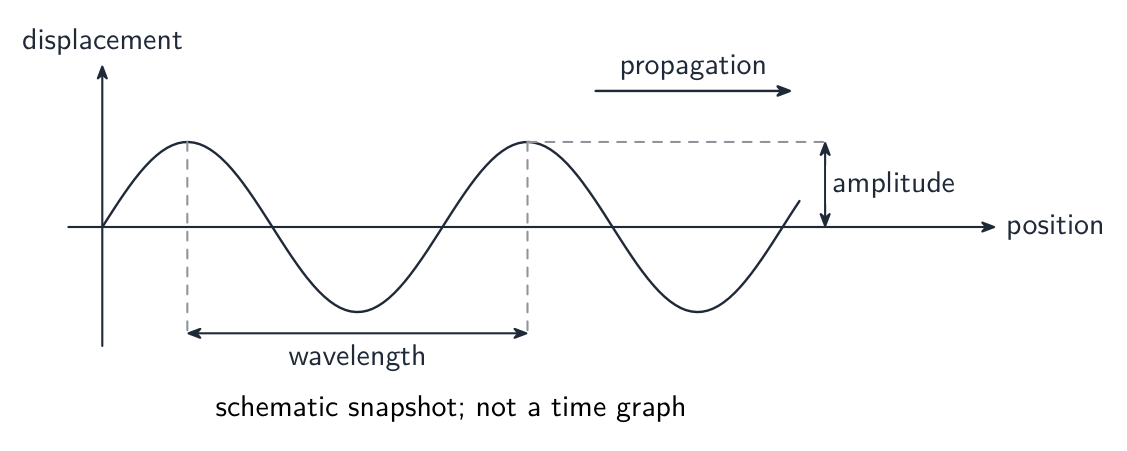
    A wave 波 transfers energy through a travelling disturbance without carrying each medium particle along with it. Frequency 频率 counts complete oscillations per second. Wavelength 波长 is the spacing of successive points in the same phase. Speed 波速 relates them through the wave equation. Amplitude is maximum displacement from equilibrium, not crest-to-trough height.

    Transverse waves 横波 oscillate perpendicular to propagation; longitudinal waves 纵波 oscillate parallel to it. The direction drawn on a page alone does not decide the type. A string point may oscillate vertically while the disturbance moves horizontally.

    The electromagnetic spectrum 电磁波谱 runs through radio, microwaves, infrared, visible light, ultraviolet, X-rays and gamma rays. Electromagnetic waves do not require a material medium. They share the same vacuum speed while differing in frequency and wavelength; mechanical waves do not all have that speed.

    Worked example: choose the equation for the question

    The supplied string wave has frequency 5.0 hertz and wavelength 0.40 metres:

    $$v=f\lambda$$
    $$v=5.0\ \text{Hz}\times0.40\ \text{m}=2.0\ \frac{\text{m}}{\text{s}}$$

    Its period is the time per complete oscillation:

    $$T=\frac{1}{f}$$
    $$T=\frac{1}{5.0}=0.20\ \text{s}$$

    An amplitude of 0.030 metres gives a crest-to-trough height of 0.060 metres. Neither is the 0.40-metre wavelength. A marked point oscillates about equilibrium; no supplied observation establishes that changing amplitude changes frequency.

    Bahasa Indonesia

    Gelombang mentransfer energi melalui gangguan yang merambat tanpa membawa setiap partikel medium bersamanya. Frekuensi menghitung osilasi lengkap per detik. Panjang gelombang adalah jarak antar titik berturut-turut dalam fase yang sama. Kecepatan menghubungkannya melalui persamaan gelombang. Amplitudo adalah simpangan maksimum dari kesetimbangan, bukan tinggi puncak hingga lembah.

    Gelombang transversal berosilasi tegak lurus terhadap propagasi; gelombang longitudinal berosilasi sejajar dengannya. Arah yang digambar di halaman saja tidak menentukan jenisnya. Titik tali mungkin berosilasi secara vertikal sementara gangguan bergerak secara horizontal.

    Spektrum elektromagnetik meliputi radio, gelombang mikro, inframerah, cahaya tampak, ultraviolet, sinar-X, dan sinar gamma. Gelombang elektromagnetik tidak memerlukan medium material. Mereka berbagi kecepatan vakum yang sama sambil berbeda dalam frekuensi dan panjang gelombang; gelombang mekanik tidak semuanya memiliki kecepatan tersebut.

    Snapshots gelombang transversal skematik memisahkan panjang gelombang dan amplitudo dari arah propagasi.

    Contoh terpecah: pilih persamaan untuk pertanyaan

    Gelombang tali yang disediakan memiliki frekuensi 5,0 hertz dan panjang gelombang 0,40 meter:

    $$v=f\lambda$$
    $$v=5.0\ \text{Hz}\times0.40\ \text{m}=2.0\ \frac{\text{m}}{\text{s}}$$

    Periode adalah waktu per osilasi lengkap:

    $$T=\frac{1}{f}$$
    $$T=\frac{1}{5.0}=0.20\ \text{s}$$

    Amplitudo 0,030 meter memberikan tinggi puncak hingga lembah 0,060 meter. Keduanya bukan panjang gelombang 0,40 meter. Titik yang ditandai berosilasi sekitar kesetimbangan; tidak ada observasi yang disediakan yang menetapkan bahwa mengubah amplitudo mengubah frekuensi.

    Vocabulary · ⁨Kosa kata⁩ Train · ⁨Latih⁩
    English Bahasa Indonesia
    wave/weɪv/ gelombang
    Frequency/ˈfriːkwənsi/ Frekuensi
    wavelength/ˈweɪvleŋθ/ panjang gelombang
    speed/spiːd/ kecepatan (besaran skalar)
    Transverse waves/trænsˈvɜːs weɪvz/ Gelombang transversal
    longitudinal waves/ˌlɒŋɡɪˈtjuːdɪnl weɪvz/ gelombang longitudinal
    electromagnetic spectrum/ɪˌlektrəʊməɡˈnetɪk ˈspektrəm/ spektrum elektromagnetik
    Additional notes PDF

    A team investigation needs more than divided writing

    Two teams describe the same pond. One records where and when observations were made; the other combines undated photographs and a website's general statements. Which report lets a reader check its conclusions? This supplement develops the collaborative investigation and Internet-research outcomes alongside the original GAC023 handout. Follow the current centre brief for the required task, methods and assessment criteria.

    Agree a question, method and team record

    A collaborative investigation 合作探究 shares a scientific task with clear responsibilities and a common method. Choose a narrow question that permitted observations can address. For example: how does the proportion of ground covered by the selected plant differ between two accessible, teacher-approved areas? This is a comparison of coverage, not automatically a test of growth rate or proof of the cause of a difference.

    A sampling method 取样方法 specifies how observations are selected. Define the areas and observation period before collecting records. Use the same frame size and counting rule at both areas. Select positions by an agreed method, rather than choosing only attractive examples. Random selection within an accessible area can reduce deliberate selection, but cannot represent places excluded from that area. Keep repeats 重复测量 distinct from revisiting the exact same record: ten photographs of one patch are not ten independent patches.

    Agree which member records location and time, which estimates coverage and which checks the entries. Rotate or check roles if different observers could systematically use different rules. A common recording sheet needs labels, units, the selection method and any deviations. Keep each original record and identify its observer. Resolve a disagreement by checking the agreed rule and evidence; do not replace an inconvenient result with the group average.

    Obtain teacher agreement before fieldwork. Respect access restrictions, weather and local site rules. Use permitted observations without entering unsafe water or collecting unknown organisms or chemicals. A report about a proposed investigation must call it proposed. Research does not replace required fieldwork.

    Analyse a supplied case without inventing causes

    The following supplied data 给定数据 are fictional practice records, not a completed field investigation. Both areas use the same coverage rule and frame size. Each row represents a different selected position.

    Position Area A coverage / % Area B coverage / %
    1 20 40
    2 30 50
    3 40 60
    Mean 30 50

    Calculate each mean from its three records. The mean difference is 50 − 30 = 20 percentage points 百分点. Each area's range is twenty percentage points. A difference of twenty percentage points is not the same statement as a twenty-percent relative increase: relative to A's mean, the increase would be 20 ÷ 30 × 100%, approximately 66.7%.

    A suitable conclusion 结论 is: in the supplied samples, mean coverage was greater in B, with variation within both areas. Three samples do not establish all seasons or every part of the pond. The table gives no light, soil, water or time-series measurements. It therefore cannot show that pollution caused the difference or that a plant grew faster. Coverage also does not measure species richness. Identify the additional question and measurements needed rather than inventing an explanation.

    Describe the local environment through different evidence

    A physical feature 物理特征 concerns conditions such as layout, slope, shade or water movement. A chemical feature 化学特征 concerns substances and quantities, such as a dated concentration measured by a stated method. A biological feature 生物特征 concerns organisms, their distribution and relationships. Keep the categories connected without treating one as proof of another.

    For a local environment report, use a labelled location description and dated records. State which observations your team made and which came from another source. An organism photograph can support an identification within its limits; it cannot establish drinking-water safety. A chemical result without a date, unit or method may be unsuitable for the comparison. If the assignment uses secondary information only, state that limitation rather than presenting it as your own measurement.

    Research online and make the report traceable

    A secondary source 二手资料 reports information collected or interpreted by someone else. Check the producer, date, purpose, method and relevance to your question. Prefer the original measurement record or research report when available. A search-result preview does not replace reading the source. Two websites repeating one report are not two independent observations.

    Keep a source log as you research: author or organisation, title, date, address, the exact claim used and its limits. Use the reference style required by your brief. A citation 引用标注 links a claim to its source; the reference list gives the details needed to locate it. Explain the idea in your own words while citing it. Cite borrowed images and respect their permitted use. Do not make a missing date, method or author up.

    Organise the report around question and background, method and team responsibilities, results, discussion and conclusion, and references. Distinguish observation from explanation, and your records from published background. Show checked calculations, units and labelled tables. Discuss a specific limitation and a matching improvement. A reflection should identify each person's actual contribution and a concrete coordination issue; equal-length paragraphs do not demonstrate equal participation.

    Practice and explained answers

    1. Why are ten photographs of one patch not ten independent patches?
    2. Calculate the mean difference for the supplied coverage data, with its unit.
    3. Can these data prove pollution caused the coverage difference? Explain.
    4. What must accompany a borrowed chemical measurement?
    5. Two sites repeat one report. How many independent records does this establish?
    6. What should a team do when its members disagree about one coverage entry?

    Answers.

    1. The sampled location has not changed; extra photographs do not broaden sampling.
    2. 50 − 30 = 20 percentage points, not twenty percent relative to A.
    3. No. Pollution was not measured, and alternative explanations remain.
    4. Its source, date, unit, method and relevant limitations.
    5. One underlying report; repetition alone adds no independent observation.
    6. Check the shared rule and evidence; retain the original record and correction trail.

Log in or create account · ⁨Masuk atau buat akun⁩

IGCSE, A-Level & AP