AC power and three-phase
הוצג| English | משמעות |
|---|---|
| real power | real power |
| power factor | גורם הספק |
| complex power | הספק מרוכב |
| reactive power | reactive power |
| power-factor correction | Parallel capacitance supplying the load reactive power locally. |
| three-phase | תלת-פאזי |
1 kW and 1 kVA
- A 1 kW heater and a 1 kVA capacitor bank both draw "1 k-something" from the supply. Only the heater turns that into energy on the bill.
- The capacitor's current flows to and fro, doing no net work but still loading the cables. This lesson separates the two kinds of power.
Real power and the power factor
- With RMS phasors $\mathbf{V}$ and $\mathbf{I}$ at angle $\theta$ apart, the average power is $P = VI\cos\theta$ in watts. This is the real power 有功功率 that heats and turns things.
- The power factor 功率因数 $\cos\theta$ is the share of $VI$ that does work: 1 for a resistor, 0 for a pure inductor or capacitor.
A load draws 10 A RMS from 230 V RMS with the current lagging by 60°. What is its real power, in watts?
רמת קושי 2/5 · 140 מטבעות + בונוס קטן בהשלמה הראשונה היום
$P = VI\cos\theta = 230 \times 10 \times 0.5 = 1150$ W. The power factor 0.5 means half of the 2300 VA does work.
Complex power and the power triangle
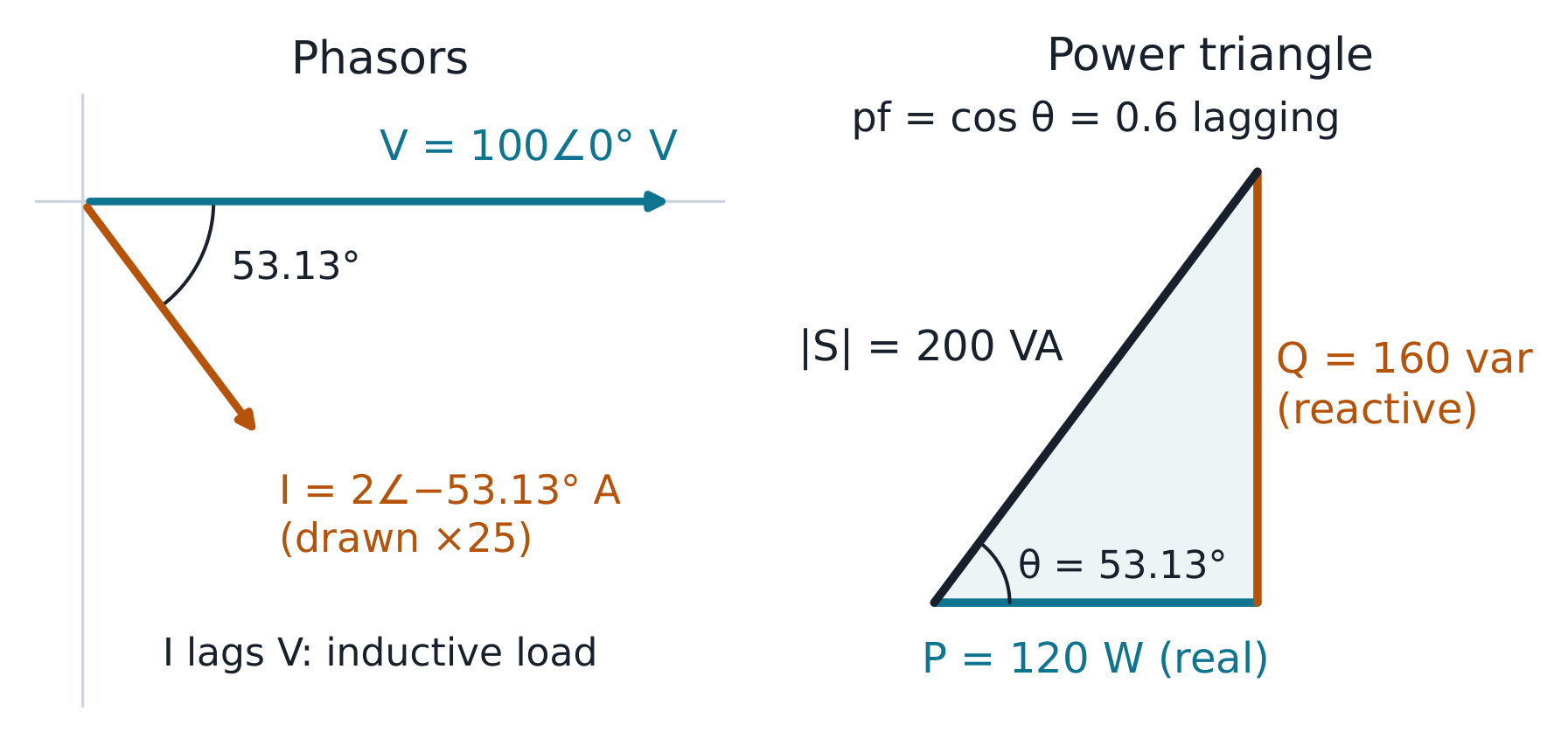
- Complex power 复功率 is $S = \mathbf{V}\mathbf{I}^{*} = P + jQ$. $Q = VI\sin\theta$ is the reactive power 无功功率 in var, power borrowed and returned each cycle.
- $|S| = VI$ in VA is the apparent power, which sets the cable and transformer size. The three form a right triangle: $|S|^{2} = P^{2} + Q^{2}$.
Match each quantity to its unit and meaning.
רמת קושי 2/5 · 140 מטבעות + בונוס קטן בהשלמה הראשונה היום
$S = P + jQ$ and $|S|^{2} = P^{2} + Q^{2}$: the power triangle.
Worked example: the RL load
- An RMS $100\angle 0^{\circ}\,\text{V}$ across $30 + j40\,\Omega$ draws $2\angle -53.13^{\circ}\,\text{A}$. $P = 100 \times 2 \times 0.6 = 120\,\text{W}$, $Q = 100 \times 2 \times 0.8 = 160\,\text{var}$, $|S| = 200\,\text{VA}$, pf 0.6 lagging.
- Check without the angle: $P = |I|^{2}R = 4 \times 30 = 120\,\text{W}$ and $Q = |I|^{2}X = 4 \times 40 = 160\,\text{var}$.
The RL load (I = 2 A through R = 30 Ω, X = 40 Ω) has Q equal to —
רמת קושי 1/5 · 100 מטבעות + בונוס קטן בהשלמה הראשונה היום
$Q = |I|^{2}X = 4 \times 40 = 160$ var, a check that never uses the phase angle; $P = 4 \times 30 = 120$ W likewise.
A load of 30 + j40 Ω draws 2 A RMS. What is its apparent power?
רמת קושי 1/5 · 100 מטבעות + בונוס קטן בהשלמה הראשונה היום
$|S| = |I|^{2}|Z| = 4 \times 50 = 200$ VA, which matches $\sqrt{120^{2} + 160^{2}} = 200$.
Power-factor correction
- Power-factor correction 功率因数校正 puts a capacitor in parallel with the load. The capacitor supplies the load's reactive power locally, so the supply carries only $P$.
- A capacitor at voltage $V$ supplies $Q_{C} = \omega C V^{2}$. To cancel 160 var at 100 V, 50 Hz: $C = \dfrac{160}{2\pi \cdot 50 \cdot 100^{2}} = 50.9\,\mu\text{F}$.
A load takes 400 var (lagging) from a 200 V RMS, 50 Hz supply. What parallel capacitance cancels it, in µF?
רמת קושי 2/5 · 140 מטבעות + בונוס קטן בהשלמה הראשונה היום
$C = \dfrac{Q}{\omega V^{2}} = \dfrac{400}{2\pi \cdot 50 \cdot 200^{2}} = 31.8\,\mu\text{F}$.
Three-phase: work per phase
- A three-phase 三相 supply has three voltages 120° apart. In a balanced star connection, the line voltage is $\sqrt{3}$ times the phase voltage and the line current equals the phase current.
- Solve one phase, then multiply by 3: $P = 3V_{ph}I_{ph}\cos\theta = \sqrt{3}\,V_{L}I_{L}\cos\theta$.
A star motor on a 415 V line with $10 + j10\,\Omega$ per phase: $V_{ph} = \dfrac{415}{\sqrt{3}} = 239.6\,\text{V}$, $I = \dfrac{239.6}{14.14} = 16.94\,\text{A}$, at 45° lagging. $P = 3 \times 239.6 \times 16.94 \times 0.7071 = 8611\,\text{W}$, and $\sqrt{3} \times 415 \times 16.94 \times 0.7071$ gives the same.
A star load of 10 + j10 Ω per phase on a 415 V line draws total power of about
רמת קושי 1/5 · 100 מטבעות + בונוס קטן בהשלמה הראשונה היום
$V_{ph} = \dfrac{415}{\sqrt{3}} = 239.6$ V, $I = \dfrac{239.6}{14.14} = 16.94$ A, $P = 3 \times 239.6 \times 16.94 \times \cos 45^{\circ} = 8.61$ kW, the same as $\sqrt{3} \times 415 \times 16.94 \times 0.707$.
Three common slips
- Line voltage in a per-phase formula. Divide by $\sqrt{3}$ first for a star load.
- Dropping the power factor. It belongs in both $3V_{ph}I_{ph}\cos\theta$ and $\sqrt{3}\,V_{L}I_{L}\cos\theta$.
- Correcting at the wrong voltage. A capacitor's $Q_{C}$ depends on the voltage where it is connected.
For a balanced star load on a 400 V line, each phase impedance sees 400 V.
רמת קושי 1/5 · 100 מטבעות + בונוס קטן בהשלמה הראשונה היום
Each phase sees the phase voltage, $\dfrac{400}{\sqrt{3}} = 231$ V. Only a delta load has the full line voltage across each phase.
Recap
- $S = \mathbf{V}\mathbf{I}^{*} = P + jQ$; $P$ is billed, $Q$ is borrowed, $|S|$ sizes the cables.
- Check with $|I|^{2}R$ and $|I|^{2}X$; a parallel capacitor supplies $Q$ locally.
- Three-phase: solve one phase; in star, $V_{L} = \sqrt{3}\,V_{ph}$.