Growth: small rates, compounded
הוצג| English | משמעות |
|---|---|
| rule of 70 | rule of 70 |
| capital/ˈkæpɪtl/ | Produced assets used to make other goods and services. |
| total factor productivity | total factor productivity |
1.75 points, compounded for a working life
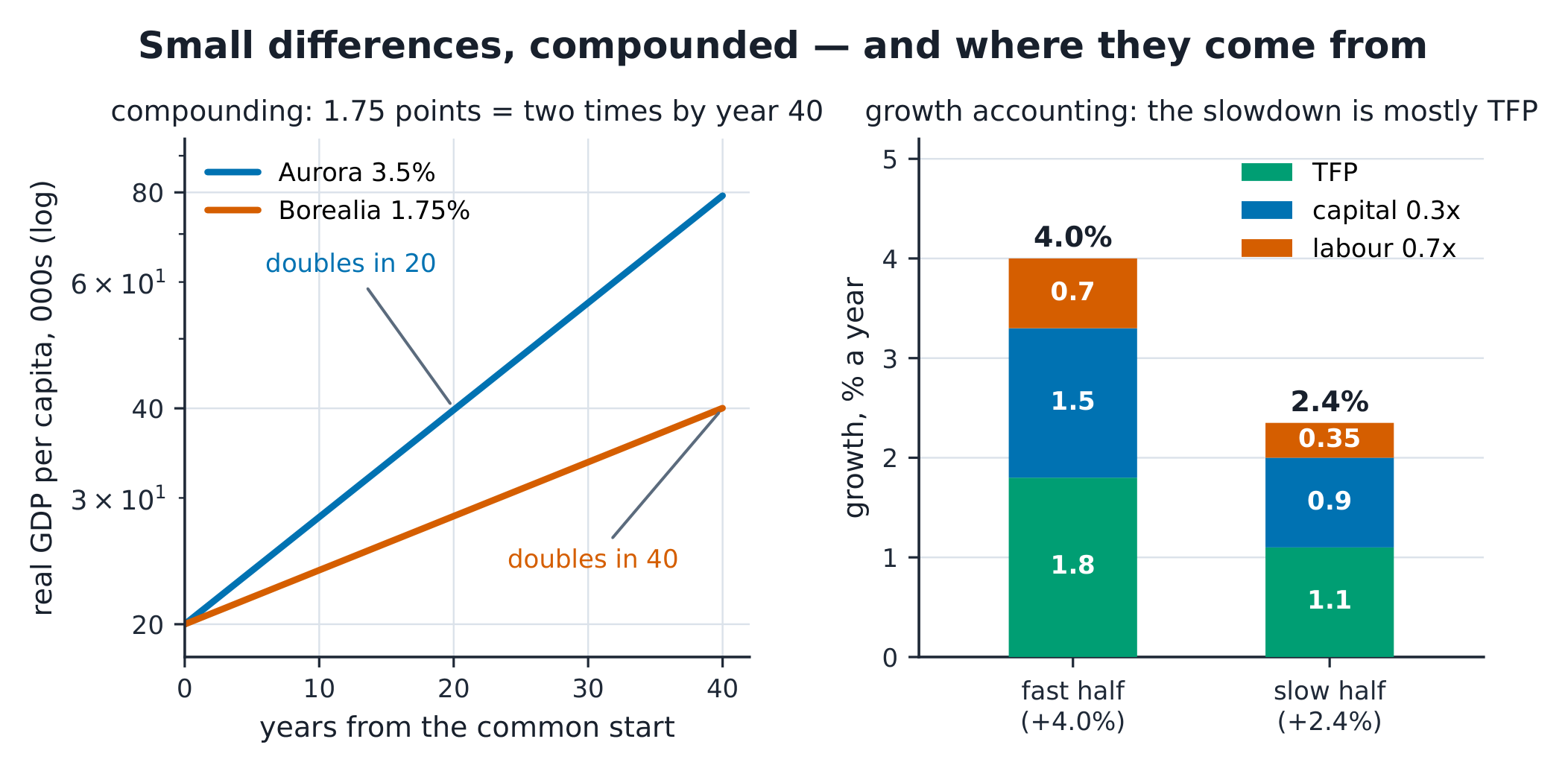
- Two neighbours start at the same income. One compounds at 3.5% a year, the other at 1.75%. After 40 years one is twice as rich as the other — from a gap smaller than a recession.
- This lesson is about where growth comes from and how to check who delivered it.
The rule that turns rates into doublings
- The rule of 70: at $g$% a year, something doubles in about $70/g$ years. Aurora at 3.5% doubles in 20 years; Borealia at 1.75% needs 40.
- After 40 years: $20{,}000 \times 2^2 = 80{,}000$ against $20{,}000 \times 2 = 40{,}000$ ✓ — compounding, not the rate, is the drama.
At 3.5% growth a year, roughly how many years does income take to double?
רמת קושי 2/5 · 140 מטבעות + בונוס קטן בהשלמה הראשונה היום
Rule of 70: $70/3.5 = 20$ years. At 1.75% the same income needs 40 - the whole two-times gap of the lesson.
Income 20,000 compounds at 3.5% for 40 years. What is it at the end (thousands, nearest whole)?
רמת קושי 2/5 · 140 מטבעות + בונוס קטן בהשלמה הראשונה היום
Two doublings: $20 \times 4 = 80$ thousand. The 1.75% neighbour lands at 40 - a working life of 1.75 points bought a two-times gap.
Growth accounting: weigh the inputs
- Output comes from capital and labour with ideas on top: $\Delta Y/Y = \Delta A/A + 0.3\,\Delta K/K + 0.7\,\Delta L/L$ — the weights are income shares.
- The unexplained residual $\Delta A/A$ is total factor productivity 全要素生产率: everything inputs fail to account for.
The fast and the slow half-decade
- Fast half: output +4.0% with capital +5.0% and labour +1.0% → TFP $= 4.0 - 1.5 - 0.7 = \mathbf{1.8}$%.
- Slow half: +2.4% with +3.0% and +0.5% → TFP $= 2.4 - 0.9 - 0.35 = \mathbf{1.15}$%. The slowdown is one third fewer machines — and two thirds less improvement.
Where did the growth come from?
Decompose output growth into TFP, capital and labour contributions. Each card is one component of a verified growth episode.
Output +4.0%, capital +5.0%, labour +1.0%, alpha 0.3. What is TFP growth, in %?
רמת קושי 2/5 · 140 מטבעות + בונוס קטן בהשלמה הראשונה היום
$4.0 - 0.3 \times 5.0 - 0.7 \times 1.0 = 4.0 - 1.5 - 0.7 = 1.8$%.
The slow half: output +2.4%, capital +3.0%, labour +0.5%. TFP growth, in % (one decimal)?
רמת קושי 2/5 · 140 מטבעות + בונוס קטן בהשלמה הראשונה היום
$2.4 - 0.9 - 0.35 = 1.15$%. The 1.6-point fall in TFP dwarfs the 0.6-point fall in capital's contribution.
Residuals keep you honest
- A minister claims the fast years were "investment-driven". The ledger: 1.5 of the 4.0 came from capital, 0.7 from labour, 1.8 from TFP — more than half was doing things better, not owning more.
- TFP is a residual: measurement error in K or L lands silently in A. Trust the decomposition's shape, not its third decimal.
A minister credits the fast half-decade to investment. What does the ledger say?
רמת קושי 1/5 · 100 מטבעות + בונוס קטן בהשלמה הראשונה היום
Capital deepening delivered 1.5 points; TFP delivered 1.8 - more than half. The claim is arithmetically wrong, and the residual keeps it honest.'
TFP measures the level of technology in the economy.
רמת קושי 1/5 · 100 מטבעות + בונוס קטן בהשלמה הראשונה היום
It is the RESIDUAL - everything growth accounting cannot attribute to inputs: technology, but also management, matching, and measurement error in K and L.
Proximate versus fundamental
- Capital deepening, schooling, participation: proximate causes — the arithmetic of growth.
- Institutions, geography, culture, rule of law: fundamental causes — why the proximate ones differ across countries. Policy argues about the second list.
Match each cause of growth to its family.
רמת קושי 2/5 · 140 מטבעות + בונוס קטן בהשלמה הראשונה היום
Proximate causes are the arithmetic of growth; fundamental causes explain why the proximate ones differ across countries.
Why does the lesson quote growth for two half-decades separately?
רמת קושי 1/5 · 100 מטבעות + בונוס קטן בהשלמה הראשונה היום
A 4.0% window against a 2.4% one is a claim about dates as much as destiny - state the window, always.
Three growth slips
- Reading TFP as "technology". It is everything inputs fail to explain — management, matching, measurement error included.
- Extrapolating the fast phase. Convergence is conditional; the compounding line you draw is a choice.
- Comparing windows without saying so. A 4.0% half-decade against a 2.4% one is a claim about dates as much as destiny.
Recap
- $\Delta Y/Y = \Delta A/A + 0.3\Delta K/K + 0.7\Delta L/L$; weights are income shares.
- Rule of 70: rates become doublings; small gaps compound into living standards.
- Proximate causes are arithmetic; fundamental causes explain why they differ.