Your learning plan · Continue · Review →
以为 (mistakenly think)
הוצגהמיקום המנוהל נשמר בדפדפן הזה. המשך אינו משלים את השיעור או עונה על שאלותיו.
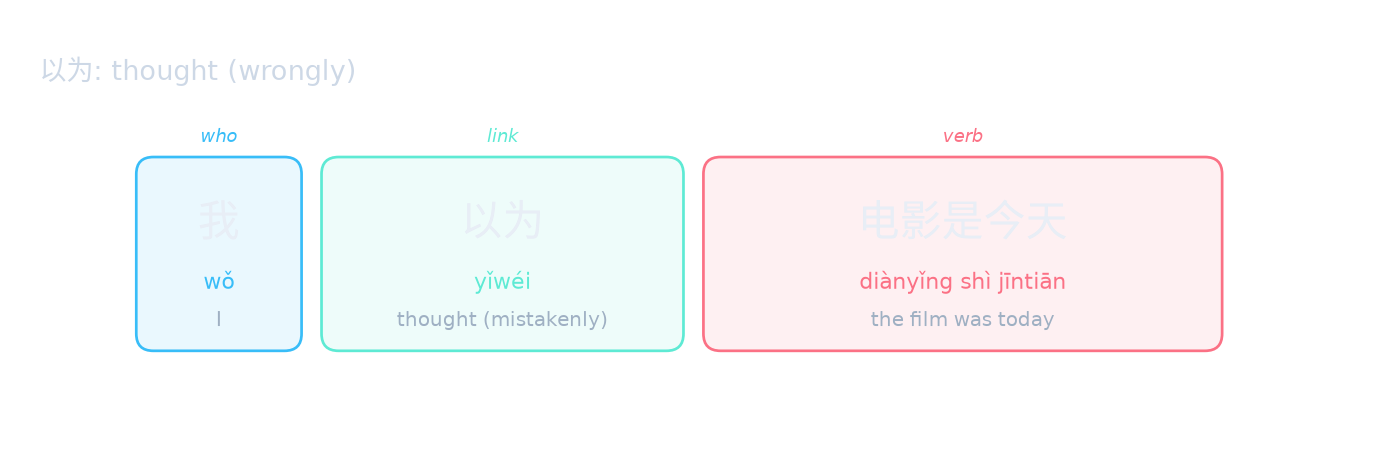
I thought it was tomorrow
- You arrive at the cinema and the staff tell you your film was yesterday.
- I我thought以为movie电影was是today今天! — "I thought the film was today!" (but I was wrong)
thought以为 = mistakenly think
- thought以为 = "thought (wrongly), assumed": the belief turned out to be false.
- Often a second clause gives the truth: I我thought以为he他was是China中国person人,original原来he他was是Japan日本person人.
I我thought以为he他was是Chinese中国人。
Complete: “I thought you were a teacher (but you're not).” 我____你是老师。
רמת קושי 1/5 · 100 מטבעות + בונוס קטן בהשלמה הראשונה היום
以为 marks a mistaken belief.
The belief and the truth
- I我thought以为you你already已经to walk走(completed / change)了,didn't expect没想到you你(even)还at / in在。 — "I thought you'd already left — I didn't expect you'd still be here."
- With (even)还 for emphasis: I我(even)还thought以为you你not不come来(completed / change)了 — "And here I was thinking you weren't coming."
I我(even)还thought以为you你not不come来了。
Build: “I thought you'd already left.”
רמת קושי 3/5 · 200 מטבעות + בונוס קטן בהשלמה הראשונה היום
以为 + mistaken belief.
我还以为你不来了 suggests the speaker was wrong.
רמת קושי 1/5 · 100 מטבעות + בונוס קטן בהשלמה הראשונה היום
The person did come; the belief was mistaken.
thought以为 versus think认为
- For a considered opinion, use think认为: I我think认为this这个method办法very很good好 — "I think this method is good." thought以为 suggests the belief was wrong.
- Do not use thought以为 for a correct belief that you are stating as fact.
In a debate: “I think this plan is reasonable.” Which verb fits?
רמת קושי 1/5 · 100 מטבעות + בונוס קטן בהשלמה הראשונה היום
A considered opinion takes 认为; 以为 suggests a mistake.
thought以为 versus to feel / think觉得
- to feel / think觉得 = feel, think (neutral, everyday): I我to feel / think觉得slightly有点儿cold冷.
- thought以为 usually comes with the realisation that it wasn't so.
I我think认为this这个method办法very很good好。
Recap
- thought以为 = thought (wrongly), assumed; often followed by the truth (original原来 / didn't expect没想到).
- Opinion = think认为; feeling or everyday "think" = to feel / think觉得.
Read the full reference: HSK 4 grammar — Verbs.
You arrive at the cinema and the staff tell you your film was yesterday. Close the examples. Say a Mandarin response, then write it in Chinese. Explain briefly in English what the lesson’s pattern adds. Compare with the model, then change one detail and try again.
This is supported productive practice. Compare meaning and structure; your answer need not copy the model. A partner or teacher must hear the spoken response to comment on pronunciation.