Your learning plan · Continue · Review →
Narrative tenses
הוצגהמיקום המנוהל נשמר בדפדפן הזה. המשך אינו משלים את השיעור או עונה על שאלותיו.
Telling a story
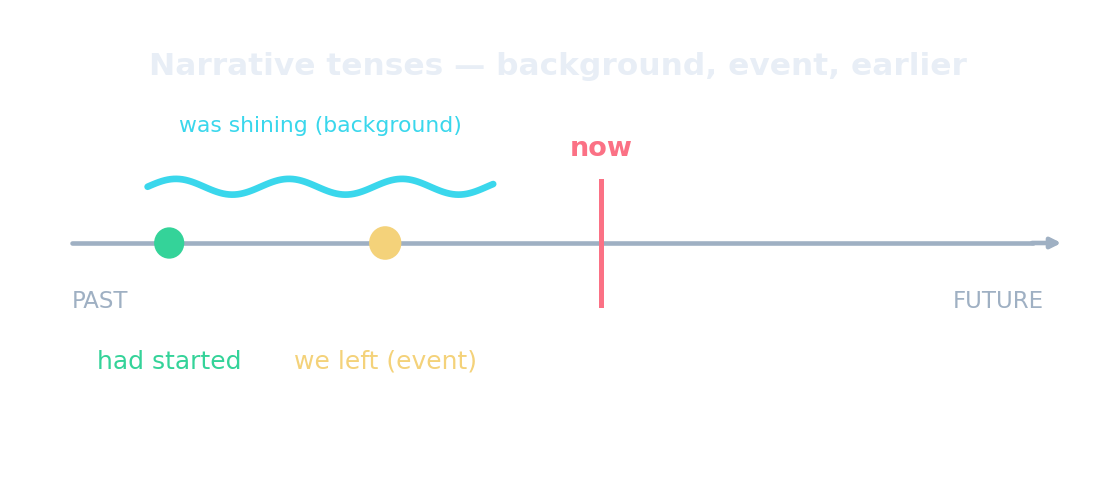
- Past simple, past continuous and past perfect can show events, activity in progress and a view back from a past reference point. A story does not need every tense.
- Outcome: preserve the intended timing when choosing a narrative form. Start with the past perfect. Starting check: does the first verb mentioned always describe the first event? No — a story can look back.
While I was looking for my notes, I realised the dog had been studying them.
Events and background
- Past simple often presents a sequence: She opened the box and found a letter. It can also describe a background state: The room was cold. Background does not always require a continuous form.
- Past continuous presents an action in progress: She was cooking when the phone rang. This does not itself say whether she finished cooking. The phone call need not stop the activity.
What is each tense doing in the story?
Read the narrative roles of these examples, using the reference time rather than an automatic tense-to-job rule.
Choose the form that explicitly presents sunshine already in progress at departure: The sun ___ when we left.
Difficulty 1/5 · 100 coins + a small bonus on first completion today
Was shining explicitly presents the sunshine in progress at departure. Shone is grammatical in another presentation, but does not mark the requested progressive view. Background itself is not a rule forcing every verb into a continuous form.
Looking back from a past point
- Past perfect uses had + past participle: When we arrived, the film had already started. The starting happened before the arrival, regardless of which clause is written first.
- The reference point may come from the surrounding story: At nine, the room was ready. Jo had cleaned it and had opened the windows. Both earlier actions can use the past perfect; it is not restricted to one action in a two-action sentence.
Complete: When we arrived, the film had already ___ (start).
Difficulty 1/5 · 100 coins + a small bonus on first completion today
Started is the participle after had. The film’s start precedes the arrival reference point. More than one earlier action can share a past-perfect viewpoint; clause order alone does not determine event order.
Putting them together
- It was raining when Jo arrived. The caretaker had left a key. Rain is in progress at arrival; leaving the key is earlier. The forms communicate that view of the events, rather than merely making a story sound varied.
- When the order is already clear, past simple can be enough: Jo collected the key, then opened the door. Earlier events do not all require past perfect. A continuing earlier activity can use past perfect continuous: Jo had been waiting for an hour when the door opened.
Can a past continuous form present an action in progress as the background scene of a past story?
Difficulty 1/5 · 100 coins + a small bonus on first completion today
Yes: was painting can present an ongoing scene. This is one use, not a requirement for all background; The room was cold uses past simple for a state. The continuous does not prove a later interruption or finish.
Translate into English: 我们到时,电影已经开始了。
Difficulty 3/5 · 200 coins + a small bonus on first completion today
When we arrived, the film had already started makes the earlier start explicit. A natural already-under-way description can also preserve the translation’s timing; the model is not the only English wording.
Common mistakes
- To say cooking was already in progress, choose She was cooking when the phone rang. When the phone rang, she cooked dinner is grammatical, but does not clearly convey that intended ongoing scene.
- Do not reject every sequence with two past perfects. By noon she had finished the report and had sent it looks back from noon. She finished it, then sent it gives a simple event sequence. Both can fit their contexts.
- It was the first time I had seen snow looks back over experience up to that past occasion. The first time I saw snow, I took a photo is also natural. Choose from the whole construction, not the words first time alone.
Match these conventional narrative teaching roles to their model tense labels. The pairing is guided; context can support other choices.
Difficulty 2/5 · 140 coins + a small bonus on first completion today
These models associate was doing with an ongoing scene, did with a sequence, had done with an earlier view and had been doing with activity over time before a past point. They are not exclusive job descriptions: background states can be simple, and a continuous frame does not guarantee a finish.
Use the past simple of be to complete the past-continuous frame: The sun ___ shining when we left.
Difficulty 1/5 · 100 coins + a small bonus on first completion today
Was agrees with the singular sun in this past-continuous frame. The frame presents sunshine in progress at departure; background weather alone is not a rule requiring a continuous tense.
- Ask what is in progress, what event is being presented and what past point the narrator looks back from.
- A tense does not guarantee an interruption, completion or exactly two actions. Do not add a past perfect just because an event is old.
Begin a short story. Write one sentence that uses two past tenses (for example, past continuous + past simple).
Difficulty 3/5 · 200 coins + a small bonus on first completion today
Example: “I was walking home when I saw an old friend.”
Worked contrasts: order and viewpoint
- Before departure: When the visitors arrived, the guide had left. The guide's departure precedes their arrival. The guide left when the visitors arrived instead connects the departure to their arrival; it does not preserve the same earlier-departure meaning.
- Still in progress: At ten, Sam was painting the sign. This locates painting around ten. The sentence leaves its later completion open; Sam painted the sign yesterday presents the painting as a past event instead.
- Two earlier events: At the inspection, the room looked different. Sam had painted the sign and had moved the desk. The inspection supplies the later point for both past perfects. Their exact order is not supplied by and alone; add then if that order matters.
“At the evening inspection, the workshop was tidy. Tia had swept the floor and had cleared the bench.” Which reading is supported?
Difficulty 1/5 · 100 coins + a small bonus on first completion today
The inspection supplies a later past reference point for both actions. And joins them without specifying which happened first. Repair: distinguish their shared relation to the inspection from their relation to each other. Fresh check: add then if the exact sequence matters.
Apply and review
- Write a short story opening with a past reference point and a clearly earlier event. Check whether your wording really expresses the order you intend.
- Later, write an ongoing scene and identify one thing its continuous form does not prove. Continue with future continuous and perfect forms. Wider fresh practice and independent review remain pending.
Usage guidance checked 2026-10-20: Cambridge, past perfect and past simple and British Council, past perfect. Local source checks; independent language, answer and learner review pending.
A log says, “At eleven, Leo was repairing the bike.” No later entry is available. What can you report from that sentence?
Difficulty 1/5 · 100 coins + a small bonus on first completion today
The continuous places the activity in progress at the reference time. It does not supply a later finish or an interruption. Repair: do not turn a viewpoint into an unstated result. Fresh check: name one extra log entry that would establish completion.
Facts: at eight last night you entered a workshop; Jo was fixing a chair then; the caretaker had unlocked the door before you arrived. No finish time for the chair is recorded. Write a 2–3 sentence English story opening using past simple, past continuous and past perfect. Keep the timing and unknown outcome accurate. Compare, then revise one timing or completion claim.
Compare the stated facts, your English forms and the intended meaning. Revise one actual mismatch, or explain why no change is needed. This written self-review does not award correctness or certify proficiency.