Your learning plan · Continue · Review →
Modal verbs — can, should, must
הוצגהמיקום המנוהל נשמר בדפדפן הזה. המשך אינו משלים את השיעור או עונה על שאלותיו.
Modal verbs — little helpers
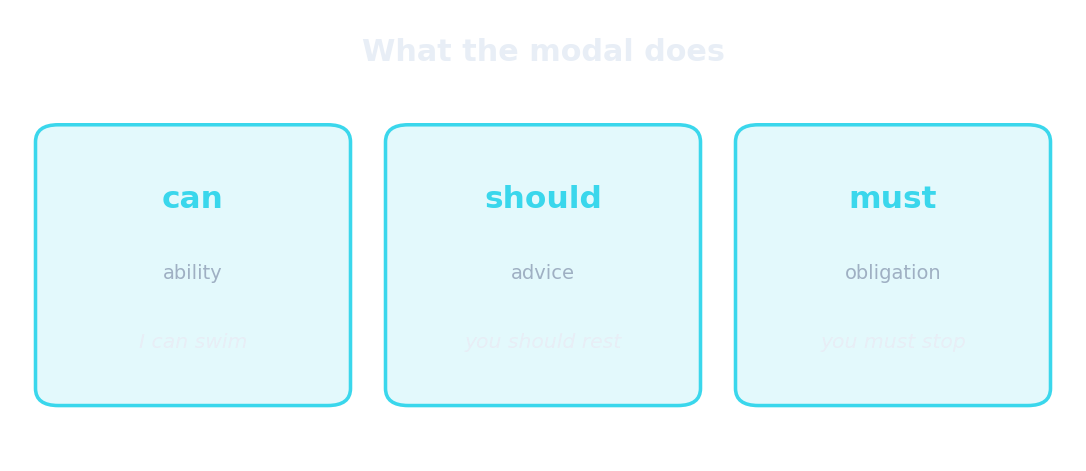
- Modal verbs add meaning: ability, advice, obligation.
- Core modals here: can, could, should, must. The related obligation pattern have to works differently: She has to go. Does she have to go?
- After these core modals, use a base verb: She can swim. You must go. Keep to in the separate have to pattern. Outcome: distinguish ability, advice, a requirement and no requirement. Start with can; does You don't have to come forbid coming? No — it says coming is not required.
I can swim, but I must wear a cap: being able to swim is not the same as a requirement.
can / could — ability & requests
- can = ability or possibility: I can swim.
- could = past ability, or a polite request: She could read at four. Could you help me?
- After can / could, use the base verb: can swim (not can to swim).
Which sentence is correct?
Difficulty 1/5 · 100 coins + a small bonus on first completion today
Can takes base swim in this frame: I can swim. The no-to pattern here applies to the core modal can, not to have to swim or ought to swim.
Mina is able to cook. Which sentence states that ability with a base verb?
Difficulty 1/5 · 100 coins + a small bonus on first completion today
Can cook uses the base verb. Can to cook and can cooking do not fit this core-modal frame. The pattern is not the have-to frame, which keeps to.
should — advice
- should = advice, "it's a good idea": You should see a doctor.
- Negative shouldn't = "it's not a good idea": You shouldn't eat so late.
- Advice often leaves more choice than a requirement, but the words alone do not guarantee a gentle tone. Should can also express an expectation: The bus should arrive soon. Read the whole context.
Give advice using the one-word modal meaning ought to: You ___ see a doctor.
Difficulty 1/5 · 100 coins + a small bonus on first completion today
Should supplies the specifically requested one-word advice modal. You could see a doctor can also be natural advice or a suggestion in another task; it is not the requested ought-to meaning here.
Translate into English: 你应该去看医生。
Difficulty 3/5 · 200 coins + a small bonus on first completion today
You should see a doctor is the model advice. You ought to see a doctor is another natural translation; a grammatical to in that frame is not the same as the incorrect should to see.
A friend studies until midnight and looks exhausted. Choose the advice.
Difficulty 1/5 · 100 coins + a small bonus on first completion today
Shouldn't study gives advice with a base verb. Must to study adds to after a core modal, and don't have to studying uses an -ing form in the have-to frame.
must / have to — obligation
- In these obligation contexts, must and have to express necessity: You must wear a seatbelt. I have to get up early. Have to changes form: has to, had to; its ordinary questions use do/does/did.
- mustn't = it's forbidden: You mustn't smoke here.
- don't have to = it's not necessary: You don't have to come.
What does the modal do?
Classify the intended ability, advice and obligation readings in these examples. Other contexts give can/could/should/must other meanings; have to has its own has to/had to forms.
On a no-smoking notice, “You mustn’t smoke here” states a rule. Does it mean smoking is forbidden?
Difficulty 1/5 · 100 coins + a small bonus on first completion today
Yes, in this explicit rule context mustn’t forbids smoking. Don’t have to would instead remove a requirement; it would not express this prohibition. Interpret the whole context rather than assigning every modal one compulsory meaning.
Choose the core-modal frame: You must ___ now.
Difficulty 1/5 · 100 coins + a small bonus on first completion today
Must go takes the base verb. Must to go is the mistake named for this core modal. Going is not the base form. Have to go is a different pattern and is not the frame asked for here.
One person has a necessary finish today. Choose the have-to frame: She ___ finish today.
Difficulty 1/5 · 100 coins + a small bonus on first completion today
She has to finish uses the third-person form of have to and keeps to. Musts adds an ending the core modal does not take, and have to does not agree with she.
Common mistakes
- For the core-modal pattern here, use You must go, not You must to go. This does not remove to from have to go or the different pattern ought to go.
- The core modal stays must: She must study, not musts. Contrast the separate pattern She has to study; do not apply one form rule to both.
- In these rules, mustn't means not allowed; don't have to means not required. These are different meanings, not interchangeable negatives. A lack of requirement does not itself tell you every other rule that may apply.
Match the intended rule, no-requirement and advice meanings of these example sentences.
Difficulty 2/5 · 140 coins + a small bonus on first completion today
In these contexts, mustn’t park forbids parking; don’t have to come removes a requirement; should rest advises; must wear a seatbelt states a requirement. Lack of a requirement is not itself a full statement of every permission or rule, and these are not all possible modal meanings.
Express a past obligation using have to: Yesterday I ___ work late.
Difficulty 1/5 · 100 coins + a small bonus on first completion today
Had to is the past form of have to for this past requirement. It is not an invented inflected form of must. This practice frame does not mean must can never occur in a past report.
The club says joining is optional. It does not forbid joining. Which sentence matches?
Difficulty 1/5 · 100 coins + a small bonus on first completion today
Don't have to join removes a requirement. Mustn't join would forbid joining, and must to join both states a requirement and adds to after must.
- The core modals practised here take a base verb; have to has its own to and changes to has to / had to.
- can / could = ability & requests; should = advice.
- In these rule contexts, must / have to = required; mustn't = forbidden; don't have to = not required.
A friend is tired and stressed. Write one sentence of advice using “should”.
Difficulty 3/5 · 200 coins + a small bonus on first completion today
Example: “You should go to bed early and relax.”
Independent decisions
- Use only the fact in the question. A base verb after can, could, should or must is a different pattern from have to.
- After a miss, name the error: the verb form, or the meaning (ability, advice, a requirement, a prohibition, or no requirement).
Choose the polite request that keeps a base verb after could.
Difficulty 1/5 · 100 coins + a small bonus on first completion today
Could you open uses the base verb in a request. Could you to open and could you opening do not fit the core-modal frame.
At age four she was able to read. Which sentence fits that past ability?
Difficulty 1/5 · 100 coins + a small bonus on first completion today
Could read states the past ability with a base verb. Could to read adds to, and musts read is neither the past-ability form nor a grammatical core modal.
Someone has a sore throat. Choose advice, not a broken requirement frame.
Difficulty 1/5 · 100 coins + a small bonus on first completion today
Should see is advice with a base verb. Must to see and should to see put to after a core modal.
The speaker expects the bus soon and is not stating a law. Which sentence fits?
Difficulty 1/5 · 100 coins + a small bonus on first completion today
Should arrive can express this expectation, with a base verb. Should to arrive adds to, and musts arrive adds an ending must does not take.
The rule requires a seatbelt. Which sentence states that requirement?
Difficulty 1/5 · 100 coins + a small bonus on first completion today
Must wear states the requirement with a base verb. Must to wear and must wearing do not fit the core-modal frame.
One person needs an early start. Choose the have-to sentence.
Difficulty 1/5 · 100 coins + a small bonus on first completion today
She has to get up early agrees with she and keeps to. Have to does not agree with she, and musts is not the have-to pattern.
Ask whether her early start is necessary, using have to.
Difficulty 1/5 · 100 coins + a small bonus on first completion today
Have to makes its question with does. Does she must mixes the core modal into the do frame, and musts she to get up is not a question pattern taught here.
A sign forbids smoking in this room. Which sentence matches the sign?
Difficulty 1/5 · 100 coins + a small bonus on first completion today
Mustn't smoke forbids smoking. Don't have to smoke only says smoking is not required, and must to smoke both uses the wrong frame and states a requirement.
The host says coming to the party is optional. Which sentence matches?
Difficulty 1/5 · 100 coins + a small bonus on first completion today
Don't have to come means coming is not required. Mustn't come would forbid coming, and must to come is a broken requirement frame.
What does "You mustn't park here" mean on a no-parking sign?
Difficulty 1/5 · 100 coins + a small bonus on first completion today
On this sign, mustn't forbids parking. Not required would be don't have to, and advice would use should.
Choose the advice sentence with a base verb.
Difficulty 1/5 · 100 coins + a small bonus on first completion today
Should rest is advice with a base verb. Should to rest and should resting do not fit the core-modal frame.
Yesterday the late shift was required. Choose the past have-to sentence.
Difficulty 1/5 · 100 coins + a small bonus on first completion today
Had to is the past of have to for this requirement. Musted is not a past form of must, and have to worked mixes the present have-to frame with a past verb.
She is required to study. Choose the core modal that does not add an ending.
Difficulty 1/5 · 100 coins + a small bonus on first completion today
Must study keeps the base modal and a base verb. Musts adds an ending, and must to study adds to. She has to study would be the separate have-to pattern.
Keep to in the have-to pattern for a necessary departure.
Difficulty 1/5 · 100 coins + a small bonus on first completion today
Have to go keeps to and a base verb. Have go drops to, and have going uses an -ing form.
Choose the polite request.
Difficulty 1/5 · 100 coins + a small bonus on first completion today
Could you help me uses a base verb after could. The other two add to or an -ing form.
Swimming is allowed, and a cap is required. Which pair keeps both facts?
Difficulty 1/5 · 100 coins + a small bonus on first completion today
Can swim states the ability or permission, and must wear states the requirement, both with base verbs. The second option adds to after both core modals. The third forbids swimming and removes the cap requirement.
Bringing lunch is optional. Lunch is not forbidden. Which sentence fits?
Difficulty 1/5 · 100 coins + a small bonus on first completion today
Don't have to bring lunch means lunch is not required. Mustn't would forbid it, and must to bring is a broken requirement.
The library forbids food. Which sentence matches that rule?
Difficulty 1/5 · 100 coins + a small bonus on first completion today
Mustn't eat forbids food. Don't have to eat only says eating is not required, and should to eat is advice with an extra to.
Choose advice to drink water, with a base verb.
Difficulty 1/5 · 100 coins + a small bonus on first completion today
Should drink is advice with a base verb. The other options add to or an -ing form.
Giving a name at the desk is required. Bringing a pen is optional. Which pair fits?
Difficulty 1/5 · 100 coins + a small bonus on first completion today
Must give states the requirement, and don't have to bring a pen leaves the pen optional. The second pair swaps those meanings. The third adds to after must and should.
Transfer: a school trip
- The notice says students can bring a bottle of water, and they must give their name to the teacher. Water is allowed; the name is required.
- They don't have to bring food. That sentence does not forbid food.
On the school bus, phones are forbidden. A packed lunch is optional. Which sentence keeps both facts?
Difficulty 1/5 · 100 coins + a small bonus on first completion today
Mustn't use a phone forbids phones. Don't have to bring lunch leaves lunch optional. The second option swaps the two meanings. The third adds to and does not state the ban or the option.
At the museum, bags may be left in the cloakroom, and a name is required at the door. Which pair fits?
Difficulty 1/5 · 100 coins + a small bonus on first completion today
Can leave a bag allows the bag, and must give your name states the requirement. The second option adds to after both core modals. The third forbids bags and removes the name requirement.
Return later
- Tomorrow, recall one ability, one piece of advice, one requirement, and the split between mustn't and don't have to before you reread. Then try the later-review choices.
- Continue with prepositions and connectors. A written self-review does not establish correctness or certify proficiency.
Usage guidance checked 2026-10-20: Cambridge, have to and must. Local source checks; independent language, answer and learner review pending.
Recall the base verb after can: I can ___.
Difficulty 1/5 · 100 coins + a small bonus on first completion today
Can swim uses the base verb. To swim and swimming do not complete this core-modal frame.
A sign forbids smoking. A second line says a jacket is optional. Which pair keeps both lines?
Difficulty 1/5 · 100 coins + a small bonus on first completion today
Mustn't smoke forbids smoking. Don't have to wear a jacket leaves the jacket optional. The second option swaps the ban and the missing requirement. The third adds to and states neither fact.