שני בלוקים, שני דגמים
הוצגThe West: influence and institutions
- The United States exerted a strong military, political, and economic influence in Western Europe, leading to the creation of world monetary and trade systems and geopolitical alliances, including NATO.
- Three kinds of influence, and two kinds of institution: monetary and trade systems, and geopolitical alliances.
- 9.2's Marshall Plan is the economic half of that influence, so the two subtopics are one account.
התאם כל בלוק למונח המשמש את CED עצמו לתאר את הקשר.
רמת קושי 2/5 · 140 מטבעות + בונוס קטן בהשלמה הראשונה היום
ההבדל במילים הוא ההבדל בטענה.
The East: domination and its institutions
- Countries east of the Iron Curtain came under the military, political, and economic domination of the Soviet Union within the Council for Mutual Economic Assistance (COMECON) and the Warsaw Pact.
- The CED uses influence for the West and domination for the East, and the difference in words is the difference in the claim.
- The institutional shape is parallel — an economic body and a military pact on each side.
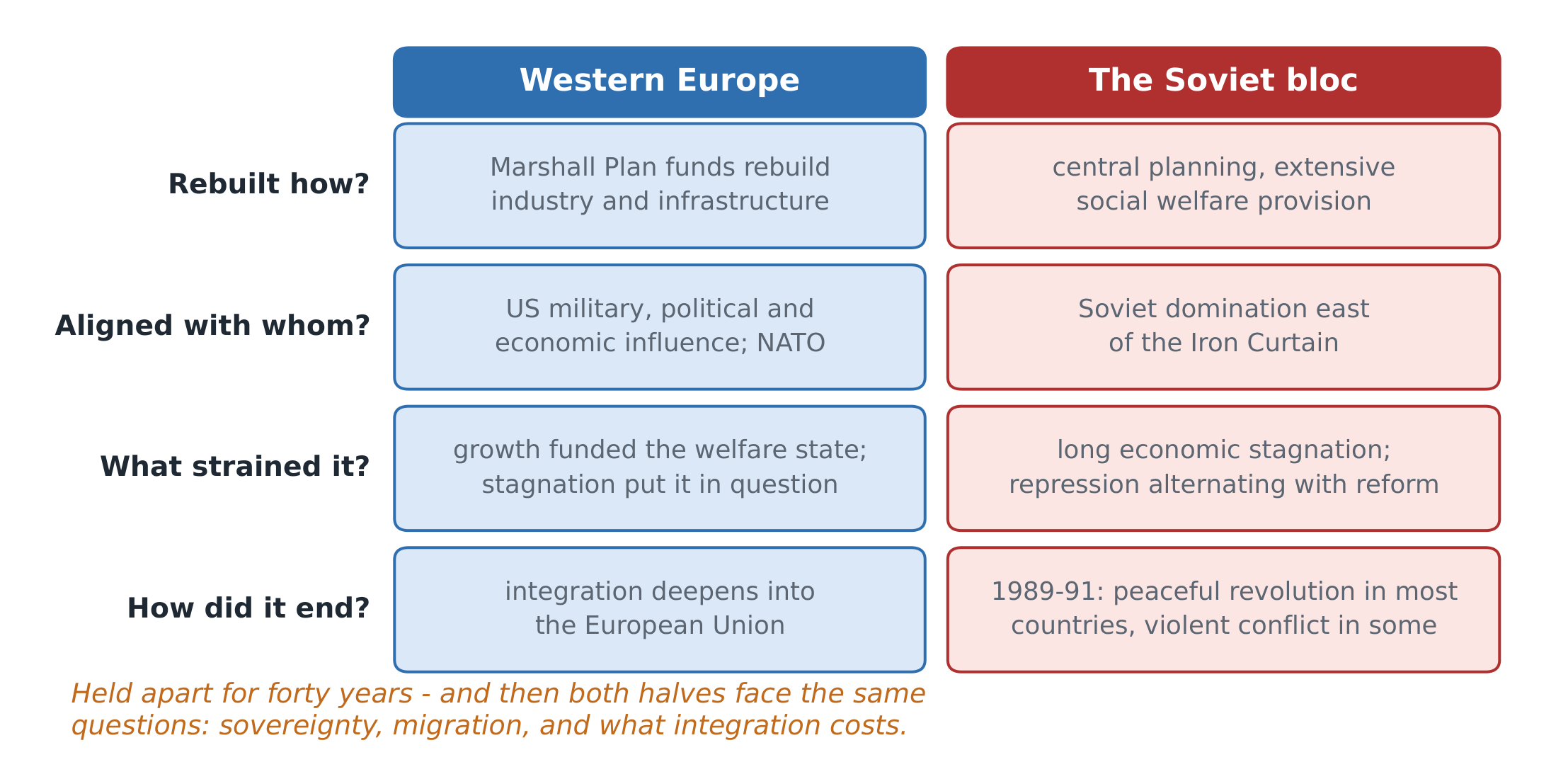
The division holds for forty years, and then both halves face the same questions
בחר את שלושת המאפיינים של הדגם הכלכלי של בלוק ברית המועצות.
רמת קושי 2/5 · 140 מטבעות + בונוס קטן בהשלמה הראשונה היום
שלושה מאפיינים כלכליים, ושלושה עלויות פוליטיות מעבר להם.
The bloc model, and what came with it
- Central and Eastern European nations within the Soviet bloc followed an economic model based on central planning, extensive social welfare, and specialised production among bloc members.
- This brought with it the restriction of individual rights and freedoms, suppression of dissent, and constraint of emigration for the various populations within the Soviet bloc.
- The CED gives the model's three economic features and its three political costs in adjacent sentences.
בחרו את כל שלוש העלויות שה-CED מציינת כהוביל הדגם איתן.
רמת קושי 2/5 · 140 מטבעות + בונוס קטן בהשלמה הראשונה היום
הרשת החברתית הייתה נרחבת בדגם, ולא בוטלה.
The CED uses influence for the West and domination for the East. That difference in words is the difference in the claim — reproduce it rather than levelling the two, and rather than reaching for stronger language of your own.
מוסד מערבי, מוסד מזרחי, כלכלת בלוק, או עלויות בלוק?
סדר כל אלמנט ביבשת המחולקת.
'התנודד בין דיכוי לרפורמה מוגבלת' מתאר...
רמת קושי 1/5 · 100 מטבעות + בונוס קטן בהשלמה הראשונה היום
למשך עשורים, עד לקריסתו.
Oscillation, then collapse
- Eastern European nations were bound by their relationships with the Soviet Union, which oscillated between repression and limited reform, until the collapse of communist governments in Eastern Europe and the fall of the Soviet Union.
- Oscillated describes a pattern, not a trend — the relationship moved back and forth for decades.
- The rise of new nationalisms in Central and Eastern Europe brought peaceful revolution in most countries but resulted in instability in some former Soviet republics.
לאומיזמים חדשים במרכז ובמזרח אירופה הביאו...
רמת קושי 1/5 · 100 מטבעות + בונוס קטן בהשלמה הראשונה היום
ה-CED מבדילה בין רוב המדינות לבין חלק מהרפובליקות.
Economic and political consequences
- The objective is the economic and political consequences of the Cold War for Europe.
- The clean structure is symmetrical: each bloc's economic model, each bloc's institutions, and one comparison sentence.
- The comparison the CED itself makes is influence against domination — use its words, not stronger ones.
Two halves of a continent each acquire an economic organisation and a military alliance in the same decade. The shapes match; the relationships inside them do not. Comparing the shapes and then the relationships is the whole of the answer.
The United States exerted a strong military, political, and economic influence in Western Europe, leading to world monetary and trade systems and geopolitical alliances, including NATO, while countries east of the Iron Curtain came under the military, political, and economic domination of the Soviet Union within COMECON and the Warsaw Pact. The bloc model rested on central planning, extensive social welfare, and specialised production, and brought with it the restriction of individual rights and freedoms, suppression of dissent, and constraint of emigration.