נאמנות לאומית
הוצגFive ways of encouraging loyalty
- Nationalists encouraged loyalty to the nation in a variety of ways, including romantic idealism, liberal reform, political unification, racialism with a concomitant anti-Semitism, and chauvinism justifying national aggrandisement.
- The list runs from the benign to the dangerous, and the CED puts them in one sentence on purpose.
- So nationalism is not one thing with one moral valence — it is a set of methods that different movements used differently.
בחרו את כול השיטות לעורור נאמנות לאומית שרשומות ברשימת ה-CED.
רמת קושי 2/5 · 140 מטבעות + בונוס קטן בהשלמה הראשונה היום
הרשימה כוללת גם גזענות עם אנטישמיות ליווי.
The dangerous end of the list
- Racialism with a concomitant anti-Semitism is named as one of nationalism's methods, not as an aberration outside it.
- Concomitant means accompanying — the CED is stating that the two travelled together.
- Recording this accurately is part of the historical account; it is what the CED asks a student to know.
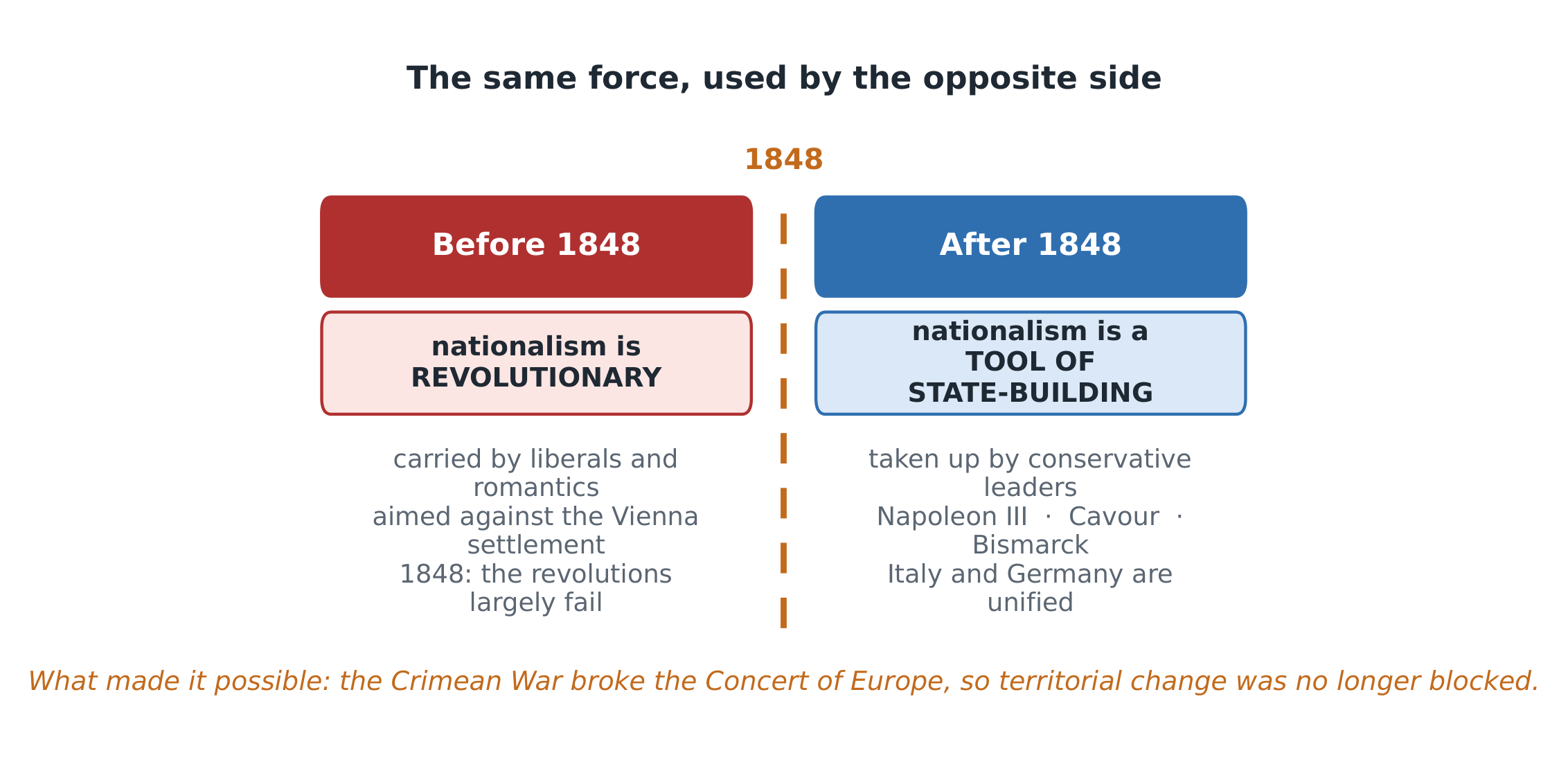
Before 1848 nationalism threatens the order; after 1848 conservatives build states with it
'ליווי' בביטוי של ה-CED פירושה...
רמת קושי 1/5 · 100 מטבעות + בונוס קטן בהשלמה הראשונה היום
ה-CED מצהיר כי שני הצדדים נסעו יחד.
Acculturation, and a response
- While during the 19th century western European Jews became more socially and politically acculturated, Zionism, a form of Jewish nationalism, developed late in the century as a response to growing anti-Semitism throughout Europe.
- The CED's structure is a contrast: acculturation on one side, and a response to growing anti-Semitism on the other.
- Zionism is classified here as a form of Jewish nationalism, which places it inside the same thread as the other national movements.
שיטה, תגובה או אסטרטגיית מדינה?
סדרו כל אלמנט של לאומיות במאה התשע עשר.
ה-CED מדגם את הציונות כ...
רמת קושי 1/5 · 100 מטבעות + בונוס קטן בהשלמה הראשונה היום
פותחה באוחר המאה כתגובה לעליית האנטישמיות.
Nationalism is a set of methods, not one thing with one moral valence. The CED's own list runs from romantic idealism and liberal reform through political unification to racialism with a concomitant anti-Semitism and chauvinism justifying national aggrandisement — all in one sentence, because different movements used different parts of it.
בחרו את כל המנהיגים השמרנים שה-CED מציין כמשתמשים בלאומיות פופוליסטית.
רמת קושי 2/5 · 140 מטבעות + בונוס קטן בהשלמה הראשונה היום
רובספיייר שייך לסעיף 5.4, ולא היה שמרן.
Conservatives use nationalism
- A new generation of conservative leaders, including Napoleon III, Cavour, and Bismarck, used popular nationalism to create or strengthen the state.
- This is the reversal that makes the century legible: a force 6.5 tried to contain becomes a tool for building states.
- Used is the verb — the CED is describing instrumental adoption, not conversion.
המונרכיה הכפולה הכירה בכוח הפוליטי של האוכלוסייה האתנית הגדולה ביותר ____.
רמת קושי 1/5 · 100 מטבעות + בונוס קטן בהשלמה הראשונה היום
ניסיון ליצב את המדינה על ידי שינוי ארגון הלאומיות.
Or reconfigure a state around it
- The creation of the dual monarchy of Austria-Hungary, which recognised the political power of the largest ethnic minority, was an attempt to stabilise the state by reconfiguring national unity.
- An attempt again: the CED records the strategy without endorsing its success.
- It is the alternative to unification — where a state cannot be built on one nation, it bargains with the largest.
A minister who spent his career opposing popular movements discovers that one of them can be pointed at a rival state. He does not become a believer; he becomes a user. The CED's verb for this is used, and it is the most economical word available.
Nationalists encouraged loyalty in a variety of ways, including romantic idealism, liberal reform, political unification, racialism with a concomitant anti-Semitism, and chauvinism justifying national aggrandisement. Zionism, a form of Jewish nationalism, developed late in the century as a response to growing anti-Semitism, alongside increasing acculturation of western European Jews. Conservative leaders — Napoleon III, Cavour, Bismarck — used popular nationalism to create or strengthen the state, and Austria-Hungary's dual monarchy attempted stability by reconfiguring national unity.