השכל, וגבולותיו
הוצגThe second half of unit 1's first sentence
- The rediscovery of works from ancient Greece and Rome and observation of the natural world changed many Europeans' view of their world.
- 1.2 followed the first half — the texts. This unit follows the second: observation.
- So the Scientific Revolution is not a new beginning in the CED's structure; it is a thread that has been running since 1450.
יחידה זו עוקבת אחר איזו מחצית מהמשפט הפותח של יחידה 1?
רמת קושי 1/5 · 100 מטבעות + בונוס קטן בהשלמה הראשונה היום
הטקסטים העקבו אחר ⟦1.2⟧; מהפכת המדע היא קו הניווט התצפיתית.
From nature to society
- The spread of Scientific Revolution concepts and practices and the Enlightenment's application of these concepts and practices to political, social and ethical issues led to an increased but not unchallenged emphasis on reason in European culture.
- The mechanism is in the sentence: methods developed for nature are applied to society.
- That application is what the word Enlightenment names in this course.
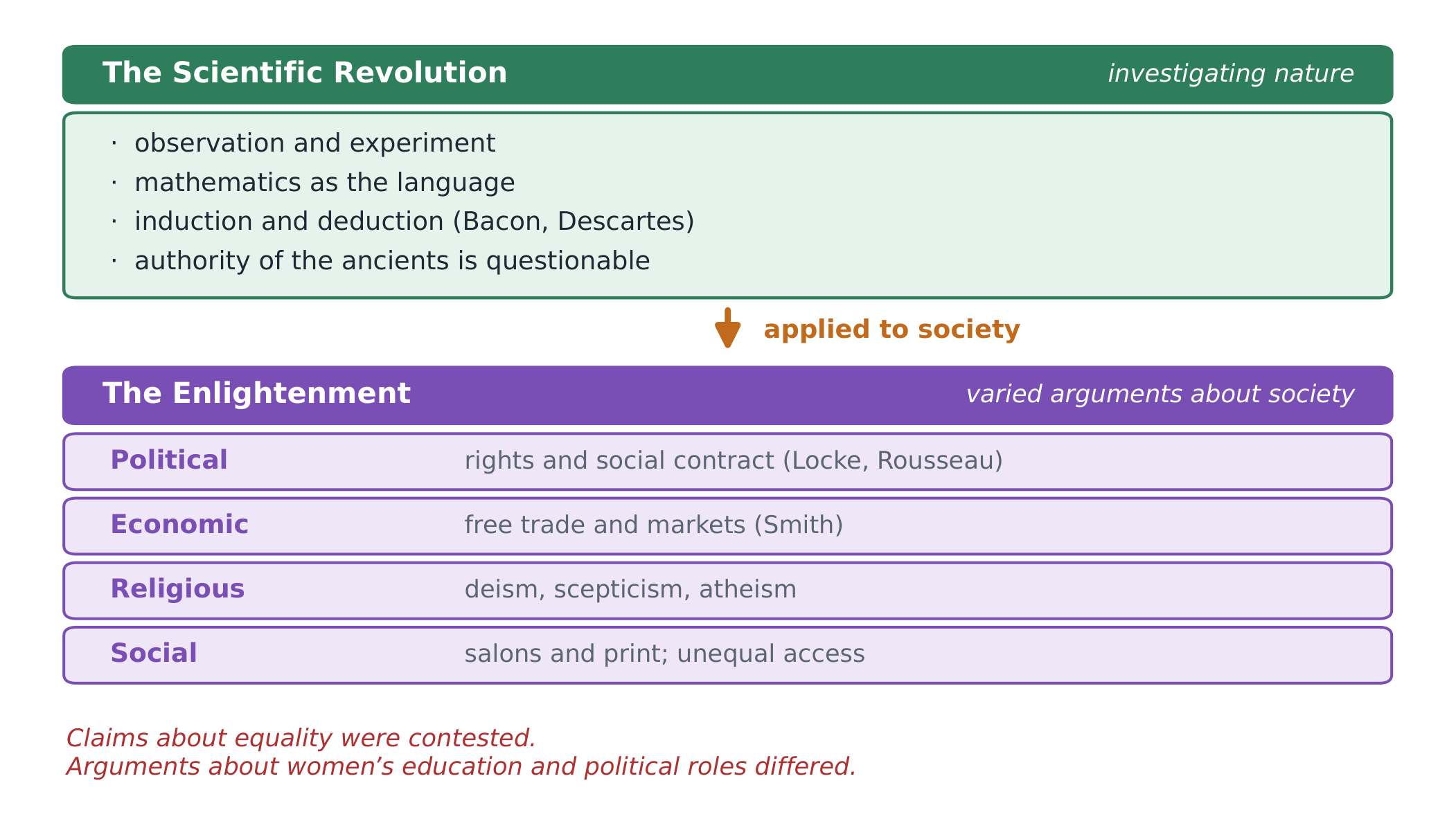
Scientific concepts and practices informed varied arguments about human institutions
תקופת ההאירוח היא ה____ של שיטות מהמהפכה המדעית לבעיות פוליטיות, חברתיות ואתיות.
רמת קושי 1/5 · 100 מטבעות + בונוס קטן בהשלמה הראשונה היום
המנגנון כתוב במשפט CED.
"But not unchallenged"
- The CED's qualifier is doing serious work: the emphasis on reason increased, and it was contested throughout.
- 4.2 records alchemy and astrology continuing; 4.3 records Rousseau's exclusion of women; unit 5 will record the reaction.
- So an answer describing an unopposed age of reason contradicts the sentence it is quoting.
השיטה, היישום, או האתגר?
סדרו את כל אלמנטים הפתיחה של היחידה.
ה-CED מתאר ניצחון בלתי מעורער של השכל.
רמת קושי 1/5 · 100 מטבעות + בונוס קטן בהשלמה הראשונה היום
הוא כותב הגברת האמינות אך לא ללא אתגרים — שני החצאים נבדקים בבחינה.
The CED writes "increased but not unchallenged emphasis on reason". Both halves are examinable: reason gained ground, and it was contested the whole time — by continuing belief in spiritual forces, by exclusions written into the new philosophy itself, and by the reaction of unit 5.
בחרו את כולם סוגי השינויים שה-CED אומר עיצבו את החיים היומיומיים.
רמת קושי 2/5 · 140 מטבעות + בונוס קטן בהשלמה הראשונה היום
שינוי צבאי שייך ל-⟦3.6⟧.
And everyday life was changing too
- The experiences of everyday life were shaped by demographic, environmental, medical and technological changes.
- So this unit is not only about ideas: 4.4 and 4.5 cover population, cities, childhood, consumption and print.
- The CED puts them in the same unit because a reading public is a precondition for a public argument.
ציבור סופר מוכשר חשוב ליחידה זו כי...
רמת קושי 1/5 · 100 מטבעות + בונוס קטן בהשלמה הראשונה היום
ציבור קוראים הוא תנאי מקדים לדיון ציבורי.
Writing the context
- Conditions: unit 1's observation and printing, unit 3's market economy and states that could fund academies.
- And a literate public large enough that a printed argument reaches beyond a university.
- Name a condition and what it made possible — the same shape as 1.1, 2.1 and World History's 8.1.
A natural philosopher publishes a mathematical account of planetary motion and keeps a working interest in alchemy. Both facts belong to the same man and the same century. The CED's not unchallenged is describing exactly that condition, and it is not a contradiction to explain away.
This unit follows the observation half of unit 1's opening sentence. Scientific Revolution concepts spread, and the Enlightenment applied them to political, social and ethical issues, producing an increased but not unchallenged emphasis on reason. Everyday life was shaped by demographic, environmental, medical and technological changes — a reading public is a precondition for a public argument.