דת ופוליטיקה שזורים זה בזה
הוצג| English | משמעות |
|---|---|
| Issues of religious reform exacerbated/ˈɪʃuːz ɒv rɪˈlɪdʒəs rɪˈfɔːm eɡˈzæsəbeɪtɪd/ | נושאי הרפורמה הדתית החמירו |
Religion sharpened existing conflicts
- Issues of religious reform exacerbated 加剧 conflicts between the monarchy and the nobility, as in the French wars of religion.
- The CED's verb is exacerbated, not caused — the monarchy-nobility conflict of 1.5 was already there.
- So religion supplied a new language and new allies for a struggle that predated it.
ה-CED טוען שהרפורמה הדתית ____ את הסכסוכים בין המלכות לבין האצולה.
רמת קושי 1/5 · 100 מטבעות + בונוס קטן בהשלמה הראשונה היום
המאבק קדם לרפורמה הדתית.
The Habsburgs on two fronts
- Habsburg rulers confronted an expanded Ottoman Empire while attempting unsuccessfully to restore Catholic unity across Europe.
- Two commitments at once, and the CED marks the second unsuccessful.
- A state fighting on two fronts must choose, and the choices it makes are the evidence for what it valued.
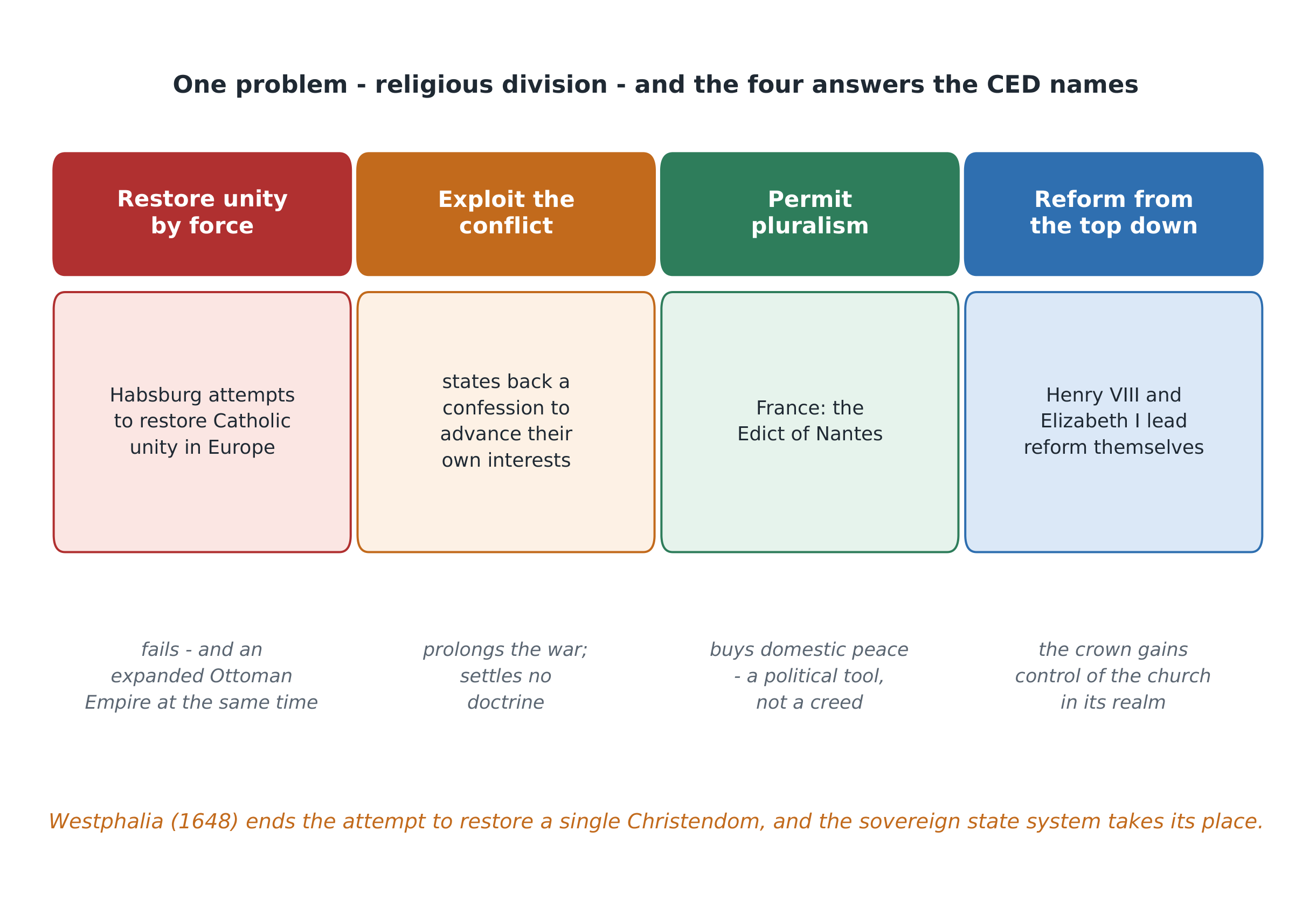
Only one of these ends the conflict, and it is not the one most rulers tried first
מדינות משני צדי המערך השתמשו בסכסוך הדתי למטרות פוליטיות וכלכליות.
רמת קושי 1/5 · 100 מטבעות + בונוס קטן בהשלמה הראשונה היום
לכן ברית חוצת-דתית היא עדות לטענת ה-CED, ולא עניין מסתורין.
States used religion instrumentally
- States exploited religious conflicts to promote political and economic interests.
- The CED says this plainly, and it applies to Catholic and Protestant states alike.
- So an alliance that crosses a confessional line is not a puzzle — it is evidence for this sentence.
החמרה, שימוש כלים או הסדר?
סדרו את כל התפתחות בשזירה בין דת לפוליטיקה.
ה-CCED מציין איזה מotiv for the Edict of Nantes?
רמת קושי 1/5 · 100 מטבעות + בונוס קטן בהשלמה הראשונה היום
הסבלנות כאן היא יוצאת מכלל רגיל שנלקחה למען הסדר.
Religious reform exacerbated conflicts that already existed. The CED's verb is deliberate — the monarchy-nobility struggle of 1.5 predates the Reformation, and religion supplied it with new language and new allies rather than creating it.
בחר שתי ההשלכות של ה- CED על הסכם וסטפליה.
רמת קושי 2/5 · 140 מטבעות + בונוס קטן בהשלמה הראשונה היום
היא העניקה לנסיכים, לבשלים ולמנהיגים מקומיים שליטה על הדת.
And a few chose pluralism
- A few states, such as France with the Edict of Nantes, allowed religious pluralism in order to maintain domestic peace.
- The CED gives the motive explicitly: domestic peace, not principle.
- A few is its qualifier — toleration in this period is an exception adopted for order.
הבאבזגרים התמודדו עם האימפריה העות'מאנית המורחבת בעת ניסיון ____ לשקם את היחידות הקתולית.
רמת קושי 1/5 · 100 מטבעות + בונוס קטן בהשלמה הראשונה היום
מדינה הנמצאת במערכת לחמה בשני חזיתות חייבת לבחור, והבחירות שלה הן עדים.
Westphalia ended an ideal
- The Peace of Westphalia (1648), which marked the effective end of the medieval ideal of universal Christendom, accelerated the decline of the Holy Roman Empire by granting princes, bishops and other local leaders control over religion.
- Two consequences in one sentence: the end of an ideal, and the decline of an institution.
- It also closes unit 1's sovereignty thread: religion is now decided locally, which is the opposite of 1.5's monarchical monopoly at the imperial level.
A Catholic power subsidises Protestant armies against a Catholic rival. Nothing about that is inconsistent once you read the CED's sentence: states exploited religious conflicts to promote political and economic interests. The confessional label describes the war's language, not always its aims.
Religious reform exacerbated monarchy-nobility conflicts, as in the French wars of religion. Habsburg rulers confronted an expanded Ottoman Empire while attempting unsuccessfully to restore Catholic unity. States exploited religious conflicts to promote political and economic interests, and a few, such as France with the Edict of Nantes, allowed pluralism to maintain domestic peace. Westphalia (1648) ended the ideal of universal Christendom and accelerated the Holy Roman Empire's decline.