Immunological memory and vaccination
Introduit| English | Sens |
|---|---|
| primary response/ˈpraɪməri rɪˈspɒns/ | primary response |
| secondary response/ˈsekəndəri rɪˈspɒns/ | secondary response |
| memory cells/ˈmeməri selz/ | A long-lived immune cell that enables a faster or stronger response when the same antigen is encountered again. |
| herd immunity/hɜːd ɪˈmjuːnɪti/ | herd immunity |
| basic reproduction number | basic reproduction number |
Once is enough
- People who had measles as children almost never catch it again. A second exposure is met before it can cause disease.
- That is immunological memory, and every vaccine copies it on purpose: the most cost-effective treatment medicine has measured.
The primary response
- In a primary response 初次应答 there is no antibody for 4–7 days. IgM appears first, then IgG, peaking around days 10–14 at a modest level.
- The delay is the time needed to find, activate and expand rare naive clones.
Put the events of a primary antibody response in order.
Difficulté 3/5 · 200 pièces + un petit bonus lors de la première réussite aujourd'hui
Rare naive clones must be found and expanded before any antibody appears.
The secondary response
- In a secondary response 再次应答 antibody rises within hours to 2 days, is mostly IgG from the start, peaks 10–100 times higher, and binds more tightly.
- The infection is usually stopped before symptoms begin.
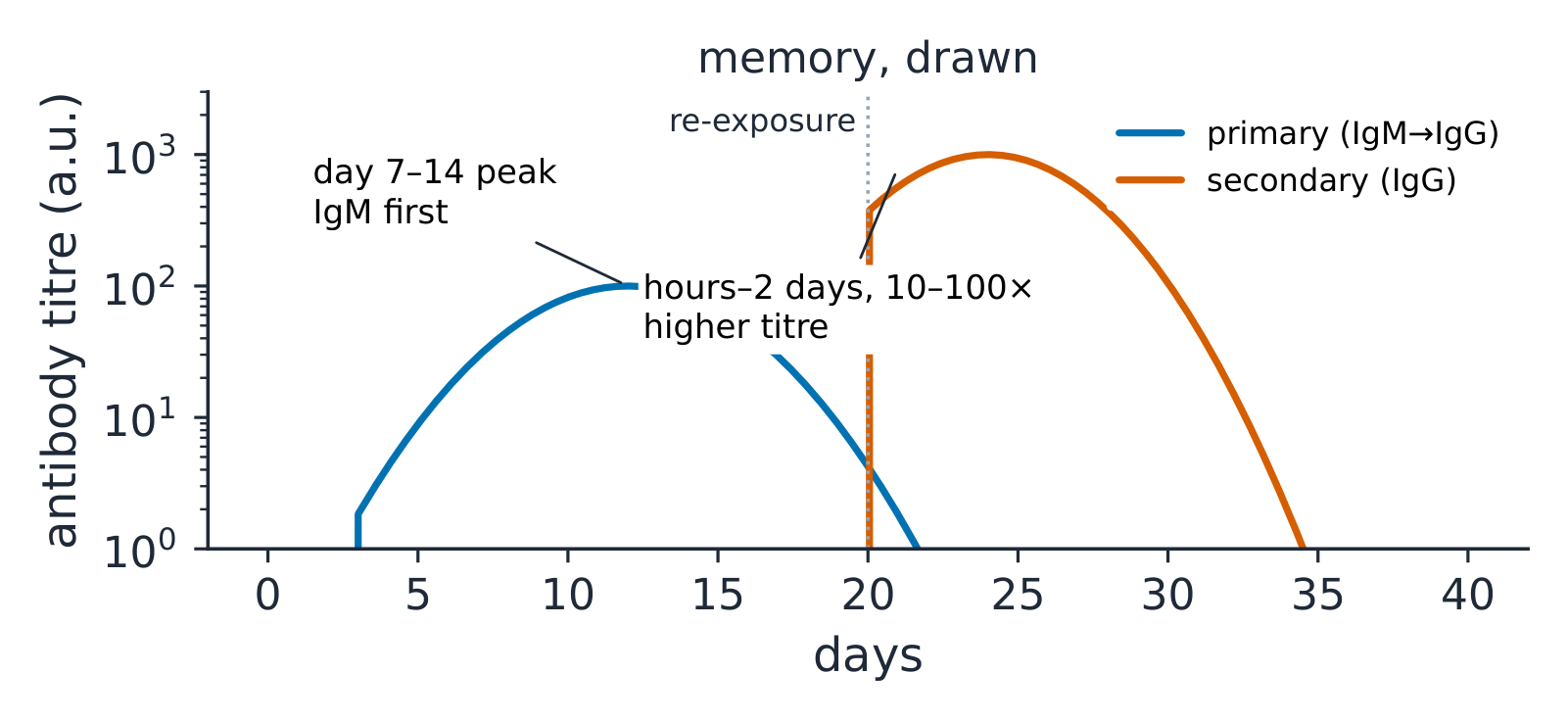
How does a secondary response differ from a primary one?
Difficulté 1/5 · 100 pièces + un petit bonus lors de la première réussite aujourd'hui
Memory cells are commoner, more sensitive and already switched to IgG.
Memory cells
- Memory cells 记忆细胞 are 10–100 times commoner than the original naive clone, respond to less antigen and divide faster. Some wait in lymph nodes; others stay in the tissues where the infection entered.
- Antibody levels fall over years, but memory B and T cells persist, so a falling titre does not mean lost protection.
When antibody levels fall years after vaccination, protection is always lost.
Difficulté 1/5 · 100 pièces + un petit bonus lors de la première réussite aujourd'hui
Memory B and T cells persist and respond quickly even when the titre is low.
Herd immunity
- The basic reproduction number 基本再生数, $R_0$, is how many people one case infects in a fully susceptible population. Spread stops when the susceptible fraction falls below $1/R_0$.
- So herd immunity 群体免疫 needs an immune fraction above $1 - 1/R_0$. Measles ($R_0$ 12–18) needs about 92–94%; influenza ($R_0$ about 1.3) about 23%.
An infection has $R_0 = 15$. What percentage of the population must be immune for herd immunity?
Difficulté 2/5 · 140 pièces + un petit bonus lors de la première réussite aujourd'hui
1 − 1/15 = 14/15 ≈ 93.3%.
Why schedules look the way they do
- Hepatitis B vaccine is given at 0, 1 and 6 months: the first dose primes (only a third to a half respond), the second boosts most people, and the third gives a lasting, high-affinity response.
- Live vaccines such as MMR copy a mild infection: one dose protects about 95%, and a second catches most of the rest. Live vaccines are not given to people with severe T-cell defects.
Why are live vaccines not given to a child with severe combined immunodeficiency?
Difficulté 1/5 · 100 pièces + un petit bonus lors de la première réussite aujourd'hui
A live vaccine is a mild infection; it needs a working immune system to stay mild.
Worked example: reading serology
- (Fictional) Day 4 of a rash: IgM positive, IgG negative. Day 14: IgM positive, IgG up fourfold. This is an acute infection.
- IgG alone at a steady level means past infection or vaccination. The class and the rise tell the time.
Match each serology result to its meaning.
Difficulté 2/5 · 140 pièces + un petit bonus lors de la première réussite aujourd'hui
The antibody class and its change over time give the timeline.
Worked example: coverage for an imperfect vaccine
- (Fictional) An infection has $R_0 = 4$, so the immune fraction must exceed $1 - 1/4 = 75\%$.
- If the vaccine protects 95% of those vaccinated, coverage must exceed $75\% \div 0.95 \approx 79\%$. A weaker vaccine needs higher coverage.
An infection has $R_0 = 5$ and a vaccine protects 90% of those vaccinated. What vaccine coverage, as a percentage, is needed?
Difficulté 2/5 · 140 pièces + un petit bonus lors de la première réussite aujourd'hui
Immune fraction 1 − 1/5 = 80%; coverage 80% ÷ 0.9 ≈ 88.9%.
Three common slips
- "The first dose protects." In a multi-dose series it primes; protection follows later doses.
- "A falling titre means protection is gone." Memory cells remain.
- Diagnosing from one IgG result. Only a rise, or IgM, dates an infection.
Recap
- Primary: 4–7 day lag, IgM then IgG, peak at 10–14 days. Secondary: hours to 2 days, IgG, 10–100 times higher.
- Memory cells are more numerous, faster and better placed; they outlast antibody.
- Herd immunity needs more than $1 - 1/R_0$ immune; divide by vaccine effectiveness to get coverage.