Intellectual property and data: the map, then the move
Introduit| English | Sens |
|---|---|
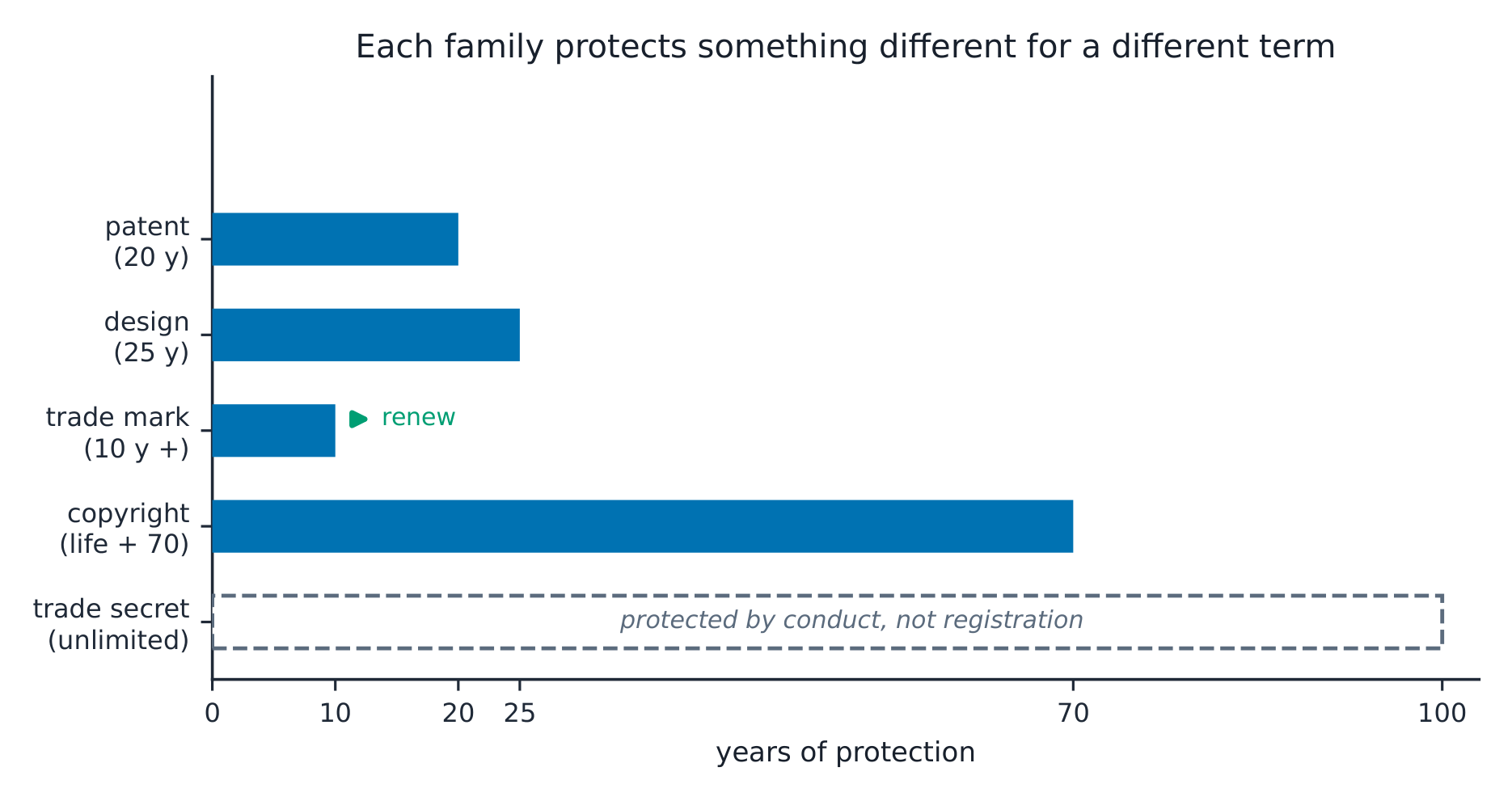
| patent/ˈpeɪtənt/ | a 20-year monopoly in exchange for full disclosure |
| trade mark | a registered sign distinguishing goods, 10 years renewable |
| copyright/ˈkɒpɪraɪt/ | the automatic right in original works, life plus 70 years |
| trade secret | information protected by conduct as long as it stays secret |
One product, four regimes
- The bun has a name (Nimbus Bloomer), a packaging design, a recipe folder marked secret - and a rival sells a Nimbus Blummer. Which family protects what is a map, not a mood.
- Jurisdiction: the UK regime; durations below are UK terms.
The families and their clocks
- Patent 专利 20 years - but full disclosure; the proving cabinet mechanism is not novel anyway. Registered design 25. Trade mark 商标 10 years, renewable for ever. Copyright 版权 life + 70, automatic. Trade secret 商业秘密 - indefinite, while conduct protects it.
Which family protects this?
Route each asset to the family that actually covers it.
Patent term, in years?
Difficulté 2/5 · 140 pièces + un petit bonus lors de la première réussite aujourd'hui
Twenty years from filing - the price is full disclosure.
A UK trade mark registration runs how many years before renewal?
Difficulté 2/5 · 140 pièces + un petit bonus lors de la première réussite aujourd'hui
Ten, renewable indefinitely.
Copyright lasts for the life of the author plus how many years?
Difficulté 2/5 · 140 pièces + un petit bonus lors de la première réussite aujourd'hui
Life + 70.
Why keep the recipe a trade secret rather than patenting it?
Difficulté 1/5 · 100 pièces + un petit bonus lors de la première réussite aujourd'hui
The patent bargain is disclosure for monopoly - wrong deal for a recipe.
Match each asset to its family.
Difficulté 2/5 · 140 pièces + un petit bonus lors de la première réussite aujourd'hui
Four regimes, four different actions.
The Blummer, and the cheapest insurance
- Identical mark on identical goods: if Bloomer is registered, infringement is made out without a confusion argument.
- Registration costs about 170 for one class - against a passing-off claim's five-figure bill with an uncapped outcome.
The ICO standard-tier maximum, in millions?
Difficulté 2/5 · 140 pièces + un petit bonus lors de la première réussite aujourd'hui
8.7m or 2% of turnover, whichever is higher.
The rival sells a Nimbus Blummer. If Bloomer is registered, the analysis is:
Difficulté 1/5 · 100 pièces + un petit bonus lors de la première réussite aujourd'hui
Registration makes the s.10(1) case straightforward.
Data rides along
- The loyalty app's 14,000 records with an allergy field: Nimbus is the controller; the allergy is special-category data.
- The ICO tiers: standard up to 8.7m or 2%; upper up to 17.5m or 4% - whichever is higher in each tier.
Never let a counterparty register your mark, and read every rights clause upside down.
Difficulté 1/5 · 100 pièces + un petit bonus lors de la première réussite aujourd'hui
The registry checks ownership, not fairness - and the sponsor draft granted all rights.
Three IP slips
- Disclosing before filing. Novelty dies; the patent with it.
- Trusting the circle-c without dated originals. Authorship evidence is the case.
- Patenting the recipe. Twenty years of monopoly, in exchange for publishing it - the NDA was the whole answer.
Recap
- Trade mark 10 + renewals; copyright life + 70; patent 20 for disclosure; secret = conduct.
- Register before you litigate: 170 beats five figures.
- License festival use with terms; never assign, never let the counterparty register your mark.