Limites de phrases,两点 et informations non essentielles
Introduit| English | Sens |
|---|---|
| dependent clause/dɪˈpendənt klɔːz/ | subordonnée |
| nonessential/ˌnɒnɪˈsenʃl/ | non essentiel |
Where does the sentence end?
- "The bridge opened in 1937 it was the longest suspension bridge in the world." Something is missing between 1937 and it.
- Boundary questions test how clauses are joined or separated: full stops, semicolons, commas with conjunctions, colons and dashes.
Identify the clauses first
- An independent clause can stand alone (subject + verb + complete thought). A dependent clause 从属分句 starts with a word like because, although, which, when, and cannot stand alone.
- Two independent clauses: full stop, semicolon, or comma + FANBOYS (for, and, nor, but, or, yet, so). Dependent + independent: often a comma: "Although it rained, we played."
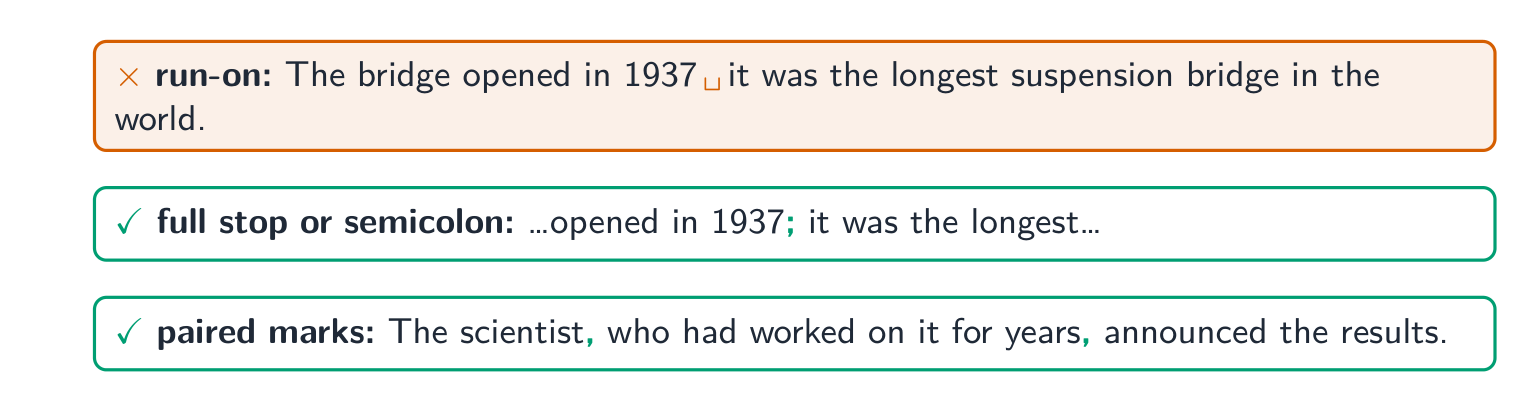
“The bridge opened in ___ it was the longest suspension bridge in the world.” Which choice is correct?
Difficulté 1/5 · 100 pièces + un petit bonus lors de la première réussite aujourd'hui
Two independent clauses with no conjunction need a semicolon (or a full stop).
The seven coordinating conjunctions are remembered as ____ (for, and, nor, but, or, yet, so).
Difficulté 1/5 · 100 pièces + un petit bonus lors de la première réussite aujourd'hui
A comma + one of these can join two independent clauses.
Colons and dashes
- A colon follows a complete clause and introduces an explanation, list or example: "The bridge had one problem: strong winds."
- Paired dashes or paired commas enclose extra (nonessential 非必要的) information; use the same mark on both sides: "The bridge — completed in 1937 — is still in use."
"The scientist, who had worked on the project for years announced the results." The nonessential clause opened with a comma, so it must close with one: "…for years, announced…".
Borde correcte ou erreur ?
Jugez si deux propositions sont correctement jointes.
“The novel — written in just six ___ became a bestseller.” Which choice is correct?
Difficulté 1/5 · 100 pièces + un petit bonus lors de la première réussite aujourd'hui
The extra information opened with a dash, so it must close with a dash.
A colon can follow a complete clause to introduce an explanation.
Difficulté 1/5 · 100 pièces + un petit bonus lors de la première réussite aujourd'hui
“The plan had one flaw: no budget.”
Essential versus nonessential
- Essential information identifies which one you mean and takes no commas: "The student who won the prize spoke first."
- Nonessential information adds extra detail about something already identified and is set off: "Maya, who won the prize, spoke first."
Which sentence uses commas correctly?
Difficulté 1/5 · 100 pièces + un petit bonus lors de la première réussite aujourd'hui
“Who won the prize” identifies which student, so it is essential and takes no commas.
Traps
- Comma splice: "The bridge opened in 1937, it was the longest…" — a comma alone cannot join two independent clauses.
- Mismatched pairs: opening with a dash and closing with a comma.
Recap
- Decide which parts are independent clauses; join them with a full stop, semicolon, or comma + FANBOYS.
- Colons follow complete clauses; paired commas or dashes must match; essential information takes no commas.
- dependent clause: A clause that cannot stand alone as a sentence.
- nonessential: Adding extra information that can be removed without changing the core meaning.