Compléter un passage avec une inférence justifiée
Introduit| English | Sens |
|---|---|
| inference/ˈɪnfərəns/ | inférence |
| plausible/ˈplɔːzɪbl/ | plausible |
| association/əˌsəʊsɪˈeɪʃn/ | association |
Finish the argument
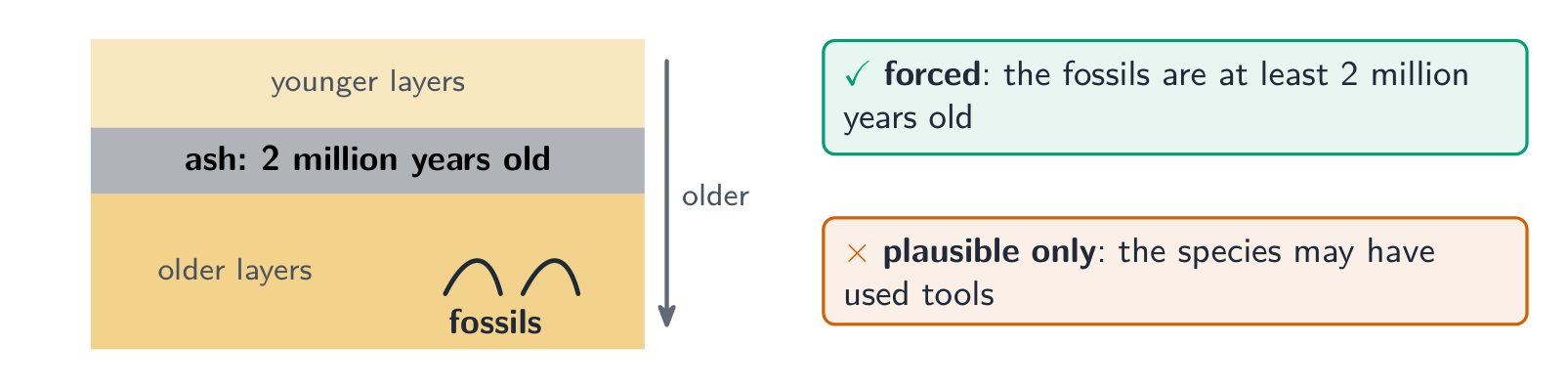
- A text ends with a blank: "Since the fossils were found below a layer of volcanic ash dated to 2 million years ago, the fossils ___."
- Inference 推断 questions ask for the conclusion that the facts in the text force, not one that only sounds reasonable.
Combine the stated facts
- Lower rock layers are older. The fossils lie below ash that is 2 million years old. So the fossils must be at least 2 million years old.
- Write the logic as a short chain: fact 1 + fact 2 → conclusion. If a choice needs a fact the text did not give, it is not a valid inference.
“Glacier X lost 30% of its ice between 1990 and 2020. Glacier Y, at a higher altitude, lost 10% over the same period. Higher glaciers are colder. Therefore, ___” Which choice most logically completes the text?
Difficulté 1/5 · 100 pièces + un petit bonus lors de la première réussite aujourd'hui
The text links altitude, temperature and smaller loss; the modest, supported conclusion is that colder conditions may have slowed the loss.
Put the inference method in order.
Difficulté 3/5 · 200 pièces + un petit bonus lors de la première réussite aujourd'hui
Building the chain first protects against plausible but unsupported options.
Necessary versus merely plausible 似乎合理的
- "The species may have used tools" might be true, but nothing in the text shows it — plausible, not supported.
- The correct choice is often modest: "are older than the ash layer" rather than "belong to the earliest human ancestors".
Text: "Plants in plot A received fertiliser; plants in plot B did not. Plot A grew taller, but plot A also received more sunlight." Valid inference: the study cannot show that fertiliser alone caused the difference. Overstated: fertiliser makes plants grow taller.
Inférence soutenue ou excès ?
Distinguer les conclusions imposées par le texte des conclusions plausibles ou excessives.
“Students in class A used a new reading app and improved their scores more than class B. Class A also had smaller groups.” Which conclusion is best supported?
Difficulté 1/5 · 100 pièces + un petit bonus lors de la première réussite aujourd'hui
Two differences between the classes mean neither can be named as the cause.
Keep uncertainty and cause in check
- If the text shows only an association 关联, the conclusion should not claim a cause.
- Words like suggests, may, is consistent with are often signs of the right answer when the evidence is limited.
An answer that is true in real life but cannot be worked out from the text can still be the correct inference.
Difficulté 1/5 · 100 pièces + un petit bonus lors de la première réussite aujourd'hui
Inferences must follow from the text.
Traps
- Outside knowledge: true in reality, but not derivable from the text.
- Overstatement: "proves", "always", "the only cause" when the text shows less.
A study showing only that two things happen together shows an ____, not a cause.
Difficulté 1/5 · 100 pièces + un petit bonus lors de la première réussite aujourd'hui
Association does not prove cause.
Recap
- Chain the stated facts to the conclusion they force; reject anything that needs extra facts.
- Prefer modest, qualified conclusions when the evidence is limited; do not upgrade association to cause.
- plausible: Reasonable or possible, though not proven.
- association: A link between two variables that may not be causal.