Nuclear changes and radiation evidence
Introduit| English | Sens |
|---|---|
| half-life/hɑːf laɪf/ | demi-vie |
| background radiation/ˈbækɡraʊnd ˌreɪdɪˈeɪʃn/ | rayonnement de fond |
What would explain this observation?
- A detector records counts even when the classroom source is removed. Background must be considered before attributing every count to the source.
Build the model
- Radioactive decay is spontaneous and random for an individual nucleus.
- Half-life 半衰期 describes the time for half the undecayed nuclei in a large population to decay, or for background-corrected activity to halve.
- half-life: Time for activity or undecayed population to halve.
- background radiation 本底辐射: Radiation measured apart from the investigated source.

Half-lives: a fraction of the nuclei remains
Individual decays are random; half-life describes the pattern for a large population.
Which count should be used for source activity?
Difficulté 1/5 · 100 pièces + un petit bonus lors de la première réussite aujourd'hui
Measure background separately and subtract over equal times, or use matching rate units, to isolate the source contribution. Corrected count rate follows source activity only with fixed geometry, efficiency and emission yield; it is not automatically the whole-source activity. Picking the largest repeat biases the result.
Match each technical term to its precise meaning.
Difficulté 2/5 · 140 pièces + un petit bonus lors de la première réussite aujourd'hui
Use the definitions to distinguish related quantities and processes.
Choose evidence that can test it
- Subtract background counts measured over the same time interval.
- Distinguish irradiation from contamination.
- Shielding, distance and reduced exposure time can reduce risk under a school-controlled procedure.
In the lab: Use teacher-managed sources and the school radiation rules. Record count duration and repeat background measurements. Do not extrapolate a half-life from one nucleus or from uncorrected readings.
Which two habits make the investigation or model in this case more defensible?
Difficulté 2/5 · 140 pièces + un petit bonus lors de la première réussite aujourd'hui
Stating the conditions and assumptions lets others repeat the work exactly, and recording the supporting evidence lets them check the conclusion. Hiding disagreeing results removes the evidence that could challenge a wrong conclusion, and one measurement can never establish a wider claim.
Work from known quantities
- Known: measured count rate falls from 100 to 55 counts per minute; background is 10.
- Source rates are 90 and 45, so one half-life has elapsed.
- Without subtraction, 55/100 would obscure the exact half in this example.
Your turn: An initial source count is 160 per minute. Find it after three half-lives.
Subtract background before comparing decay
Measured rates of 100 and 55 counts/min become source rates of 90 and 45 after subtracting a background of 10. Compare the raw 55% ratio with the corrected 50% source fraction.
An initial source count is 160 per minute. Find it after three half-lives.
Difficulté 2/5 · 140 pièces + un petit bonus lors de la première réussite aujourd'hui
The result is 20 counts/min. Known: initial count 160 per minute; three half-lives. Each half-life halves the activity: 160 -> 80 -> 40 -> 20 counts per minute. After three half-lives the count is 160/(2^3) = 20 per minute.
Check the conclusion and its limits
- An irradiated object is not automatically radioactive.
- A half-life does not predict the exact decay time of one nucleus.
Not true: Half-life predicts the exact decay time of an individual nucleus. Radioactive decay is random at the level of single nuclei. Half-life is a statistical quantity: it predicts the fraction of a LARGE number of nuclei decaying in a given time, never the moment one nucleus will decay.
- Radioactive decay is spontaneous and random for an individual nucleus.
- Subtract background counts measured over the same time interval.
- Watch for: an irradiated object is not automatically radioactive.
Radioactive decay is random at the level of single nuclei.
Difficulté 1/5 · 100 pièces + un petit bonus lors de la première réussite aujourd'hui
True. Radioactive decay is random at the level of single nuclei. Half-life is a statistical quantity: it predicts the fraction of a LARGE number of nuclei decaying in a given time, never the moment one nucleus will decay.
Time for activity or undecayed population to halve: write the technical term.
Difficulté 1/5 · 100 pièces + un petit bonus lors de la première réussite aujourd'hui
half-life means Time for activity or undecayed population to halve.
Write from an initial rate of 320 counts per minute
- A background-corrected source count rate is initially 320 counts/min, with fixed detection conditions.
- Find the count after two half-lives. Half-life does not time one nucleus.
A background-corrected source count rate is initially 320 counts/min. With fixed detection conditions, what is its expected rate after two half-lives, and why does half-life not predict the decay time of one nucleus?
Two half-lives give rate = 320 × (1/2)² = 320/4 = 80 counts/min. Background has already been removed and detection conditions stay fixed. This predicts an expected rate with random fluctuations, rather than an exact decay time for one nucleus.
An invented single-source exponential-decay model starts at 320 counts/min after background correction. With fixed detection conditions, what is the expected count rate after two half-lives?
Difficulté 1/5 · 100 pièces + un petit bonus lors de la première réussite aujourd'hui
Two half-lives give expected rate = initial rate × (1/2)² = 320/4 = 80 counts/min. Background is already removed, and the detection conditions are held fixed. This is an expected rate; observed counts in a one-minute interval can fluctuate. The 20 counts/min alternative belongs to the separate 160/8 example, while 320 counts/min is the initial rate.
Read the nuclear label before predicting change
- A nuclear symbol gives proton number $Z$ and nucleon number $A$; neutron number is $A-Z$. Isotopes share $Z$ but have different neutron numbers. Carbon-12 and carbon-14 both have six protons, but six and eight neutrons respectively. Ordinary ionisation changes electrons, not the isotope. Isotopes have very similar electronic chemistry, with mass-dependent differences possible; equal chemistry does not imply equal nuclear stability.
- A bound nucleus has less rest mass than its separated nucleons. The missing mass is a difference between two physical systems, not missing charge or disappearing nucleons. To separate the nucleus completely, supply its binding energy; forming it from free nucleons releases the corresponding energy. A nuclear reaction must conserve total energy, including rest energies and the kinetic energies of every product.
Chlorine-37 has Z = 17. Find its neutron number.
Difficulté 2/5 · 140 pièces + un petit bonus lors de la première réussite aujourd'hui
N = A − Z = 37 − 17 = 20. Changing electrons makes an ion, not a different isotope.
Calculate binding with one mass convention
- With nuclear masses, use $\Delta m=Zm_p+(A-Z)m_n-m_\mathrm{nucleus}$. An invented carbon-12 calculation uses $m_p=1.007276$ u, $m_n=1.008665$ u and nuclear mass 11.996706 u. Separate nucleons total 12.095646 u, leaving a defect of 0.098940 u. With $1\ \mathrm{u}=931.5\ \mathrm{MeV}/c^2$, the binding energy is $92.16$ MeV, or $7.680$ MeV per nucleon.
- Multiplying a mass defect in u by 931.5 produces MeV, because the conversion already supplies the required $c^2$. Do not multiply that result by $c^2$ again. Convert MeV to joules with $1\ \mathrm{MeV}=1.60\times10^{-13}$ J when using that rounded electronvolt conversion. Atomic masses include electrons: choose a cancellation-consistent convention instead of combining atomic nuclear mass with bare-proton masses silently.
Carbon-12 has A = 12 and Z = 6. Use nuclear masses mp = 1.007276 u, mn = 1.008665 u and carbon-12 mass 11.996706 u. With 1 u c² = 931.5 MeV, find total binding energy.
Difficulté 2/5 · 140 pièces + un petit bonus lors de la première réussite aujourd'hui
There are Z = 6 protons and A − Z = 12 − 6 = 6 neutrons. Free-nucleon mass is 6(1.007276) + 6(1.008665) = 12.095646 u. The defect is 12.095646 − 11.996706 = 0.098940 u. Binding energy is 0.098940 × 931.5 = 92.16261 MeV. Per nucleon it is 92.16261/12 = 7.680 MeV; do not confuse the two.
Read the binding curve as an energy comparison
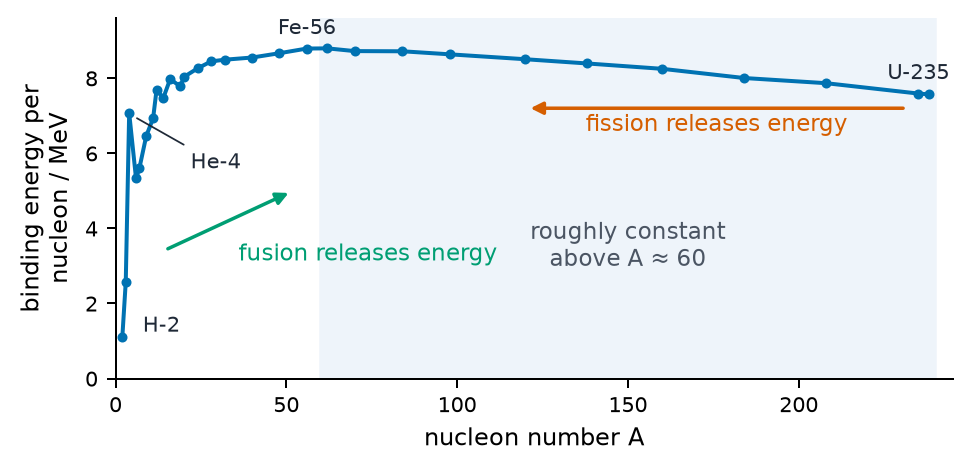
- The curve gives binding energy per nucleon, not total binding energy and not the energy released by an arbitrary single reaction. Selected light nuclei rise towards the tightly bound iron/nickel region; heavier nuclei have slightly smaller values. Helium-4 is unusually tightly bound among light nuclei. A larger average binding energy means more energy per nucleon to separate the nucleus completely, rather than a guarantee against every possible radioactive transition.
- Favourable fusion of light nuclei or fission of heavy nuclei increases the total binding energy of the products and releases the difference. Count every product and multiply each per-nucleon value by its nucleon number before comparing totals. A broad curve explains the trend but cannot establish that every proposed fusion or fission reaction is exothermic. Exact reaction energies follow the mass difference of the specified initial and final systems.
What establishes that a particular proposed nuclear reaction releases energy?
Difficulté 1/5 · 100 pièces + un petit bonus lors de la première réussite aujourd'hui
Compare all initial and final masses or total binding energies. A trend in per-nucleon binding does not establish every possible reaction.
Separate a random event from a statistical trend
- In the constant-rate model, one undecayed nucleus has the same conditional chance of decaying in the next equal interval regardless of its age. We cannot predict its individual decay time. Spontaneous means a triggering collision is unnecessary. For ordinary classroom sources, changes of temperature, pressure or chemical environment approximately leave the decay rate unchanged; avoid turning that useful model into an absolute statement about every nuclear mechanism.
- A large population has a predictable declining expected number, with random fluctuations in observations. Half-life gives a population trend, not a deadline: a particular nucleus can decay much sooner or survive several half-lives. Four starting nuclei need not become exactly two after one half-life. A good model distinguishes what is expected from what any one trial must produce.
What does one half-life require of four initially undecayed nuclei?
Difficulté 1/5 · 100 pièces + un petit bonus lors de la première réussite aujourd'hui
Half-life describes the expected population fraction under the constant-rate model, not an exact small-sample count or an individual deadline.
Balance alpha and beta changes
- An alpha particle contains two protons and two neutrons, so alpha decay changes $(A,Z)$ to $(A-4,Z-2)$. For example, polonium-210, $Z=84$, produces lead-206, $Z=82$, plus an alpha particle. A beta-minus decay converts a neutron to a proton, electron and electron antineutrino: $A$ stays fixed and $Z$ increases by one. Strontium-90 therefore produces yttrium-90 with $Z=39$, not zirconium or a mass-89 daughter.
- Beta-plus emission converts a proton to a neutron, positron and electron neutrino within an energetically allowed nuclear transition; $A$ stays fixed and $Z$ decreases by one. Fluorine-18, $Z=9$, produces oxygen-18, $Z=8$. An emitted beta electron is created in the nuclear transition rather than being an old orbital electron knocked out. Balance nucleon number and charge, and include the correct neutrino partner.
Strontium-90 has Z = 38 and emits beta-minus. Find the daughter proton number.
Difficulté 2/5 · 140 pièces + un petit bonus lors de la première réussite aujourd'hui
A neutron changes into a proton, electron and electron antineutrino. Nucleon number remains 90 and Z rises to 39.
Identify what gamma emission changes
- An excited daughter nucleus can emit a gamma photon as it falls to a lower nuclear state. Its proton and neutron counts remain unchanged: the same nuclide loses excitation energy. Gamma is electromagnetic radiation, while alpha is a helium nucleus and beta is an electron or positron. A source may have a sequence of different emissions; its label does not imply every detected event has one particle type or energy.
- Ionisation removes electrons from atoms; excitation raises an internal state without necessarily removing an electron. Charged alpha and beta particles can transfer energy to atomic electrons directly. Gamma photons transfer energy through interactions that produce moving charged particles, which then ionise. Electric neutrality does not make gamma radiation unable to transfer energy or automatically harmless.
An excited nucleus emits a gamma photon. What changes?
Difficulté 1/5 · 100 pièces + un petit bonus lors de la première réussite aujourd'hui
Gamma emission is nuclear de-excitation. Photon energy is positive even though its charge and rest mass are zero.
Interpret absorbers with stated limits
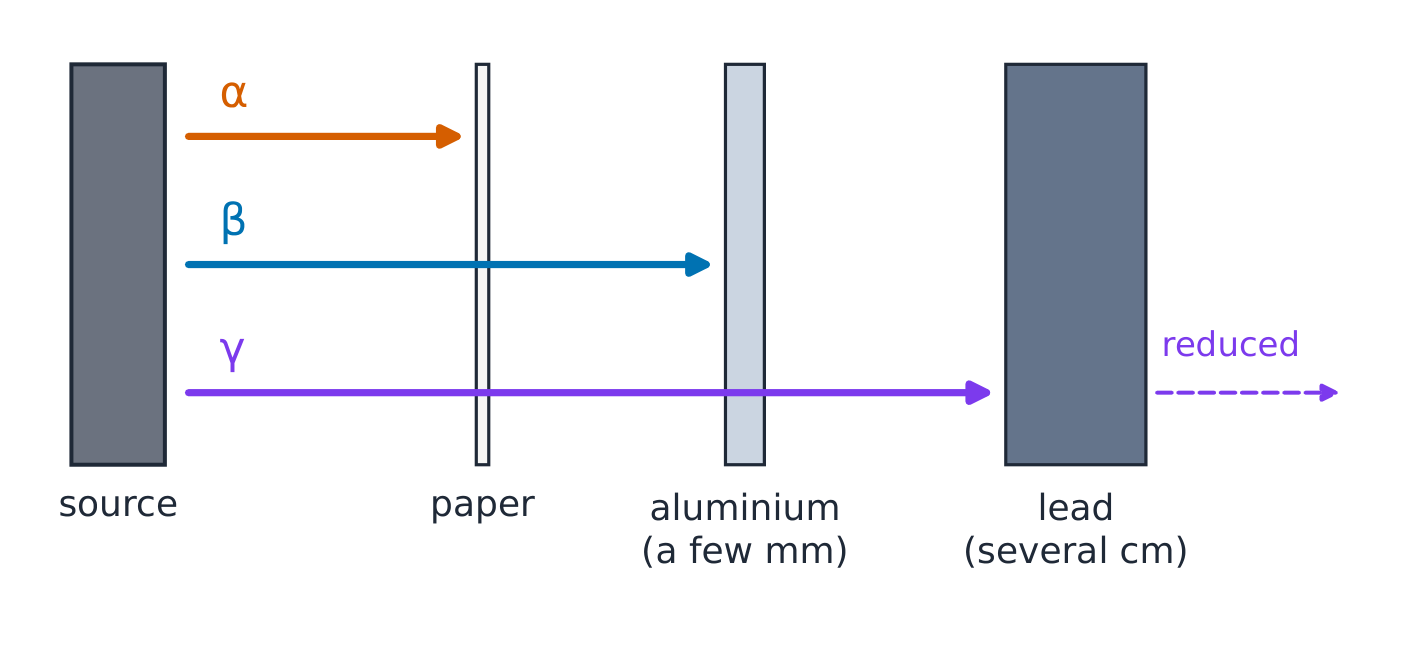
- For typical classroom energies, paper stops alpha, a few millimetres of aluminium can stop beta, and thick lead reduces gamma intensity. These are energy-dependent comparisons, not exact universal ranges. Gamma attenuation is gradual rather than a hard distance after which every photon vanishes. Detector geometry, absorber scattering, source mixtures and measurement uncertainty affect the observed count changes.
- In invented repeated measurements, counts per minute are 600 unshielded, 450 behind paper and 30 behind aluminium; background is 30. In the intended simple model, the paper-sensitive component indicates alpha and the further aluminium-sensitive component beta. The final reading resolves no gamma contribution above background; it cannot prove that an arbitrarily weak gamma component is absent. Keep source position and counting times controlled before attributing changes to the absorber.
After aluminium, an intended classroom measurement is statistically consistent with background. What can be concluded?
Difficulté 1/5 · 100 pièces + un petit bonus lors de la première réussite aujourd'hui
Finite measurement precision can set a detection limit, not prove an arbitrarily weak component absent. Geometry and absorber effects must also be controlled.
Distinguish activity from detector counts
- Activity $A$ is the expected decay rate of the source, in becquerels: one Bq means one decay per second. A detector records events during a chosen interval; count rate is counts divided by duration. Radiation can miss the detector, fail to trigger it or be attenuated on the way. Background can add unrelated events. Thus a reading of 100 counts per second need not mean a source activity of 100 Bq.
- Use $R_\mathrm{source}=R_\mathrm{measured}-R_\mathrm{background}$. Proportionality between this corrected rate and activity requires fixed geometry, detection efficiency and emission yield, with negligible detector dead-time effects. Moving the source closer can raise the count while activity stays unchanged. A changing detector response can mimic a changing source, so an experiment needs measurement controls as well as a decay equation.
Moving a detector closer increases its count rate. Must source activity have increased?
Difficulté 1/5 · 100 pièces + un petit bonus lors de la première réussite aujourd'hui
The detector samples part of the emission. Fixed geometry and efficiency are required when corrected count rate is used as a proportional measure of activity.
Follow the same fraction through equal half-lives
- Half-life $T_{1/2}$ is the time for the expected undecayed population or activity to halve. A fixed-condition corrected count rate follows the same fraction. After $n$ half-lives, the remaining fraction is $(1/2)^n$: one, one-half, one-quarter, one-eighth. Equal half-lives remove equal fractions of what remains, not equal numbers of nuclei.
- For an invented activity of 640 Bq and half-life 2.0 h, 8.0 h contains four half-lives: $640\to320\to160\to80\to40$ Bq. After three half-lives the remaining fraction is $1/8$, and the fraction decayed is $7/8$; neither is a time. State whether the question asks for surviving parent nuclei, decayed fraction, activity, or an instrument reading.

An activity of 640 Bq has half-life 2.0 h. Find its expected activity after 8.0 h.
Difficulté 2/5 · 140 pièces + un petit bonus lors de la première réussite aujourd'hui
Number of half-lives n = 8.0/2.0 = 4. Expected activity A = 640(1/2)⁴ = 640/16 = 40 Bq. Equal times halve what remains rather than subtracting 320 Bq every time.
Subtract background before halving
- In invented data, a detector reads 245 counts per minute initially and background is 25 counts per minute. Source rate is $245-25=220$. After three half-lives it is $220/8=27.5$ counts per minute. The expected detector reading is then $27.5+25=52.5$ counts per minute. A fractional expected rate is sensible even though an actual observed count is an integer.
- Background itself does not halve with the investigated source. Directly dividing 245 by eight would incorrectly decay the background contribution. Conversely, returning 27.5 when asked for the whole detector reading omits it. If the raw rate falls from 100 to 55 with constant background 10, corrected rates 90 and 45 indicate one half-life in the ideal example; the raw ratio 0.55 is not a number of half-lives.
Initial detector rate is 245 counts/min and constant background is 25 counts/min. Find the expected whole-detector rate after three half-lives.
Difficulté 2/5 · 140 pièces + un petit bonus lors de la première réussite aujourd'hui
Initial source rate is 245 − 25 = 220 counts/min. Three half-lives leave 220 × (1/2)³ = 220/8 = 27.5 counts/min from the source. Add unchanged background: detector rate = 27.5 + 25 = 52.5 counts/min. Expected rate need not be an integer.
Design a half-life measurement that can distinguish decay
- Follow the teacher-managed source procedure. Measure background for a known, sufficiently long duration and check its stability; measure source-plus-background counts at recorded elapsed times, with fixed geometry and detector settings. Convert each measurement to the same rate units before subtraction. Longer counting generally reduces relative counting noise, but the sample must not change appreciably within each interval unless interval averaging is included in the model.
- Plot corrected rate against time and fit a sensible declining trend rather than joining every noisy point. Read several halving intervals and compare their spread. An invented rate falling from 1200 to 150 in 15 days has three halvings, so half-life is 5.0 days. A low source rate dominated by uncertain background cannot support a precise half-life simply because a smooth curve can be drawn through it.
An invented corrected rate falls from 1200 to 150 in 15 days. Find half-life.
Difficulté 2/5 · 140 pièces + un petit bonus lors de la première réussite aujourd'hui
1200→600→300→150 is three halvings. Divide the elapsed 15 days by three.
Date a sample only after justifying the clock
- Once a sample stops exchanging carbon with its surroundings, its carbon-14 fraction can be compared with an assumed initial value for equivalent carbon amounts. In an invented closed-sample model, a remaining fraction $1/8$ means three half-lives, giving $3\times5730=17\,190$ years. Comparing unequal wood masses without normalising carbon content would not identify that fraction correctly.
- Real archaeological dates also need sample preparation, contamination checks and calibration for atmospheric variation. Remeasurement of Ötzi samples reports calibrated prehistoric date intervals; our invented fractions are not that study's measurements. Carbon-14 is a clock for suitable once-living material, not a universal way to date any rock or any age.
An invented closed-sample carbon-14 ratio is one eighth its assumed initial value. Use half-life 5730 years; find idealised decay age.
Difficulté 2/5 · 140 pièces + un petit bonus lors de la première réussite aujourd'hui
One eighth is three half-lives. Age = 3 × 5730 = 17190 years, or 17200 to three significant figures and 17000 to two. A real calendar date also requires justified initial ratios, contamination checks and calibration.
Match an isotope to the measurement window
- For external gamma imaging, escaping photons can reach a camera, and an approximately 6 h technetium-99m physical half-life provides a useful measurement window. Chemical targeting, activity and biological removal also matter. Half-life alone does not determine dose or make a procedure safe. Distinguish radiation type from the particular source design and professional use; this is a comparison of physical principles.
- For thickness control, choose radiation that is partly attenuated across the operating thickness range so the count responds measurably to changes. Beta can suit thin paper; typical alpha may all be stopped and gamma may change too little. A long-lived source reduces drift during operation, but calibration and fixed geometry remain necessary. The appropriate radiation depends on energy and material thickness, not just a memorised three-word ranking.
Why might beta radiation suit thin-paper thickness control?
Difficulté 1/5 · 100 pièces + un petit bonus lors de la première réussite aujourd'hui
The source energy, material and thickness must produce a measurable response. Fixed geometry and calibration are still required.
Distinguish irradiation from contamination
- Irradiation means exposure to radiation from a source; contamination means radioactive material is on or within an object. Removing an external source ends that exposure, while contamination can continue emitting until the material is removed or decays. Irradiation does not automatically turn an object into a radioactive source; activation requires suitable nuclear reactions and conditions.
- A typical alpha particle is stopped by outer skin, but an internal alpha-emitting contaminant can deposit energy densely in tissue; other source emissions may still matter externally. Reason from activity, radiation energy, time, distance, shielding and exposure route. For classroom work follow the teacher's controlled procedure. A short half-life means activity decreases quickly, rather than guaranteeing that released material becomes safe after a chosen wait.
What distinguishes radioactive contamination from irradiation by an external source?
Difficulté 1/5 · 100 pièces + un petit bonus lors de la première réussite aujourd'hui
Contamination is material transfer; irradiation is exposure. Activation requires suitable nuclear reactions, and risk depends on more than physical half-life.
Explain a complete decay investigation
- State the nuclide notation, emission change and the population quantity being modelled. Use a consistent mass convention for energy, correct background before fractions, and distinguish a count rate from whole-source activity. Explain why repeated random observations scatter around an expected trend instead of claiming the curve predicts each individual nuclear event.
- Finish with the limits that matter: fixed detector conditions, a sufficiently large population, a justified initial ratio for dating and a suitable material/energy range for absorption. Recompute a measured reading by adding stable background back to the decayed source rate. An answer should connect these controls to the conclusion they support, rather than listing safety or experimental vocabulary without a reason.
AHL: connect nuclear binding to a short-range interaction
- Two protons 2.0 fm apart repel electrically with $F=k e^2/r^2$. Using $k=8.99\times10^9\ \mathrm{N\,m^2}/\mathrm{C^2}$ and $e=1.60\times10^{-19}$ C gives about 58 N. Their gravitational attraction is vastly smaller. The existence of bound nuclei therefore requires an additional attractive interaction at nuclear separations; electrical attraction cannot bind two positively charged protons.
- The residual nuclear force provides attraction at appropriate separations and repulsion at sufficiently short distances. Short range leads to saturation: each nucleon gains most of its binding from nearby neighbours. Approximately common nuclear density and near-constant binding energy per nucleon for many medium/heavy nuclei support this picture, without making every nucleus identical or removing surface, shell and electrostatic effects.
With k = 8.99 × 10⁹ N m²/C² and e = 1.60 × 10⁻¹⁹ C, find the electric repulsion between protons separated by 2.0 fm.
Difficulté 2/5 · 140 pièces + un petit bonus lors de la première réussite aujourd'hui
Convert r = 2.0 fm = 2.0 × 10⁻¹⁵ m. F = ke²/r² = (8.99 × 10⁹)(1.60 × 10⁻¹⁹)²/(2.0 × 10⁻¹⁵)² = 57.536 N ≈ 58 N. This is repulsion; gravity is vastly too weak to bind the nucleus.
AHL: use the stability band as a guide
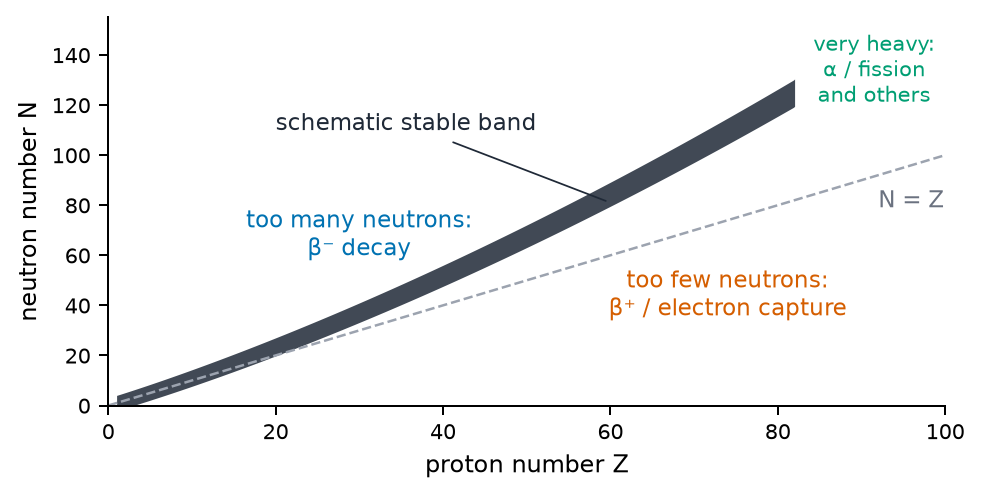
- Light stable nuclei tend to have neutron number close to proton number; many heavier stable nuclei have more neutrons. Lead-208 has $N/Z=126/82=1.54$. Extra neutrons contribute nuclear binding without adding proton–proton electrical repulsion. The balance depends on size and nuclear structure, so a ratio alone cannot establish stability or uniquely identify the next decay.
- A neutron-rich nucleus can move towards the band by beta-minus emission; a proton-rich one may use beta-plus emission or electron capture when energetically allowed. Alpha decay is common for very heavy nuclei, with other modes possible. Lead is the highest-$Z$ element with stable nuclides: even bismuth-209 has experimentally detected alpha decay. A lifetime far beyond ordinary observation is not proof of stability.
Which is the soundest use of the neutron/proton stability band?
Difficulté 1/5 · 100 pièces + un petit bonus lors de la première réussite aujourd'hui
Neutron-rich beta-minus and proton-rich beta-plus/electron capture are useful trends. Long lifetime is not stability, and total nuclear energy/structure matters.
AHL: explain the broad binding-energy plateau
- For many nuclei above about $A=60$, binding energy per nucleon is roughly 7.6–8.8 MeV. With a short-range interaction, adding a nucleon to a large nucleus usually adds a similar number of nearby interactions. Total binding energy therefore grows roughly with $A$, giving a broad per-nucleon plateau rather than growth proportional to the number of all possible nucleon pairs.
- The curve slowly falls at high $A$ because electrical repulsion acts between proton pairs over the whole nucleus. Surface nucleons have fewer neighbours, contributing to weaker average binding in many light nuclei. This is an explanatory trend, not an exact calculation for every isotope: helium-4 and nuclear shell effects remind us that a smooth curve leaves out real structure.
Why is binding energy per nucleon roughly constant for many medium/heavy nuclei?
Difficulté 1/5 · 100 pièces + un petit bonus lors de la première réussite aujourd'hui
Saturation gives approximately proportional total binding and nucleon number. Surface, shell and electrostatic terms still change the detailed curve.
AHL: distinguish discrete branches from a continuous spectrum
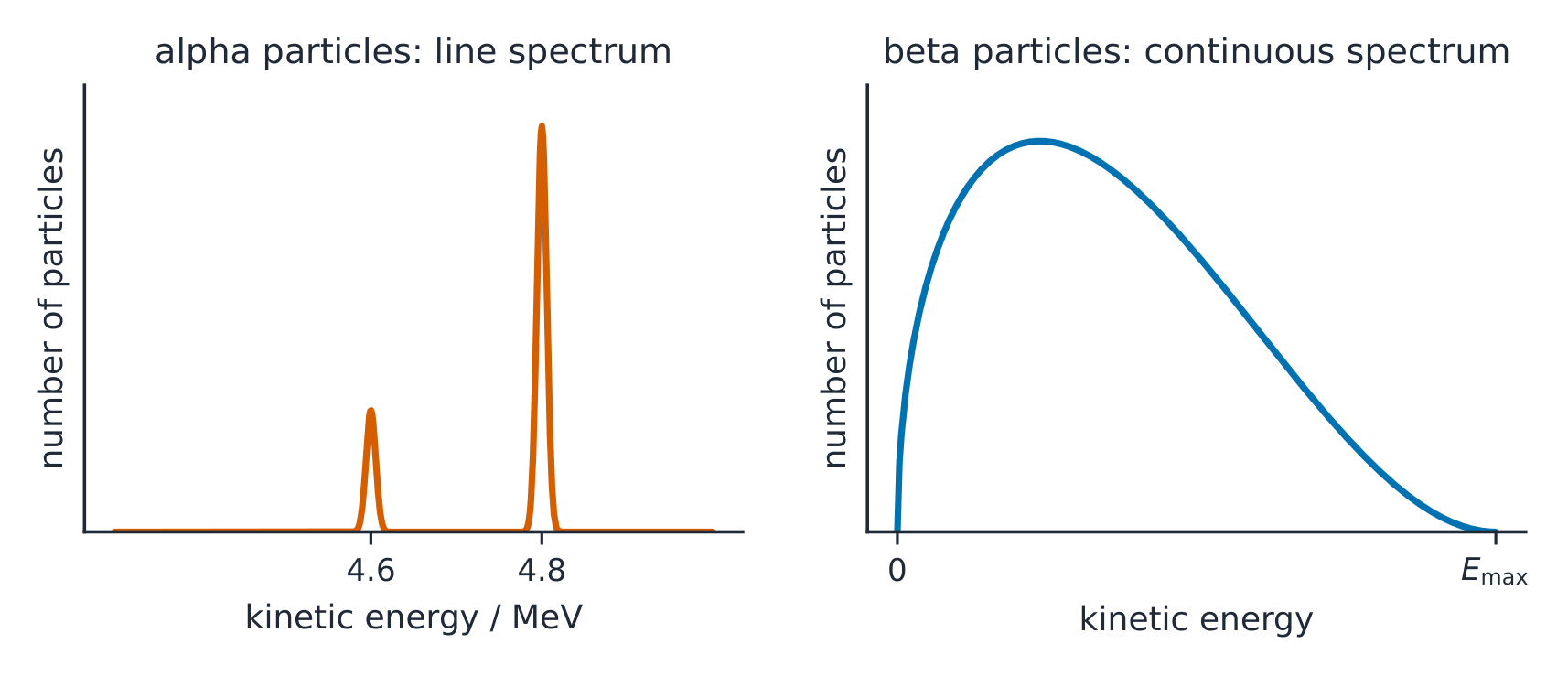
- In an invented heavy-nucleus example, alpha particles have energies 5.30 and 5.12 MeV. Different branches can leave the same daughter in its ground or an excited state; subsequent de-excitation gives a gamma photon. Neglecting daughter recoil, the inferred gamma energy is $5.30-5.12=0.18$ MeV. An exact calculation must include the different daughter recoil energies, so alpha-energy differences are not universally equal to gamma energy without qualification.
- A beta spectrum instead has a continuous range of kinetic energies for a given branch. Beta particle, (anti)neutrino and recoiling daughter share the available energy and momentum differently in different events. With only a daughter and beta particle from the same parent state at rest, two-body conservation would fix their energies. The additional particle explains the continuous sharing; the endpoint is close to the available kinetic energy when recoil and neutrino mass are negligible.
Invented two-step emission: Levels are at 0.50, 0.20 and 0 MeV. With daughter recoil neglected, the first transition emits $0.50-0.20=0.30$ MeV and the second emits $0.20-0=0.20$ MeV. The two photon energies add to 0.50 MeV; each photon carries one level difference, not necessarily the whole initial excitation energy.

Invented alpha branches are 5.30 and 5.12 MeV. Neglect daughter recoil; infer the subsequent gamma energy.
Difficulté 2/5 · 140 pièces + un petit bonus lors de la première réussite aujourd'hui
The approximate level gap is 5.30 − 5.12 = .18 MeV. Exact branch accounting includes the differing daughter recoils.
AHL: derive activity from a constant hazard
- For independently decaying parent nuclei with constant decay constant $\lambda$ and no replenishment, $N=N_0e^{-\lambda t}$ and activity $A=\lambda N$. Here $N$ is the expected surviving parent population; daughter activity is a separate question if daughters are radioactive. Setting $N/N_0=1/2$ gives $T_{1/2}=\ln2/\lambda$. Use matching time units in the exponent.
- With an 8.0 day half-life, $\lambda=\ln2/(8.0\times86400)=1.003\times10^{-6}$ per second. An assigned $2.0\times10^{15}$ parent nuclei have activity about $2.01\times10^9$ Bq. The fraction after 20 days is $2^{-20/8}=0.1768$; the time to 10% is $\ln10/\lambda=26.58$ days. Do not insert days into an exponent with a per-second decay constant.
With half-life 8.0 days and 86400 seconds per day, find decay constant in units of 10⁻⁶ per second.
Difficulté 2/5 · 140 pièces + un petit bonus lors de la première réussite aujourd'hui
λ = ln 2/(8 × 86400) = 1.002817 × 10⁻⁶ per second. To two significant figures this is 1.0 × 10⁻⁶ per second, so enter 1.0 for the requested coefficient. Use the same time units in λt.
AHL: fit a decay constant and check the model
- Taking a logarithm gives $\ln(R/R_\mathrm{ref})=\ln(R_0/R_\mathrm{ref})-\lambda t$ for a background-corrected rate proportional to one exponential. The fixed reference makes the logarithm dimensionless and affects the intercept only. Invented log-rate values falling from 8.0 to 5.0 over 10 minutes give gradient $-0.30$ per minute, $\lambda=0.30$ per minute and half-life $0.693/0.30=2.31$ minutes.
- Fit multiple appropriate points, not two noisy extremes by default. Unsubtracted constant background flattens the late-time log graph; negative corrected counts cannot be logged. A mixture of parent nuclides or changing efficiency need not be one straight line, and radioactive daughters can require a fuller model. After 3.5 half-lives the single-parent surviving fraction is $2^{-3.5}=0.08839$, not a rounded choice between three and four halvings.

Find the surviving fraction after 3.5 half-lives in a single-parent constant-rate model.
Difficulté 2/5 · 140 pièces + un petit bonus lors de la première réussite aujourd'hui
N/N₀ = 2⁻³·⁵ = .0883883. Do not round the elapsed time to an integer number of half-lives.
AHL: turn a decay constant into a probability correctly
- The probability that an initially undecayed nucleus decays within $\Delta t$ is $1-e^{-\lambda\Delta t}$. For small $\lambda\Delta t$, it is approximately $\lambda\Delta t$. With $\lambda=0.010$ per second, the probability in 1.0 s is $0.009950$, close to 0.010. In 100 s it is $1-e^{-1}=0.6321$, not 1.0; in 200 s the naive product would even exceed one.
- The surviving nuclei do not become older in the sense of acquiring a higher hazard under this constant-rate model. Conditional on survival, the next equal interval has the same probability as before. Meanwhile a whole sample's activity falls because fewer parent nuclei remain. Explain this difference between constant per-nucleus hazard and declining whole-sample rate to reconcile randomness with the exponential curve.
Explain a defensible radioactive-decay investigation, including nuclear changes, energy, detector readings, half-life, dating and isotope choice.
Each conclusion must follow from a defined system and a controlled measurement, with limits relevant to the inference.
A nucleus has decay constant .010 per second. Find its probability of decaying within the next 100 s, conditional on being undecayed now.
Difficulté 2/5 · 140 pièces + un petit bonus lors de la première réussite aujourd'hui
The exact probability is 1 − exp(−λΔt) = 1 − e⁻¹ = .6321206. The product λΔt = 1 is outside the small-interval approximation.