Thermodynamic systems and energy accounts
Introduit| English | Sens |
|---|---|
| internal energy/ɪnˈtɜːnl ˈenədʒi/ | énergie interne |
| adiabatic/ˌædiəˈbætɪk/ | adiabatique |
What would explain this observation?
- Compressing a gas can warm it even without a heater. Work is another path for energy transfer into the system.
Build the model
- Internal energy 内能 is a property of the chosen system.
- Heat and work describe energy transfer across its boundary.
- For an ideal monatomic gas, internal energy depends on temperature and amount.
- adiabatic 绝热的: A process with no heat transfer.
- internal energy: Total microscopic kinetic and potential energy of a system.

In this convention, what happens during adiabatic compression?
Difficulté 1/5 · 100 pièces + un petit bonus lors de la première réussite aujourd'hui
Adiabatic means no heat transfer (Q = 0). In compression the surroundings do work on the gas, and with Q = 0 that work raises the internal energy. Work done BY the gas is negative in compression under this convention.
Match each technical term to its precise meaning.
Difficulté 2/5 · 140 pièces + un petit bonus lors de la première réussite aujourd'hui
Use the definitions to distinguish related quantities and processes.
Choose evidence that can test it
- State a sign convention before using the first law.
- Here change in internal energy equals heat into the system minus work done by the system.
- Expansion work can reduce internal energy when no heat enters.
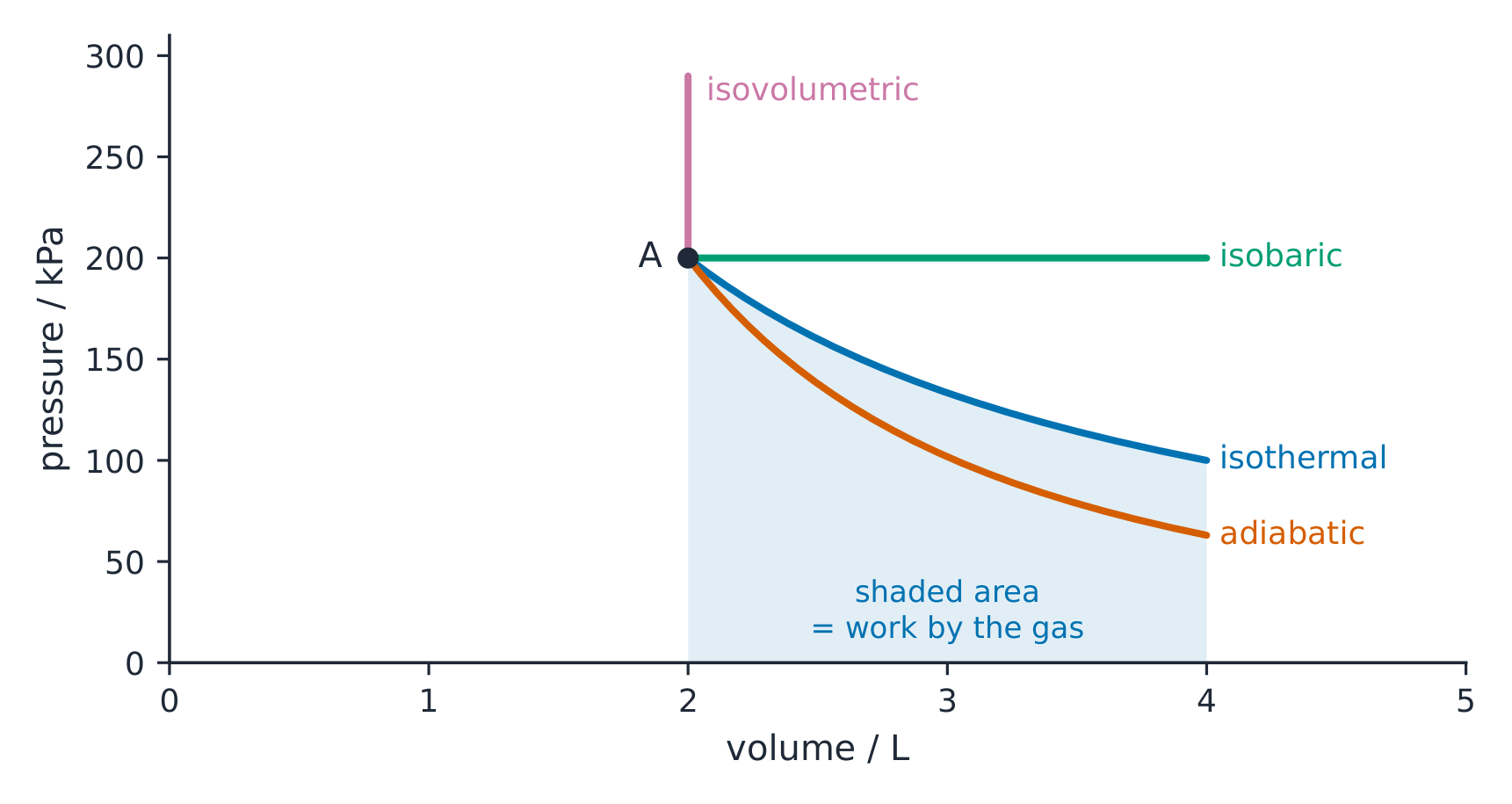
In the lab: Identify whether a process is isothermal, adiabatic or at constant volume. On a pressure-volume graph, area under the process curve gives work done by the gas. The path matters for work even when endpoints match.
Which two habits make the investigation or model in this case more defensible?
Difficulté 2/5 · 140 pièces + un petit bonus lors de la première réussite aujourd'hui
Stating the conditions and assumptions lets others repeat the work exactly, and recording the supporting evidence lets them check the conclusion. Hiding disagreeing results removes the evidence that could challenge a wrong conclusion, and one measurement can never establish a wider claim.
Work from known quantities
- Known: gas gains 300 J by heating and does 120 J of work.
- With ΔU = Q-W, ΔU = 300-120 = 180 J.
- For adiabatic compression, Q=0 and work done by the gas is negative, so ΔU is positive.
Your turn: A gas gains 500 J of heat and does 200 J work. Find internal-energy change.
Two sign conventions, one energy change
300 J of heat enters and 120 J of work leaves the gas. Transfer directions determine ΔU; work-by and work-on conventions describe the same physical process.
A gas gains 500 J of heat and does 200 J work. Find internal-energy change.
Difficulté 2/5 · 140 pièces + un petit bonus lors de la première réussite aujourd'hui
The result is 300 J. Known: heat gained Q = 500 J; work done by the gas W = 200 J. Use the stated convention delta U = Q - W. Delta U = 500 - 200 = 300 J. The internal energy rises by 300 J because more energy entered as heat than left as work.
Check the conclusion and its limits
- Adiabatic does not mean constant temperature.
- Use the stated sign convention; some courses write work done on the gas with the opposite sign.
Not true: Every adiabatic process has constant temperature. Adiabatic fixes heat transfer (Q = 0), not temperature. With only pressure-volume work, adiabatic compression warms a fixed ideal-gas sample, while expansion doing positive work cools it. Insulated free expansion into vacuum has Q = W = 0, so ideal-gas temperature remains unchanged. Isothermal, not adiabatic, is the constant-temperature process.
- Internal energy is a property of the chosen system.
- State a sign convention before using the first law.
- Watch for: adiabatic does not mean constant temperature.
Adiabatic fixes heat transfer (Q = 0), not temperature.
Difficulté 1/5 · 100 pièces + un petit bonus lors de la première réussite aujourd'hui
True. Adiabatic fixes heat transfer (Q = 0), not temperature. With only pressure-volume work, adiabatic compression warms a fixed ideal-gas sample, while expansion doing positive work cools it. Insulated free expansion into vacuum has Q = W = 0, so ideal-gas temperature remains unchanged. Isothermal, not adiabatic, is the constant-temperature process.
A process with no heat transfer: write the technical term.
Difficulté 1/5 · 100 pièces + un petit bonus lors de la première réussite aujourd'hui
adiabatic means A process with no heat transfer.
Calculate the internal-energy change from the transfers
- A gas gains 800 J of heat and does 350 J of work.
- Find the change in internal energy. Adiabatic means no heat transfer, not constant temperature.
A gas gains 800 J of heat and does 350 J of work. What is the change in its internal energy, and why is an adiabatic process not automatically isothermal?
With heat positive into the gas and work positive by it, ΔU = Q − W = 800 − 350 = +450 J. The positive sign means internal energy rises. Adiabatic means Q = 0, so ΔU = −W: compression has negative W and can increase internal energy and temperature without heat entering.
In the written case a gas gains 800 J of heat and does 350 J of work. Find the internal-energy change.
Difficulté 1/5 · 100 pièces + un petit bonus lors de la première réussite aujourd'hui
800 minus 350 is 450 J. Other options — 300 J (the lesson change for 500 J of heat and 200 J of work); 800 J (the heat gained).
Choose a system and separate stores from transfers
- A system is the matter inside a chosen boundary. A closed gas cylinder exchanges no matter but can exchange energy through heating and work. An isolated model exchanges neither matter nor energy. Insulation alone does not make a system isolated if a piston still transfers mechanical energy across its boundary. State which pieces of apparatus belong to your system before making an energy account.
- Internal energy U is a state property of the system; heat Q and work W describe transfers during a process. A gas does not “contain heat” in the same sense that it has internal energy. All numerical cases below are invented models. Unless specified otherwise, use a fixed amount of monatomic ideal gas, R = 8.31 J/(mol K), with changes in the system's bulk kinetic and gravitational energy negligible.
A gas is sealed behind a movable piston. Insulation prevents heat transfer, but an external motor compresses it. Which classification follows?
Difficulté 1/5 · 100 pièces + un petit bonus lors de la première réussite aujourd'hui
No matter crosses the stated boundary, so it is closed. Work crosses when the motor compresses it, so it is not isolated; Q = 0 alone does not prevent other energy transfers.
Set signs before substituting into the first law
- Use Q positive for heat entering and W positive for work done by the system. Conservation gives $\Delta U=Q-W$. A gas supplied with 300 J that does 120 J of work gains 180 J internally. If instead 120 J is done on it while it gains that same 300 J by heating, W is −120 J and the gain is 420 J.
- Signs describe transfer directions, rather than whether a process is useful. If a gas loses 100 J as heat while its surroundings do 250 J of work on it, Q = −100 J and W = −250 J, giving ΔU = +150 J. Check the result independently: 250 J enters mechanically and 100 J leaves thermally. For the stated fixed-amount ideal-gas model, an increase in U implies an increase in temperature.
A gas loses 100 J as heat while 250 J of work is done on it. Use Q positive into the gas and W positive by the gas. Find ΔU.
Difficulté 2/5 · 140 pièces + un petit bonus lors de la première réussite aujourd'hui
Q = −100 J and W = −250 J. ΔU = Q − W = −100 − (−250) = +150 J; mechanical input exceeds heat lost by 150 J.
Find work from the actual pressure–volume path
- Boundary work is the integral of external resisting pressure with volume change; for a slow equilibrium piston process, the gas pressure matches it closely and the gas's pressure–volume curve gives the work. At constant 150 kPa, expansion from 2.0 to 5.0 L gives W = 450 J. The reverse compression gives −450 J. One kPa multiplied by one litre equals one joule.
- For a straight rising path from (2 L, 100 kPa) to (5 L, 300 kPa), mean pressure is 200 kPa and the trapezium area gives W = 600 J. For a curved path, use its appropriate area rather than an endpoint pressure times ΔV. A rapid irreversible process may lack a well-defined uniform gas pressure throughout; do not assume any connecting line on a graph is the actual path.
A slow equilibrium gas expansion follows a straight P–V line from 2 L and 100 kPa to 5 L and 300 kPa. Find work done by the gas.
Difficulté 2/5 · 140 pièces + un petit bonus lors de la première réussite aujourd'hui
Use trapezium area: average pressure = (100 + 300)/2 = 200 kPa; ΔV = 3 L. W = 200 × 3 = 600 J. A kPa multiplied by a litre is one joule.
Calculate state changes independently of the path
- For the fixed monatomic ideal model, $\Delta U=\dfrac32nR\Delta T=\dfrac32\Delta(PV)$. Use the difference of the final and initial products PV, not a product of separate changes ΔP and ΔV. Two moles cooling from 400 to 250 K have ΔU = −3,739.5 J. This formula applies to all paths between those states, including constant-pressure changes.
- Between A = (2 L, 100 kPa) and B = (5 L, 300 kPa), PV rises from 200 to 1,500 J, so ΔU = 1,950 J. A straight path gives W = 600 J and Q = 2,550 J. Going first vertically to 300 kPa and then horizontally gives W = 900 J and Q = 2,850 J. The endpoints fix ΔU, while the path changes Q and W by equal amounts.
A fixed amount of monatomic ideal gas changes from 2 L at 100 kPa to 5 L at 300 kPa, along any path. Find ΔU.
Difficulté 2/5 · 140 pièces + un petit bonus lors de la première réussite aujourd'hui
ΔU = 3Δ(PV)/2 = 1.5 × (300 × 5 − 100 × 2) = 1,950 J. The endpoints fix ΔU; the chosen path affects Q and W separately.
Identify the constraint rather than memorising a curve
- At fixed volume with only pressure–volume work, W = 0 and Q = ΔU. At constant pressure, W = PΔV. For fixed amount of ideal gas, constant temperature gives ΔU = 0 and hence Q = W. Adiabatic means Q = 0, so ΔU = −W; it says nothing by itself about whether work is zero.
- In the illustrated equilibrium processes from A, the vertical line holds volume fixed, the horizontal line holds pressure fixed and the isotherm has PV constant. The reversible monatomic adiabatic curve falls more steeply because the expanding gas also supplies work from its internal energy. The figure is an invented ideal-model comparison, not experimental readings. Do not assign its reversible curve to every insulated process.
Compare constant-volume and constant-pressure heating
- For 0.50 mol helium warming from 300 to 400 K, ΔU = 623.25 J. At fixed volume, no pressure–volume work is done and heat supplied is 623.25 J. At constant 100 kPa, the ideal volume increase is 0.004155 m³, so W = 415.5 J and Q = 1,038.75 J, about 1.04 kJ. Use unrounded intermediate values when adding these quantities.
- The temperature rise is the same, but the heat input differs because the expanding gas also does work. Equivalently, constant-volume molar heat capacity is 3R/2 and constant-pressure heat capacity is 5R/2 for this monatomic model. These values do not automatically describe all molecular gases, whose rotational and vibrational energy can contribute to internal energy.
An invented .50 mol monatomic ideal gas warms by 100 K at constant pressure. Use R = 8.31 J/(mol K). Find heat supplied.
Difficulté 2/5 · 140 pièces + un petit bonus lors de la première réussite aujourd'hui
For a monatomic ideal gas, ΔU = 3nRΔT/2 = 1.5 × .50 × 8.31 × 100 = 623.25 J. At constant pressure, W = PΔV = nRΔT = .50 × 8.31 × 100 = 415.5 J. From ΔU = Q − W, Q = ΔU + W = 623.25 + 415.5 = 1,038.75 J, about 1.04 kJ. At fixed volume the expansion-work term would be zero.
Distinguish adiabatic from reversible adiabatic
- A reversible adiabatic change of the stated monatomic ideal gas obeys $PV^{5/3}=\text{constant}$ and $TV^{2/3}=\text{constant}$. From 100 kPa and 300 K, compression to one eighth of the initial volume gives pressure multiplied by 32 and temperature multiplied by 4: 3,200 kPa and 1,200 K. From 200 kPa, 3.0 L and 300 K, expansion to 6.0 L instead gives about 63.0 kPa and 189 K.
- Rapid compression can approximate negligible heat transfer, but speed alone does not prove the process reversible or justify the power law. In insulated free expansion into an evacuated compartment, the gas does no boundary work: Q = W = 0. For an ideal gas ΔU = 0 and temperature is unchanged, even though the process is adiabatic and irreversible. Its equilibrium endpoints need not lie on a reversible adiabat.
An insulated ideal gas expands freely into an evacuated compartment. No other work occurs. Which statement follows?
Difficulté 1/5 · 100 pièces + un petit bonus lors de la première réussite aujourd'hui
No heat enters and the vacuum offers no resisting pressure. ΔU = Q − W = 0. For fixed ideal-gas amount U depends only on T, so temperature is unchanged. The irreversible expansion does not obey the reversible adiabatic power law.
Add every stage around a complete cycle
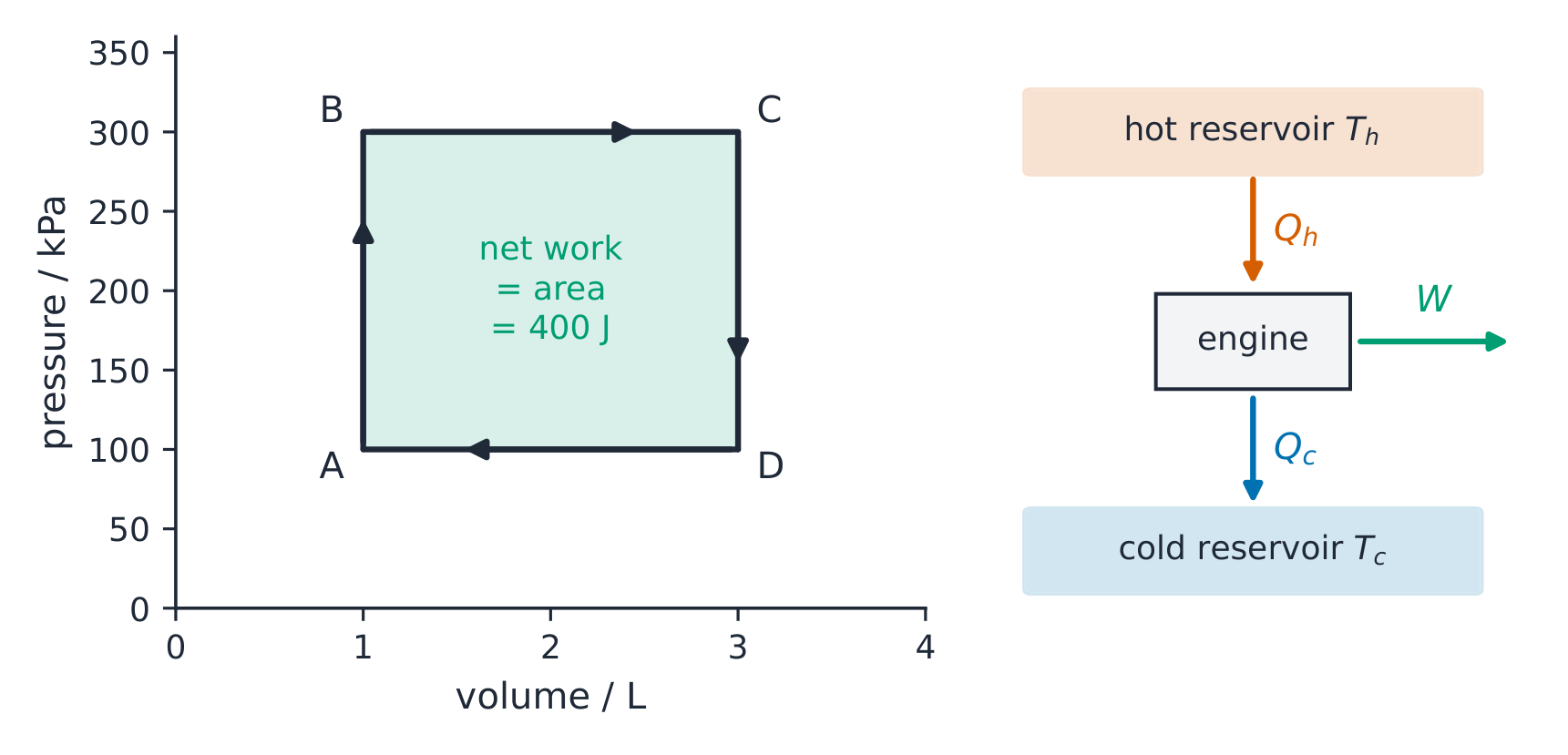
- In the invented rectangular cycle, A = (1 L, 100 kPa), B = (1 L, 300 kPa), C = (3 L, 300 kPa) and D = (3 L, 100 kPa). A→B has W = 0, ΔU = +300 J and Q = +300 J. B→C has W = +600 J, ΔU = +900 J and Q = +1,500 J. Apply the same first law separately to each leg.
- C→D has W = 0, ΔU = −900 J and Q = −900 J; D→A has W = −200 J, ΔU = −300 J and Q = −500 J. The internal-energy changes sum to zero, while net work and net heat both equal +400 J. The clockwise loop has positive work; reversing it gives −400 J. Enclosed area gives net work, not total heat input.
Count heat input before finding engine efficiency
- Write Qh and Qc as positive magnitudes of heat received and rejected in a cycle. Then W = Qh − Qc and efficiency is W/Qh. For the rectangle, heat enters during two legs: Qh = 300 + 1,500 = 1,800 J. Heat rejected is 900 + 500 = 1,400 J. Efficiency is therefore 400/1,800, about 22.2%, rather than 400 divided by the net heat of 400 J.
- A separate invented engine receiving 2,400 J and rejecting 1,800 J per cycle does 600 J of work and has efficiency 25%. At 20 cycles each second, useful power would be 12,000 W. An energy balance can rule out an engine whose outputs exceed its input, but satisfying that balance alone does not establish that it also obeys the second law.
An invented monatomic rectangular cycle has heat transfers +300, +1500, −900 and −500 J on its four legs. Find its efficiency as a percentage.
Difficulté 2/5 · 140 pièces + un petit bonus lors de la première réussite aujourd'hui
Heat input is the sum of positive transfers: Qh = 300 + 1,500 = 1,800 J. Rejected heat magnitude Qc = 900 + 500 = 1,400 J. Over a full cycle ΔU = 0, so Wnet = Qh − Qc = 1,800 − 1,400 = 400 J. Efficiency = Wnet/Qh × 100 = 400/1,800 × 100 ≈ 22.2%. Dividing by net heat instead would incorrectly give 100%.
Use the Carnot limit with absolute temperatures
- For two reservoirs maintained at Th and Tc, no heat engine exceeds $\eta_{\rm max}=1-T_c/T_h$. Equality is the reversible Carnot limit, involving two isothermal and two reversible adiabatic legs. With Th = 600 K and Tc = 300 K, the maximum is 50%. Use kelvin; subtracting 273 from both temperatures changes the ratio and gives a wrong limit.
- Suppose a proposed engine between those reservoirs receives 1,000 J, does 600 J of work and rejects 400 J. It conserves energy, but its 60% efficiency exceeds the 50% limit. Reservoir entropy changes would total −1,000/600 + 400/300 = −0.333 J/K per cycle. That negative total reveals the second-law failure. Real friction and finite-temperature heat transfer increase total entropy and reduce attainable efficiency.
A cyclic engine between reservoirs at 600 K and 300 K receives 1000 J, does 600 J of work and rejects 400 J. Is the claim physically consistent?
Difficulté 1/5 · 100 pièces + un petit bonus lors de la première réussite aujourd'hui
600 + 400 = 1000 J, so the first law is satisfied. The second law limits efficiency to 1 − 300/600 = .50. Reservoir entropy changes sum to −.333 J/K, which cannot be the total change of an isolated combination.
Calculate entropy with a reversible reference path
- Entropy S is a state property with units J/K. For reversible heat transfer at a constant temperature, $\Delta S=Q_{\rm rev}/T$; if temperature varies, add small contributions along a reversible reference path. This lets you calculate the state change even if the actual route was irreversible. Dividing all the heat in any arbitrary process by one convenient temperature is not a general entropy formula.
- Melting 1.0 kg of ice reversibly at 273 K with latent heat 334,000 J/kg gives ΔS ≈ 1,223 J/K. Freezing the same amount under the same equilibrium conditions gives the opposite sign. Boiling 2.0 kg of water at 373 K with latent heat 2.26 million J/kg gives about 12,118 J/K. The supplied heat, phase-change temperature and amount must belong to the same stated process.
An invented reversible melting process absorbs 334000 J at a constant 273 K. Find the entropy change of the melting sample.
Difficulté 2/5 · 140 pièces + un petit bonus lors de la première réussite aujourd'hui
ΔS = Qrev/T = 334000/273 ≈ 1223 J/K, about 1.2 × 10³ J/K. Constant temperature and reversible reference heat justify this ratio.
Count accessible microstates under stated assumptions
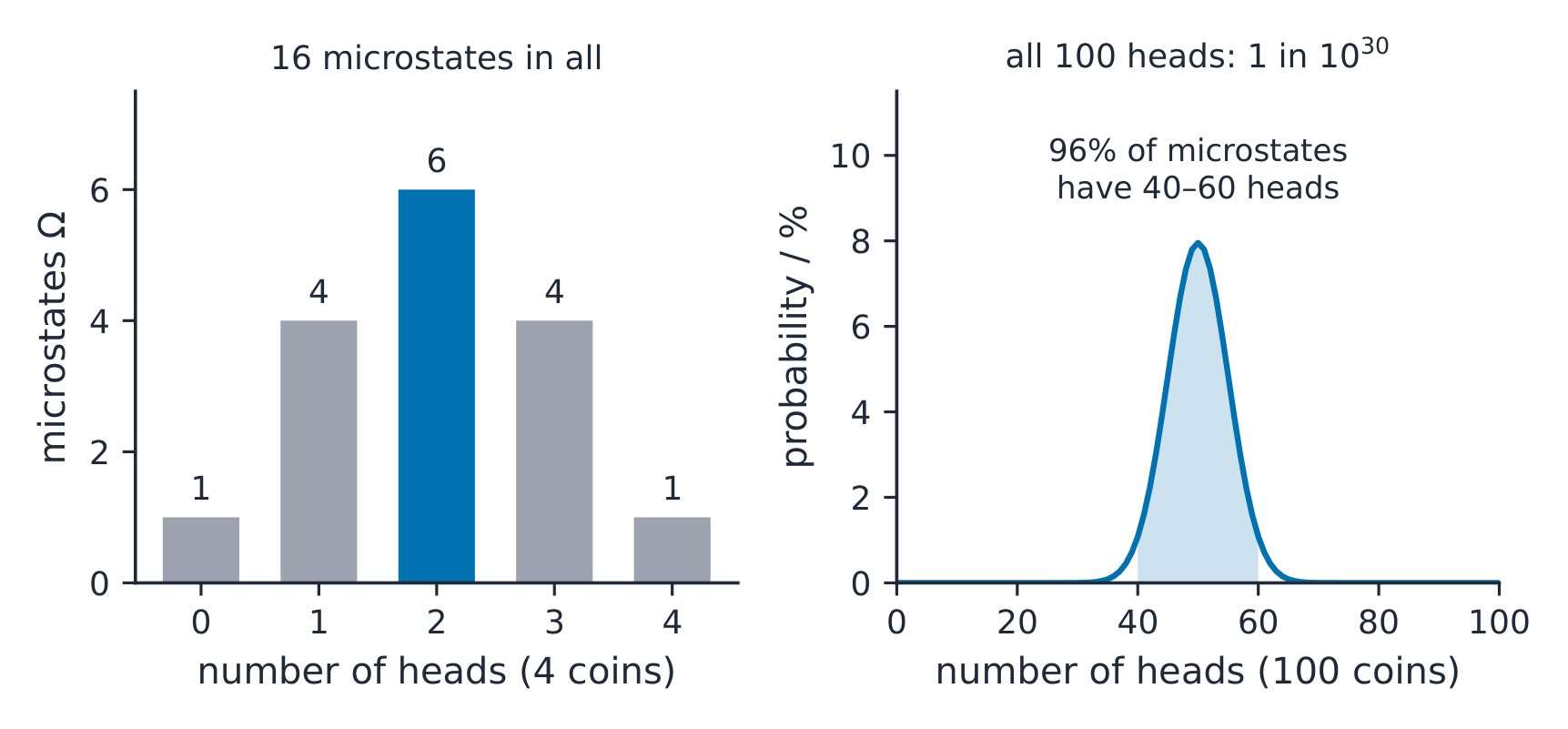
- A microstate specifies a detailed microscopic arrangement; a macrostate specifies bulk constraints and can correspond to many microstates. Under an equal-probability model for accessible states, a macrostate with multiplicity Ω has entropy $S=k_B\ln\Omega$. For four independent fair coins, the counts for 0 to 4 heads are 1, 4, 6, 4 and 1. “Two heads” has probability 6/16, rather than one fifth simply because there are five head-count categories.
- With six fair coins, three heads has 20 arrangements out of 64, and, using kB = $1.38\times10^{-23}$ J/K, the illustrative expression kB ln 20 gives about $4.13\times10^{-23}$ J/K. Coins are a counting analogy, not a measurement of a gas's entropy. Independent fair flips are essential for equally probable coin sequences; biased or correlated flips do not support that assumption. Entropy describes accessible multiplicity more precisely than a judgement that something looks untidy.
Six independent fair coins are tossed. There are 20 sequences with exactly three heads and 64 possible sequences. What is the probability of exactly three heads, as a percentage?
Difficulté 2/5 · 140 pièces + un petit bonus lors de la première réussite aujourd'hui
Probability = 20/64 × 100 = 31.25%. Equal likelihood belongs to the fair independent sequences, not to the seven different head-count categories.
Add entropy changes of the whole isolated combination
- The entropy of an isolated system stays constant for a reversible process and increases for an irreversible one. A subsystem can lose entropy if its surroundings gain enough. For 1,000 J passing between large reservoirs held at 400 and 300 K, the hot reservoir changes by −2.5 J/K and the cold one by +3.333 J/K: total +0.833 J/K. Each reservoir is at a fixed temperature, even though the transfer between them is irreversible.
- For a separate 600 J transfer from 500 to 300 K, total change is −600/500 + 600/300 = +0.8 J/K. Reversing those heat transfers without another change would make the total negative. Thermal insulation does not require entropy to be constant: the insulated free expansion described earlier produces entropy internally, despite Q = 0. The formula Qactual/T alone would miss it.
600 J passes from a reservoir maintained at 500 K to one maintained at 300 K. Find their total entropy change.
Difficulté 2/5 · 140 pièces + un petit bonus lors de la première réussite aujourd'hui
Hot reservoir: −600/500 = −1.2 J/K. Cold reservoir: +600/300 = +2 J/K. Total = +.8 J/K, positive for irreversible heat flow across a finite temperature difference.
Explain refrigerators and local entropy decreases
- A refrigerator transfers heat from a cold compartment to a warmer room by receiving work. If it removes 300 J per cycle and needs 100 J of electrical work, it rejects 400 J to the room. Removing heat from the food can lower its entropy; the appliance and room must be included before testing the second law. In an actual irreversible cycle, their combined entropy increase exceeds the decrease in the cold compartment.
- The Clausius statement rules out spontaneous cold-to-hot heat transfer with no other effect. The Kelvin statement rules out cyclic conversion of heat from a single reservoir entirely into work. A one-off gas expansion can convert heat to work without contradicting the cyclic statement, because the gas has changed state and has not yet been returned to its starting condition. Always include restoration of the working system when evaluating a claimed engine.
Check energy and entropy as separate tests
- Start with the system boundary, fixed amount and sign convention. Obtain W from the stated physical path, find ΔU from equilibrium endpoints and calculate Q = ΔU + W. For cycles check that all ΔU values sum to zero, and identify every positive heat-input stage before calculating efficiency. Use the graph's units: kPa times L gives J, not kJ.
- Then apply the second law using the relevant reservoir temperatures or a reversible entropy path, including surroundings. Check whether a supposedly adiabatic formula actually assumes reversibility, and whether an entropy calculation assumes constant temperature or equally probable states. In measurements, account for piston friction, thermal leakage and sensor equilibration. A matching first-law total does not rescue an impossible entropy decrease for an isolated combination.
Explain how to test a thermodynamic process and a cyclic engine, including signs, path conditions and total entropy.
The first law counts energy and the second law limits possible processes. Both tests need an explicit boundary, correct temperatures and the right process assumptions.